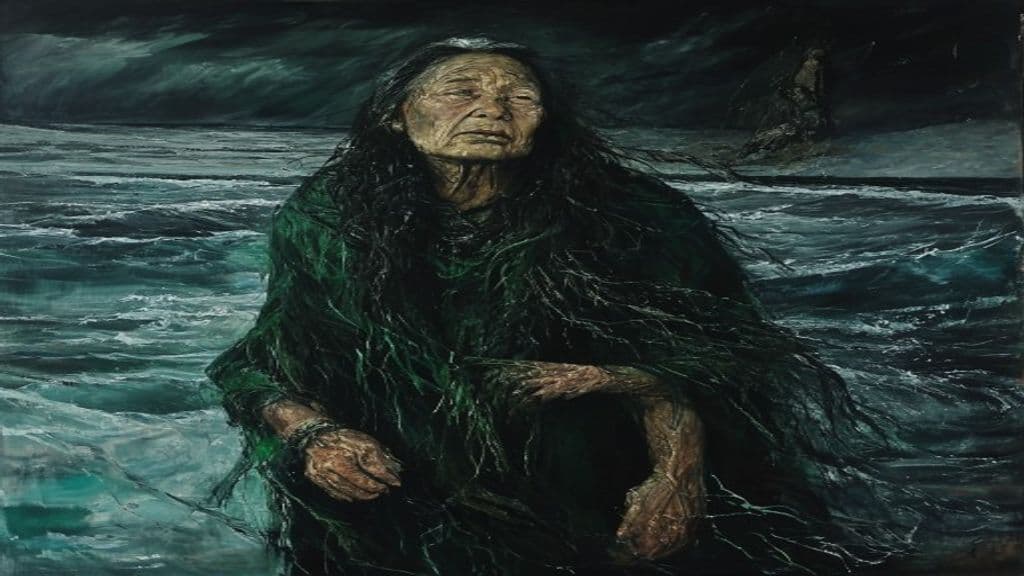
In the Inughuit (Smith Sound) variant summarized in Rasmussen (1921), a woman who becomes the sea-mother was cast overboard during a storm; her grandfather cut off the hand by which she still grasped the boat, and she became one-handed and took up residence at the bottom of the sea. This narrative is given as an origin for her present condition and role as a submerged, powerful female proprietor of sea creatures. Regional variants (named Sedna, Arnapkapfaaluk, Arnakuagsak, etc.) preserve the core theme of a woman transformed into the owner/provider of marine life while differing in local detail.
Sources consistently describe her as an 'old woman of the sea' or 'mother of the sea' and narrate a mutilation motif: in the cited Inughuit tale she is one-handed after relatives cut off her hand. Beyond this aged female characterization and the one-handed detail, the supplied materials do not provide a standardized visual iconography (no consistent descriptions of hair, skin, hybrid anatomy, or size are given in the excerpts provided).
Nerrivik is described primarily as the mother/owner of sea creatures and the provider of food for Inuit communities; she is named as the patron of fishermen and hunters. Her disposition or standing in mythic accounts is tied to whether hunters and fishermen are able to catch enough food. The supplied sources emphasize provision and patronage of subsistence resources rather than cataloguing a wider system of supernatural powers.

A'akuluujjusi
A'akuluujjusi is an Inuit primordial creator mother who fashioned the non-human animals and adjusted their physical traits so they could be hunted by people.
Agloolik
Agloolik (Inuktitut: ᐊᒡᓗᓕᒃ) is an Inuit spirit that dwells beneath Arctic sea ice and functions as a tutelary guardian of seals. Hunters and fishermen petition Agloolik for success; prayers before fishing are said to bring blessings of prey.
Kigatilik
Kigatilik is an entity in Inuit religion commonly described in sources as a "demon" and reported as a fanged being that kills angakkuit (shamans). The available attestations are very brief and do not provide detailed mythology or rituals.
Kikituk
A kikituk is an Inuit shamanic animal effigy or carving that is invested with spirit-force by a shaman and used as a spiritual weapon; the shaman brings the effigy to life, casts it toward a target where it is said to destroy the opponent's heart, and then retrieves it. Sources present the kikituk as a spirit-infused object functioning as the material focal point of a shaman's animalistic power in Inuit practice.
Nanook
Nanook is the Inuit name applied to the polar bear and, in Inuit religious descriptions, the spiritual master associated with bears who regulates human–bear relations, deciding whether hunters deserve success and punishing violations of hunting taboos.
Pinga
Pinga is an Inuit goddess associated with the hunt, the well‑being of animals (especially caribou in Caribou Inuit contexts), and with medicine. She is described in modern summaries as sky‑associated — often rendered 'She Who is On High' — and functions as an overseer of ethical hunting practice whose disposition can influence hunting success.
Nereids
Nereids are the class of female sea-nymphs in Greek myth, traditionally the fifty daughters of Nereus and the Oceanid Doris, associated especially with the Aegean Sea. They appear as beautiful young women who dwell in the sea and form the retinue of major sea-deities, acting as benevolent helpers of sailors and participants in mythic narratives.
Nereus
Nereus is an archaic Greek sea-god, eldest son of Pontus and Gaia, known as an aged, truthful 'Old Man of the Sea' who fathers the Nereids and functions as a source of prophetic counsel; he shares traits with other sea-elders like Proteus and later recedes in prominence beneath Poseidon.
Nergal
Nergal is a major Mesopotamian deity associated with war, disease, inflicted death, and rulership of the underworld. Principal cult center at Kutha (temple E‑Meslam), he appears in hymns and myths (e.g., the Epic of Erra, "Nergal and Ereshkigal") and is sometimes equated with or called Erra or Meslamtaea.
Nerthus
Nerthus is an early Germanic cultic deity attested in Tacitus's Germania as the focus of a wagon‑procession cult kept on an island in a sacred grove. Tacitus reports a ritual in which a cart draped in white is drawn among communities, bringing a suspension of warfare and communal celebration, followed by ritual washing of cult objects in a secluded lake.
Neshmet
Divine vessel or bark in Egyptian tradition associated with the god Nun, used as a conveyance for Osiris during the Osiris festival at Abydos. (Note: 1. Power tier should be Primordial as it is associated with the primordial deity Nun. 2. No mention of physical appearance or abilities beyond being a vessel for Osiris, so these sections are inaccura)
Nessie (Loch Ness Monster)
A legendary lake creature of Scottish folklore said to inhabit Loch Ness in the Scottish Highlands, popularly depicted as a large, long‑necked animal with one or more humps. Its existence is driven by anecdotal sightings, disputed photographs, sonar claims, hoaxes, and sustained popular and scientific interest since 1933.
Community Record
- [1]Eskimo Folk-Tales. Rasmussen, Knud (1921). Eskimo Folk-Tales. (Smith Sound / Inughuit myth summarized describing the hand-cutting origin and her being one-handed at the bottom of the sea.)academic
- [2]Nerrivik — Wikipedia. Wikipedia entry 'Nerrivik' summarizing identification as sea-mother, patron of fishermen and hunters, and noting Canadian equivalents Sedna/Arnapkapfaaluk and Greenlandic Arnakuagsak.wiki
- [3]Arnakuagsak — Wikipedia. Wikipedia entry for Arnakuagsak noting Greenlandic sea-mother figure comparable to Sedna/Nerrivik and described as a primary deity ensuring hunters catch food.wiki
- [4]NERRIVIK - the Inuit Goddess of the Sea (Inuit mythology). Popular compilation summarizing Nerrivik as sea-mother and patron of fishermen/hunters; repeats core motifs found in ethnographic summaries.folk
- [5]Wikidata: Nerrivik (Q1972147). Wikidata entry linking identifiers and name variants for the Inuit sea-mother figure.wiki