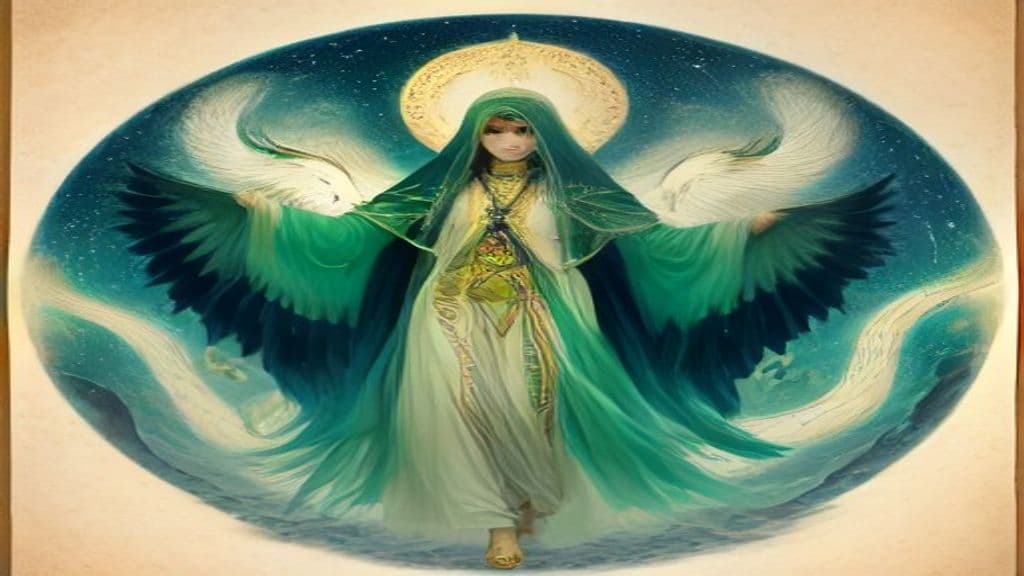
No cosmogonic origin, genealogy, or hierarchical placement is provided in the cited sources. The figure appears within hadith-related narrative material (noted in compilations associated with Jalal al-Din al-Suyuti) as an angelic being who intervenes in human emotional distress, but the texts do not supply an origin story or broader theological status beyond that remedial role.
In the attested hadith-related account Artiya'il is reported to have 'come down in the shape of a bird.' No further species identification, coloration, size, or additional physical details are provided in the cited materials; the bird-form is the sole descriptive element recorded in the available excerpts.
The only attested function in the cited sources is that Artiya'il relieves or 'removes' human grief, anxiety, or memories of distress. In the recorded narrative he directly appears to an anxious person (Abu Muslim al-Khawlani awaiting news from Byzantium), introduces himself as the angel who removes anxiety-related memories, and thereby provides comfort. The sources do not ascribe other powers (such as fate-altering, judicial, or physical-healing abilities) nor do they describe broader behaviors beyond this remedial intervention.
Artemis
Artemis is an ancient Greek goddess of hunting, the wilderness and wild animals, transitions (especially childbirth and puberty), vegetation, and chastity. Twin sister of Apollo and daughter of Zeus and Leto, she functions as a protector of young children and maidens while also capable of inflicting disease or punishment for transgressions against her sacred laws.
Artemis Entreri
Artemis Entreri is a fictional human character in the Forgotten Realms setting of Dungeons & Dragons, portrayed as a professional assassin and a recurring antagonist and foil—most notably—to the dark elf Drizzt Do'Urden across multiple novels and game products.
Artemis of Bana‑Mighdall
A fictional Amazon superheroine from DC Comics, introduced as a rival to Princess Diana of Themyscira who briefly took on the mantle of Wonder Woman, died fulfilling a prophecy, was sent to the Underworld, and later returned to life.
Arteïs
Arteïs (Ancient Greek: Άρτηίς, -ίδος) is attested in classical Greek summaries as a mortal woman named as the mother, by Alector, of Prothoenor—a Boeotian leader in the Trojan War. She appears in genealogical/epic context and is not presented in the supplied sources as a supernatural being.
Arthur Curry (Aquaman)
A fictional comic-book superhero created for DC Comics, Arthur Curry (commonly called Aquaman) debuted in More Fun Comics #73 and has been presented across anthology and solo series; he is depicted within DC continuity as a leading Atlantean figure and, in later reinterpretations, as king of Atlantis.
Artio
Artio is a Gaulish/Celtic goddess whose name literally means 'bear' (Gaulish Arti(o)-). She is attested in Roman-period contexts among the Helvetii and the Treveri by two short inscriptions and a Roman-period bronze statuette group (the Muri group). Scholars read her as an animal-associated tutelary deity linked to bears and to mediation between humans and wild animals.
Aruna
Aruna is the Hittite term for the sea that functions both as a non-personified sacred presence (numen) and, in some texts, as a personified sea-deity. Attestations are regionally concentrated in southeastern Anatolia and Aruna appears in ritual, legal, and mythological contexts (notably the Telipinu composition CTH 322).
Arunachal macaque (Macaca munzala)
A biological species of high‑altitude macaque native to the Eastern Himalaya, treated in the sources as a natural history and conservation subject rather than a supernatural being. It is a compact, brown, short‑tailed macaque found in deep montane forests of Arunachal Pradesh, Bhutan and adjacent China, and is considered endangered.
Arundelconodon hottoni
Arundelconodon hottoni is an extinct genus and species of small Mesozoic mammal (family Triconodontidae) known from jaw and dental remains recovered from the Arundel Clay (Potomac Group) of Maryland, USA. Described from a right mandibular ramus with five teeth, it is interpreted as an Early Cretaceous triconodont whose anatomy informs triconodontid evolution and the composition of eastern North American faunas.
Arundhatī (Arundhati)
Arundhatī is a mytho-religious figure in Hindu literature, famed as the chaste wife of the sage Vasiṣṭha and an exemplar of conjugal fidelity. She is also identified with the faint star Alcor (the companion of Mizar) in Ursa Major and is invoked in marriage rites and seasonal observances as a visible emblem of ideal marital unity.
Aruru
Aruru is a Mesopotamian goddess attested from Ur III onward whose identity shifts from an early vegetation-associated, forceful local deity to a later epithet or aspect of high mother/earth/vegetation goddesses (e.g., Ninhursag). She is frequently described as the 'older sister of Enlil' and appears in god lists, hymns, and later literary tradition.
Arvernus
Arvernus is a Gallo-Roman theonym attested as a tribal epithet of the Arverni and identified with the Gaulish form of the Roman god Mercury in inscriptional and onomastic sources. The name functions as a localized manifestation of Mercury tying the Roman deity to the Arverni people and their territory (notably the Puy-de-Dôme / Auvergne lexical field).
Community Record
- [1]Artiya'il. Wikipedia, entry 'Artiya'il'.wiki
- [2]Artiya'il (alternate URL). Wikipedia, entry 'Artiya'il' (alternate link).wiki
- [3]Artiya'il Angel (glossary entry). Imaginova glossary entry for 'Artiya'il'.other
- [4]RhymeZone: artiya'il definitions. RhymeZone entry for 'artiya'il'.other