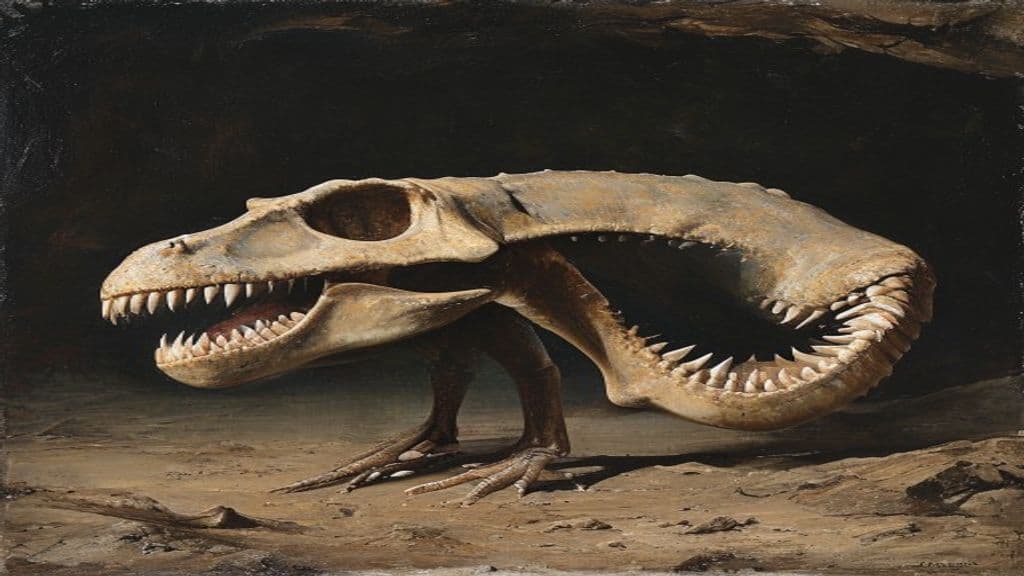
Arundelconodon hottoni was named for its provenance in the Arundel Clay (the genus name combining 'Arundel' and Greek conodon, 'cone-tooth') and in honor of Nicholas Hotton (species name). It was described from a holotype right mandibular ramus with two premolars and three molars; additional referred juvenile material reported in 2001 preserves pieces of jaw with up to seven alveoli. The taxon was established within Triconodontidae by the describing authors and subsequent workers have discussed its position as a basal member of Alticonodontinae.
Known material consists primarily of a small right mandibular ramus (holotype <25 mm long) bearing five teeth (two premolars and three molars) and additional referred juvenile jaw pieces preserving up to seven alveoli. Premolars are large relative to the molars and possess four cusps; preserved tooth lengths range ~2.89–3.43 mm and widths ~1.03–1.30 mm, with all preserved teeth showing two well-divided roots. Diagnostic features cited by describers include a weak, discontinuous lingual cingulid on the lower molars, an interlocking system between adjacent molars (groove on one face and ridge on the other extending from crown to root), and a Meckelian groove on the jaw.
As a fossil mammal, direct behaviors are not preserved; paleobiological inferences derive from dental and jaw morphology and phylogenetic placement. The enlarged premolars and interlocking molars suggest adaptations for processing food consistent with triconodont feeding mechanics, but precise diet, locomotion, and ecology remain undocumented in the sources. Within the scientific framework Arundelconodon contributes to interpretations of Early Cretaceous mammal diversity on the eastern North American seaboard.
Comodon
Comodon is the scientific genus name applied to an extinct mammal known from a mandible (USNM 2703) from Quarry 9 at Como Bluff, Wyoming, in the Late Jurassic Morrison Formation. The name was erected as a replacement for the preoccupied Phascolodon and is used within paleontological nomenclature rather than as a mythic or folkloric being.
Cronopio dentiacutus
Cronopio dentiacutus is an extinct small insectivorous mammal species from the early Late Cretaceous of Patagonia (La Buitrera, Argentina). Described from partial skull and jaw material, it is named after Julio Cortázar’s fictional 'cronopios' and the Latin dentiacutus ('sharp-toothed'), and is placed among South American meridiolestidan/dryolestoid mammals.
Arthur Curry (Aquaman)
A fictional comic-book superhero created for DC Comics, Arthur Curry (commonly called Aquaman) debuted in More Fun Comics #73 and has been presented across anthology and solo series; he is depicted within DC continuity as a leading Atlantean figure and, in later reinterpretations, as king of Atlantis.
Artio
Artio is a Gaulish/Celtic goddess whose name literally means 'bear' (Gaulish Arti(o)-). She is attested in Roman-period contexts among the Helvetii and the Treveri by two short inscriptions and a Roman-period bronze statuette group (the Muri group). Scholars read her as an animal-associated tutelary deity linked to bears and to mediation between humans and wild animals.
Artiya'il
Artiya'il (Arabic: رتائيل) is an angelic figure in Islamic lore attested in hadith-related accounts; in the cited narratives he appears to relieve human grief or anxiety, once appearing 'in the shape of a bird' to identify himself as the remover of anxiety.
Aruna
Aruna is the Hittite term for the sea that functions both as a non-personified sacred presence (numen) and, in some texts, as a personified sea-deity. Attestations are regionally concentrated in southeastern Anatolia and Aruna appears in ritual, legal, and mythological contexts (notably the Telipinu composition CTH 322).
Arunachal macaque (Macaca munzala)
A biological species of high‑altitude macaque native to the Eastern Himalaya, treated in the sources as a natural history and conservation subject rather than a supernatural being. It is a compact, brown, short‑tailed macaque found in deep montane forests of Arunachal Pradesh, Bhutan and adjacent China, and is considered endangered.
Arundhatī (Arundhati)
Arundhatī is a mytho-religious figure in Hindu literature, famed as the chaste wife of the sage Vasiṣṭha and an exemplar of conjugal fidelity. She is also identified with the faint star Alcor (the companion of Mizar) in Ursa Major and is invoked in marriage rites and seasonal observances as a visible emblem of ideal marital unity.
Aruru
Aruru is a Mesopotamian goddess attested from Ur III onward whose identity shifts from an early vegetation-associated, forceful local deity to a later epithet or aspect of high mother/earth/vegetation goddesses (e.g., Ninhursag). She is frequently described as the 'older sister of Enlil' and appears in god lists, hymns, and later literary tradition.
Arvernus
Arvernus is a Gallo-Roman theonym attested as a tribal epithet of the Arverni and identified with the Gaulish form of the Roman god Mercury in inscriptional and onomastic sources. The name functions as a localized manifestation of Mercury tying the Roman deity to the Arverni people and their territory (notably the Puy-de-Dôme / Auvergne lexical field).
Arvirargus
Arvirargus is a legendary British king presented in medieval chronicle tradition (notably Geoffrey of Monmouth) as a first‑century AD ruler who fought the Romans, married a Roman emperor's daughter in narrative, rebuilt cities, and was buried at Gloucester; modern scholarship treats Geoffrey's account as highly romanticised and of uncertain historicity, possibly echoing the historical Caratacus/Togodumnus.
Arvoitus (Finnish Riddle Entity)
A supernatural entity embodying the concept of a riddle or puzzle, often used in Finnish folklore to test one's wisdom and knowledge. (Note: 1. Power tier: Minor Spirit (Arvoitus does not interact directly with humans but presents itself as a puzzle, suggesting it's more of a subtle, local entity rather than a powerful regional one.) 2. Ap)
Community Record
- [1]Arundelconodon. Wikipedia contributors. 'Arundelconodon.' Wikipedia, The Free Encyclopedia.wiki
- [2]Arundelconodon hottoni (fossil triconodont). Digimorph: Arundelconodon hottoni specimen page.other
- [3]Arundelconodon hottoni (Digimorph mirror). Digimorph: Arundelconodon hottoni specimen page (mirror URL).other
- [4]List of the Mesozoic life of Maryland. Wikipedia contributors. 'List of the Mesozoic life of Maryland.'wiki
- [5]Palaeos Vertebrates Mammalia: Triconodonta: Triconodontidae. Palaeos: Triconodontidae overview.other
- [6]The Dinosaur Fund - news (1999). The Dinosaur Fund: news item referencing Arundel Clay work.other