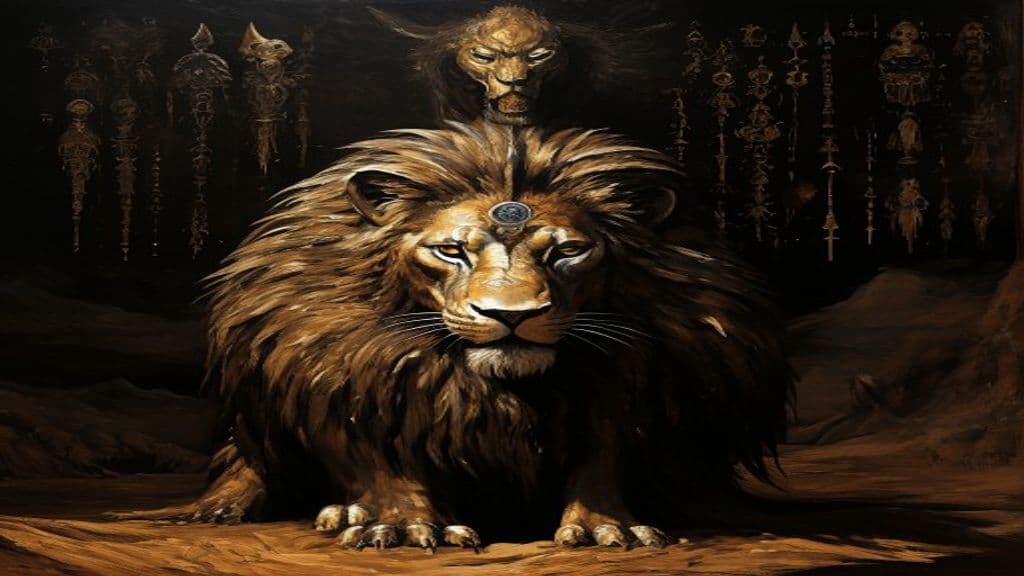
Surviving references do not preserve a narrative cosmogonic origin for Ash. The attested record presents Ash as an Amazigh sky god whose name and cult were known to ancient Egyptians from the Protodynastic period onward; Egyptian sources record his titles and local associations (for example, as ‘Lord of the Tehenu’ and with the city-title Nebuty/He of Nebut) but do not supply a preserved birth myth or detailed origin story in the available material.
Iconographic and textual evidence portrays Ash usually as a human figure with the head of a desert-associated animal: variants include lion, vulture, hawk, snake, or the unidentified Set-animal. Some depictions show Ash with multiple heads, and occasional compound representations link Ash with other deities (for example, occasional connections to Min in certain iconographic contexts). These descriptions derive from seal and relief evidence noted in the sources.
The sources attribute to Ash sky-god status in the Amazigh frame and localized responsibilities in Egyptian records: he is identified with vineyards of the western Nile Delta, with oasis domains, and given territorial titles such as ‘Lord of the Tehenu’ and Nebuty (He of Nebut). Egyptian texts associate him with Set—sometimes as an ally, sometimes identified as the same figure—reflecting overlapping desert and western-land functions. The attestations emphasize cultic and territorial roles rather than narrative deeds; no mythic feats or cosmological acts are recorded in the provided material.

Ahmose‑Nefertari
Ahmose‑Nefertari was an 18th‑Dynasty Egyptian queen who, after her death, received institutionalized cult worship and was venerated in the Theban necropolis and Deir el‑Medina. Sources present her both as a historically attested royal (great royal wife and king's mother) and as a deified figure given epithets such as 'Goddess of Resurrection', 'Mistress of the Sky', and 'Lady of the West'.
Akhekh
The Akhekh (also Akhekhu/Akekhu) is a composite legendary creature from ancient Egyptian myth and art, associated with the god Set and with liminal domains of darkness, the western desert, chaos, and water. It appears in texts and iconography in variable forms — from serpentine/dragon-like to winged antelope or griffin-like hybrids — and functions as a chthonic, martial, and portentous figure rather than a fully specified ritual agent in the surviving excerpts.
Ankh
A symbol representing life in ancient Egyptian cosmology, often associated with eternal life and resurrection. (Note: - Power tier should be Ancient (not Primordial), as it's a symbol representing concepts in ancient Egyptian cosmology. - Abilities description is too vague; consider specifying how the Ankh affects or)
Bes
Bes is an ancient Egyptian household protective deity, commonly kept close to domestic life to guard mothers, children, and childbirth; he also defends households against snakes and malevolent spirits and is associated with music, dance, and sexual vitality.
Book of Caverns (Egyptian tradition)
The Book of Caverns is an ancient Egyptian text that describes Ra's journey through the underworld, Duat. It does not describe a specific supernatural entity but mentions interactions between Ra and the residents of the underworld. (Note: 1. Power tier should be Ancient (deity-level) since it describes a journey of the sun god Ra and interactions between him and other deities. 2. Origin story needs clarification that the Book of Cavern)
Book of the Dead
A collection of magical spells and texts that assist a deceased person's journey through the Duat (underworld) into the afterlife. (Note: 1. Power tier: Reduce to Ancient (deity-level), as it's a collection of spells and texts that aid in the deceased person's journey, but not a cosmic entity itself. 2. Appearance: Remove or rephrase, a)
Dragon (Long)
Long (龍, "dragon") is a pervasive cultural and artistic motif that appears in Taoist sacred-geographical contexts, Chinese literature, and modern exhibitions; the provided sources treat it as part of the broader mythic imagery present around Taoist sites and ritual scenes rather than as a single, consistently described doctrinal entity.
Mummy (undead) (Egyptian tradition)
In Egyptian folklore, a mummy is an undead creature believed to be the reanimated corpse of a deceased person. (Note: * Power tier: Should be Primordial, given the association with cosmic entities and magical powers tied to ancient Egyptian rituals. * Abilities: Clarify that supernatural abilities refer to those on a)
Nebty Name
One of the 'great five names' used by Egyptian pharaohs, representing a specific aspect of their divine authority. (Note: - Power tier should be Ancient (deity-level) since it's one of the 'great five names' used by pharaohs, representing divine authority. - Abilities need to be clarified or removed, as the text currentl)
Neshmet
Divine vessel or bark in Egyptian tradition associated with the god Nun, used as a conveyance for Osiris during the Osiris festival at Abydos. (Note: 1. Power tier should be Primordial as it is associated with the primordial deity Nun. 2. No mention of physical appearance or abilities beyond being a vessel for Osiris, so these sections are inaccura)
Opening of the Year Festival
Ancient Egyptian festival marking the beginning of the year, tied to astronomical and calendrical events, and associated with gods such as Re (Ra) and Sothis (Sopdet). The event likely represents cyclical renewal and rebirth of life. (Note: 1. Power tier should be Ancient (deity-level) given the festival's association with gods such as Re and Sothis, and its significance in establishing cosmic order. 2. Add sensory cues related to agricu)
Rekhyt
Rekhyt (Ancient Egyptian rḫyt) is a term attested from the Early Dynastic Period referring to a northern people of the Nile Delta and, from the Middle Kingdom onwards, is also attested as a bird-sign and as a deity or personified figure in Egyptian royal and religious iconography.
Community Record
- [1]Ash (deity) — Wikipedia. Wikipedia, 'Ash (deity)', (accessed via provided snapshots cited in research notes).wiki
- [2]Ash (deity) — Wikipedia (duplicate snapshot). Wikipedia, 'Ash (deity)', (alternate snapshot cited in research notes).wiki