
The Akhekh is attested in ancient Egyptian mythic imagination and art as a creature etymologically tied to darkness (from Egyptian kkw) and associated with Set. Sources describe it as occupying the liminal, chthonic zones that belong to Set — the western desert, night/darkness, chaotic waters — and in some accounts it is treated either as an ally of Set or as an incarnation of that god. Its presence in Egyptian iconography and in magico-medical contexts (for example, its depiction on the Metternich Stele) places the Akhekh within the broader Egyptian system of dangerous but culturally significant monstrous beings rather than as a domestic spirit or household deity (Wikipedia; A Book of Creatures; Metternich Stele; Biblical Cyclopedia).
Accounts vary, but all supplied sources concur that the Akhekh is a composite quadruped with wings. Modern summaries and encyclopedic treatments describe a serpentine or dragon-like form with a long body and occasionally a crocodile-like snout; alternative historical descriptions record an antelope-like or oryx-like body with bird's wings (Budge), an antelope body with three uraei on the head, and Pierret's account of an eagle's head on a winged lion's body (griffin-like). Thus the creature's morphology is reported in variant traditions as a winged quadruped with combinations of avian wings, mammalian bodies (antelope/oryx or lion), serpentine tails or multiple snake heads, and in some summaries a crocodilian snout (Wikipedia; A Book of Creatures; Pierret via A Book of Creatures; Budge via A Book of Creatures).
The sources do not enumerate a catalogue of specific magical powers but present the Akhekh through its symbolic associations and occasional iconographic actions. It is linked to Set and therefore to darkness, chaos, the western desert, and water; treated as a portent of terror and martial might (for example, royal similes likening Ramesses II to the Akhekh in war). One iconographic depiction on the Metternich Stele shows an Akhekh pulling an archer's chariot over two crocodiles, implying great brute strength or dominance over other dangerous animals. Later interpretive sources (Biblical Cyclopedia) label it among serpentine names of evil, reflecting post-antique reinterpretation rather than a detailed ancient power list (Wikipedia; Metternich Stele; Biblical Cyclopedia; A Book of Creatures).
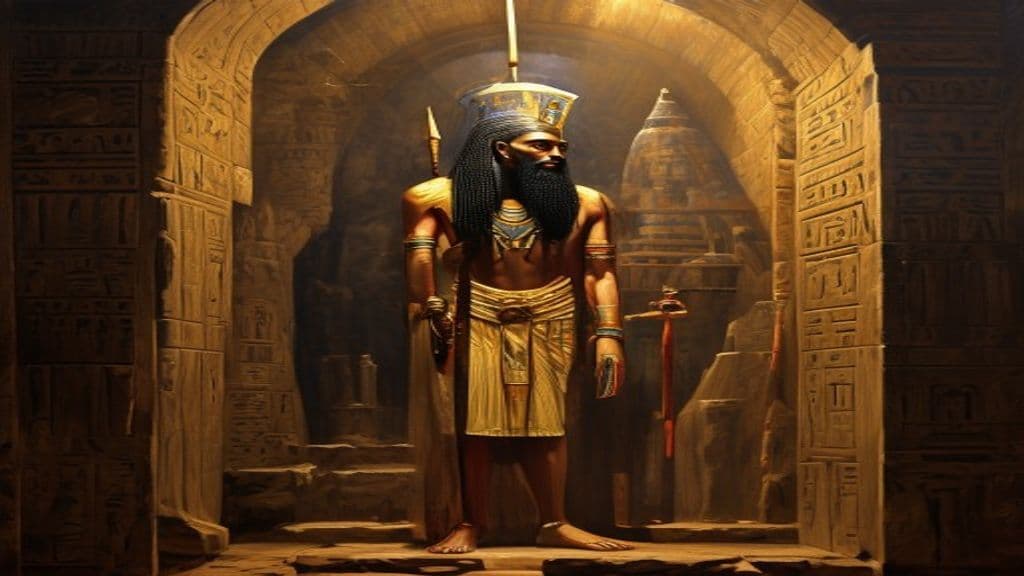
Seth
Two distinct traditional personae share the name 'Seth' in the supplied corpus: (1) the Abrahamic Seth, the third son of Adam and Eve and an antediluvian patriarch associated in later traditions with righteous lineage and transmission of knowledge; and (2) the Egyptian god Set/Seth, a powerful deity ritually opposed in the cult of Osiris, for whom a temple rite titled 'The book of the victory over Seth' prescribes the making of a red-wax figure to effect his downfall.

Griffin
The griffin (also griffon, gryphon) is a composite legendary creature combining the body, tail, and hind legs of a lion with the head, wings, and often taloned forelegs of an eagle. In classical and medieval Eurasian traditions it functions chiefly as a majestic guardian figure associated with rulership and the protection of treasure, and appears widely across artistic vocabularies rather than as a single codified religious being.
Ahmose‑Nefertari
Ahmose‑Nefertari was an 18th‑Dynasty Egyptian queen who, after her death, received institutionalized cult worship and was venerated in the Theban necropolis and Deir el‑Medina. Sources present her both as a historically attested royal (great royal wife and king's mother) and as a deified figure given epithets such as 'Goddess of Resurrection', 'Mistress of the Sky', and 'Lady of the West'.
Ankh
A symbol representing life in ancient Egyptian cosmology, often associated with eternal life and resurrection. (Note: - Power tier should be Ancient (not Primordial), as it's a symbol representing concepts in ancient Egyptian cosmology. - Abilities description is too vague; consider specifying how the Ankh affects or)
Ash (Yuc)
Ash (Tamazight Yuc) is an Amazigh sky god recorded in Egyptian sources and worshipped by Libyan and Tehenu tribes of the Western Desert. In Egyptian texts he is presented as a named deity connected with the vineyards of the western Nile Delta, oases, and as ‘Lord of the Tehenu,’ and is sometimes associated or equated with the god Set.
Bes
Bes is an ancient Egyptian household protective deity, commonly kept close to domestic life to guard mothers, children, and childbirth; he also defends households against snakes and malevolent spirits and is associated with music, dance, and sexual vitality.
Book of Caverns (Egyptian tradition)
The Book of Caverns is an ancient Egyptian text that describes Ra's journey through the underworld, Duat. It does not describe a specific supernatural entity but mentions interactions between Ra and the residents of the underworld. (Note: 1. Power tier should be Ancient (deity-level) since it describes a journey of the sun god Ra and interactions between him and other deities. 2. Origin story needs clarification that the Book of Cavern)
Book of the Dead
A collection of magical spells and texts that assist a deceased person's journey through the Duat (underworld) into the afterlife. (Note: 1. Power tier: Reduce to Ancient (deity-level), as it's a collection of spells and texts that aid in the deceased person's journey, but not a cosmic entity itself. 2. Appearance: Remove or rephrase, a)
Dragon (Long)
Long (龍, "dragon") is a pervasive cultural and artistic motif that appears in Taoist sacred-geographical contexts, Chinese literature, and modern exhibitions; the provided sources treat it as part of the broader mythic imagery present around Taoist sites and ritual scenes rather than as a single, consistently described doctrinal entity.
Mummy (undead) (Egyptian tradition)
In Egyptian folklore, a mummy is an undead creature believed to be the reanimated corpse of a deceased person. (Note: * Power tier: Should be Primordial, given the association with cosmic entities and magical powers tied to ancient Egyptian rituals. * Abilities: Clarify that supernatural abilities refer to those on a)
Nebty Name
One of the 'great five names' used by Egyptian pharaohs, representing a specific aspect of their divine authority. (Note: - Power tier should be Ancient (deity-level) since it's one of the 'great five names' used by pharaohs, representing divine authority. - Abilities need to be clarified or removed, as the text currentl)
Neshmet
Divine vessel or bark in Egyptian tradition associated with the god Nun, used as a conveyance for Osiris during the Osiris festival at Abydos. (Note: 1. Power tier should be Primordial as it is associated with the primordial deity Nun. 2. No mention of physical appearance or abilities beyond being a vessel for Osiris, so these sections are inaccura)
Opening of the Year Festival
Ancient Egyptian festival marking the beginning of the year, tied to astronomical and calendrical events, and associated with gods such as Re (Ra) and Sothis (Sopdet). The event likely represents cyclical renewal and rebirth of life. (Note: 1. Power tier should be Ancient (deity-level) given the festival's association with gods such as Re and Sothis, and its significance in establishing cosmic order. 2. Add sensory cues related to agricu)
Rekhyt
Rekhyt (Ancient Egyptian rḫyt) is a term attested from the Early Dynastic Period referring to a northern people of the Nile Delta and, from the Middle Kingdom onwards, is also attested as a bird-sign and as a deity or personified figure in Egyptian royal and religious iconography.
Community Record
- [1]Akhekh (Wikipedia). Wikipedia, 'Akhekh' article — etymology, appearance variants, Set association, desert habitat, Metternich Stele referencewiki
- [2]Metternich Stela (Wikipedia). Wikipedia, 'Metternich Stela' — magico-medical Horus on the Crocodiles stele and depiction noted in Akhekh sourceswiki
- [3]Akhekh | A Book of Creatures. A Book of Creatures — summarizes Pierret and Budge variants and commentary on morphologyfolk
- [4]Akhekh - Biblical Cyclopedia. Biblical Cyclopedia entry identifying Akhekh among names of a mystical serpent of evil (later interpretive layer)other