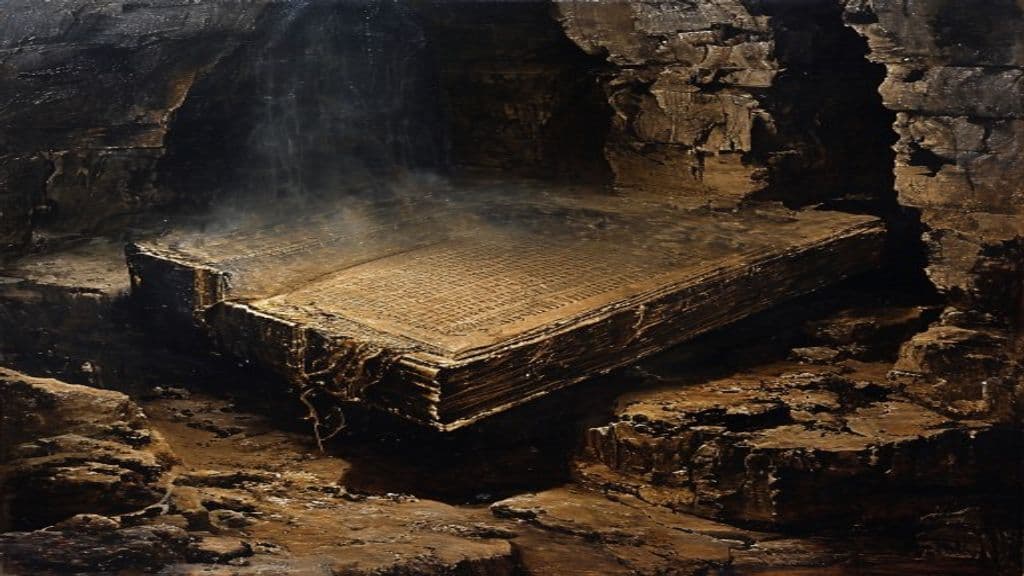
The Book of Caverns is an ancient Egyptian text that describes Ra's journey through the underworld, Duat. It reflects the importance of rebirth and regeneration in Ancient Egyptian myths and funerary texts.
The source material implies punishment and reward interactions between Ra and the residents of the underworld, but it does not describe specific abilities or behaviors for a supernatural entity.
Ahmose‑Nefertari
Ahmose‑Nefertari was an 18th‑Dynasty Egyptian queen who, after her death, received institutionalized cult worship and was venerated in the Theban necropolis and Deir el‑Medina. Sources present her both as a historically attested royal (great royal wife and king's mother) and as a deified figure given epithets such as 'Goddess of Resurrection', 'Mistress of the Sky', and 'Lady of the West'.
Akhekh
The Akhekh (also Akhekhu/Akekhu) is a composite legendary creature from ancient Egyptian myth and art, associated with the god Set and with liminal domains of darkness, the western desert, chaos, and water. It appears in texts and iconography in variable forms — from serpentine/dragon-like to winged antelope or griffin-like hybrids — and functions as a chthonic, martial, and portentous figure rather than a fully specified ritual agent in the surviving excerpts.
Am-heh
Am-heh is an Egyptian underworld deity described in modern summaries as a terrifying devourer who dwells in a lake of fire and threatens beings in the netherworld. He is portrayed in sources as a minor underworld god sometimes correlated with the devourer-figure Ammit and is said in one account to be repelled only by the god Atum.
Anchiroe
Anchiroe (also rendered Achiroë, Anchirrhoë, or Anchinoë) is a figure in Greek myth described as a daughter of the river-god Nilus and the wife of the Egyptian king Belus; she is presented as the mother of Aegyptus and Danaus and, in some accounts, of Cepheus and Phineus. The sources treat her as a genealogical/maternal ancestor rather than an active supernatural agent.
Ankh
A symbol representing life in ancient Egyptian cosmology, often associated with eternal life and resurrection. (Note: - Power tier should be Ancient (not Primordial), as it's a symbol representing concepts in ancient Egyptian cosmology. - Abilities description is too vague; consider specifying how the Ankh affects or)
Ash (Yuc)
Ash (Tamazight Yuc) is an Amazigh sky god recorded in Egyptian sources and worshipped by Libyan and Tehenu tribes of the Western Desert. In Egyptian texts he is presented as a named deity connected with the vineyards of the western Nile Delta, oases, and as ‘Lord of the Tehenu,’ and is sometimes associated or equated with the god Set.
Atef Crown
Egyptian feathered white crown associated with Osiris, symbolizing his status and power. (Note: * Power tier should be Ancient, not Greater, since it's associated with a deity. * Abilities statement is accurate based on source material, but can be rephrased for clarity: "As an inanimate object, )
Bes
Bes is an ancient Egyptian household protective deity, commonly kept close to domestic life to guard mothers, children, and childbirth; he also defends households against snakes and malevolent spirits and is associated with music, dance, and sexual vitality.
Book of Thoth
A collection of ancient Egyptian texts attributed to and believed to be created by the god Thoth, holding significant knowledge and magical power. (Note: 1. Power tier: Primordial (given its association with a deity-level entity like Thoth) 2. Appearance: While some illustrations depict it as an ornate book, the source does not explicitly describe appe)
Book of the Dead
A collection of magical spells and texts that assist a deceased person's journey through the Duat (underworld) into the afterlife. (Note: 1. Power tier: Reduce to Ancient (deity-level), as it's a collection of spells and texts that aid in the deceased person's journey, but not a cosmic entity itself. 2. Appearance: Remove or rephrase, a)
Book of the Earth
Ancient Egyptian funerary text associated with Aker, a deity possibly connected to time, the sun, and creation. (Note: 1. Power tier should be Ancient (deity-level) instead of Primordial (cosmic). 2. Abilities section is missing; source material does not mention any powers or behaviors. 3. No sensory cues, wards, or w)
Buchis
The deification of the kꜣ (ka) of the war god Montu, incarnated as a sacred bull in Egyptian mythology. (Note: - Remove "Greater" power tier; no information in source material supports this level of power. - Add sensory cues (e.g., distinctive markings, specific sounds) related to sacred bulls' selection and w)
Community Record
- [1]