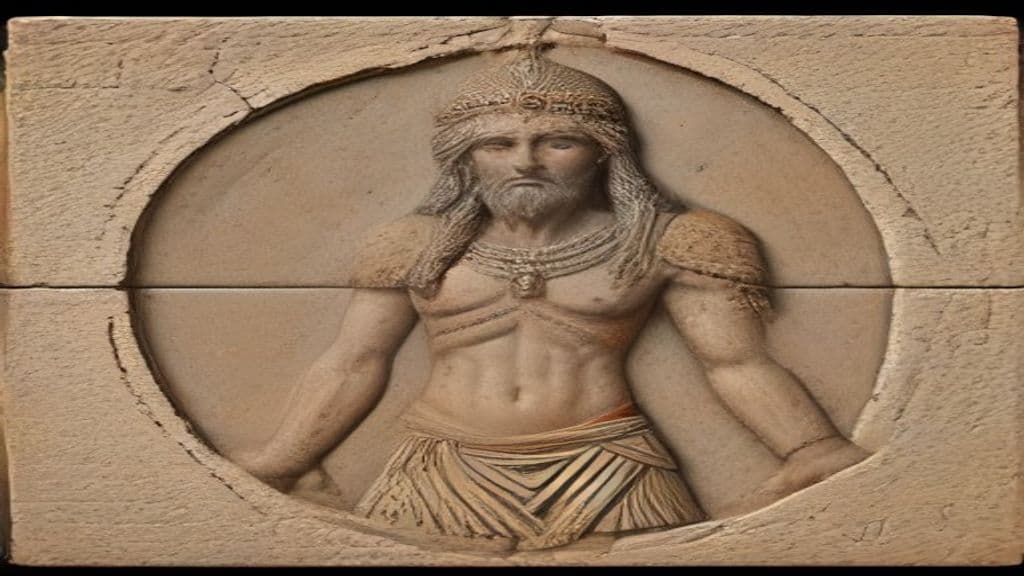
In the textual and scholarly traditions represented in the supplied sources, Ashteroth Karnaim is a toponym deriving from a cultic epithet: a compound meaning 'Astarte (Ashtaroth) of the Two Horns.' The place-name fuses civic identity and a deity's epithet, indicating the site was associated with the cult or image of the Canaanite goddess Astarte (Ashtoreth). Biblical memory casts the city as ancient and linked with the Rephaim; imperial inscriptions and later Hellenistic authors preserve the name across centuries while scholars debate its precise archaeological correlate.
Sources describe Ashteroth Karnaim in archaeological and topographical terms rather than anthropomorphically: as an ancient city or tell (archaeological mound). Candidate identifications include Tell Ashtara (a Bronze Age city), al‑Shaykh Saad (widely proposed for Karnaim in some scholarship), and other historically suggested sites such as Muzayrib and Al Churak. Artistic evidence connected to the name takes the form of relief inscriptions (e.g., Assyrian reliefs naming Ashteroth) and the iconographic implication of a horned or crescent motif tied to Astarte, but no physical description of a supernatural appearance is present in the sources.
The supplied materials do not attribute powers or agency to Ashteroth Karnaim. Instead the place functions as the scene of historical and legendary actions: in Genesis 14 it is the location where Chedorlaomer and his allies defeated the Rephaim; Assyrian reliefs and records describe deportations and imperial campaigns involving the site in the 8th century BCE. Thus 'behaviors' connected to the name are those of human polities (cultic affiliation, settlement, conquest, and exile) rather than supernatural capacities.
Ashiya Dōman Ōuchi Kagami
A compound cultural tradition surrounding the Heian-period onmyōji Ashiya Dōman and a hugely popular kabuki drama (Ōuchi Kagami) that stages supernatural episodes—notably a kitsune (Kuzunoha) who is rescued and later marries a human, Abe no Yasuna. The term is primarily attested as the title of a kabuki play and as the theatrical depiction of a historical/mythic onmyōji figure.
Ashkbous
Legendary warrior and champion in Persian mythology, from the Shahnameh epic poem. (Note: 1. Remove the statement "No physical description of Ashkbous provided in the source material." since the article explicitly mentions an appearance is not provided, implying one does not exist. 2. Powe)
Ashley Kafka
Ashley Kafka is a Marvel Comics character originally introduced as a human psychiatrist who founded and directed the Ravencroft Institute for the Criminally Insane and served as an occasional ally to Spider-Man. After being killed and later reanimated via cloning technology she is transformed into the supervillain Queen Goblin following infusion with Norman Osborn's extracted 'sins', gaining enhanced physical attributes and Goblin-themed powers.
Ashnan (Ezina)
Ashnan (Sumerian Ezina) is the Mesopotamian divine personification of grain: a goddess whose being is identified with the cereal harvest and the category 'grain' itself. Attested from the Uruk and Early Dynastic periods, she appears in hymns, cult lists and disputation literature and is invoked in civic and medical contexts.
Ashta Lakshmi
Ashta Lakshmi (Aṣṭalakṣmī) is a grouped set of eight manifestations of the Hindu goddess Lakshmi, each presiding over a distinct source or form of wealth and together worshipped as an octet, especially in South Indian and Sri Vaishnava devotional contexts. The specific formulation of these eight forms as a fixed octet has become especially prominent in modern devotional media and temple installations since the mid-20th century.
Ashtart
Ashtart (also Astarte, Athtart, ʿAṯtart) is a major Northwest Semitic goddess of the Ancient Near East attested from the Bronze Age through classical antiquity. She functions in regional pantheons alongside deities such as Baal, Anat, and the East Semitic parallel Ishtar, and is evidenced in Ugaritic mythic texts and Levantine temple archaeology (notably a 4th-century BCE chapel at Sidon).
Ashur (Aššur)
Ashur is the civic-national deity of the ancient city and polity Aššur/Assyria. He functions as the divine sovereign and patron of the city-state: kings present themselves as his governors (iššiak), his temple and cult objects (notably weapons) played central roles in oaths, ordeals, and imperial administration.
Ashvins
The Aśvin (Ashvins) are Vedic twin divine horsemen invoked in the Rigveda as youthful rescuers and restorers who travel in a swift chariot; they are closely associated with dawn/twilight, healing, and medicine and are repeatedly called upon to save, restore, or bring home those in peril.
Asháninka
The Asháninka are an Arawakan-speaking Indigenous people of the central Amazon rainforests of Peru and parts of Acre in Brazil, organized in dispersed small residential groups with deep ancestral ties to riverine and interfluvial forest territories and a subsistence economy based on swidden agriculture, hunting, fishing and gathering.
Asia (Asiê / Ἀσία)
Asia (Asiê / Ἀσία) is an Oceanid — a daughter of the primordial Titans Oceanus and Tethys — attested in Greek mythic name-lists and modern summaries as an eponymous nymph associated with Lydia/Anatolia (West Asia). Sources identify her as an Oceanid and regional eponym; one modern compilation also presents a later tradition naming her as the wife of the Titan Prometheus.
Asian dragon (long / loong)
The Chinese or Asian dragon (Chinese: long or loong) is a legendary creature in Chinese mythology, folklore, and culture, widely represented as an auspicious, potent being most commonly associated with control over water and weather. It appears across myth, art, and modern public performance rather than as a single folkloric apparition with standardized ritual responses.
Asiaq
Asiaq is a Greenlandic Inuit weather-controlling supernatural figure described in sources as a weather goddess (and more rarely as a god) who is invoked by ritual specialists (Angakoq) to influence wind, snow, rain and the timing/quantity of snow and ice melt. In Greenlandic accounts she is called the “mother of weather” and is petitioned pragmatically to secure favorable seasonal conditions.
Community Record
- [1]Ashteroth Karnaim - Wikipedia. Wikipedia contributors, 'Ashteroth Karnaim', Wikipedia, The Free Encyclopedia.wiki
- [2]Tell Ashtara - Wikipedia. Wikipedia contributors, 'Tell Ashtara', Wikipedia, The Free Encyclopedia.wiki
- [3]Ashteroth-karnaim - Biblical Cyclopedia. Biblical Cyclopedia, entry 'Ashteroth‑karnaim'.other
- [4]What is ASHTEROTH KARNAIM? - ChristianAnswers.Net. ChristianAnswers.net, 'ASHTEROTH KARNAIM' dictionary entry.other
- [5]Ashteroth Karnaim - St‑Takla.org. St‑Takla.org biblical dictionary entry 'Ashteroth Karnaim'.other
- [6]Genesis 14 (multiple translations / archive). Archive copy of Genesis 14 (cited passage describing defeat of the Rephaim in Ashteroth‑karnaim).literary
- [7]Unlocked Literal Bible Genesis 14. Unlocked Literal Bible, Genesis 14.literary
- [8]World English Bible British Edition - Genesis 14. World English Bible (British Edition), Genesis 14.literary
- [9]Wikidata: Ashteroth Karnaim. Wikidata entry Q2915901 for Ashteroth Karnaim.wiki