
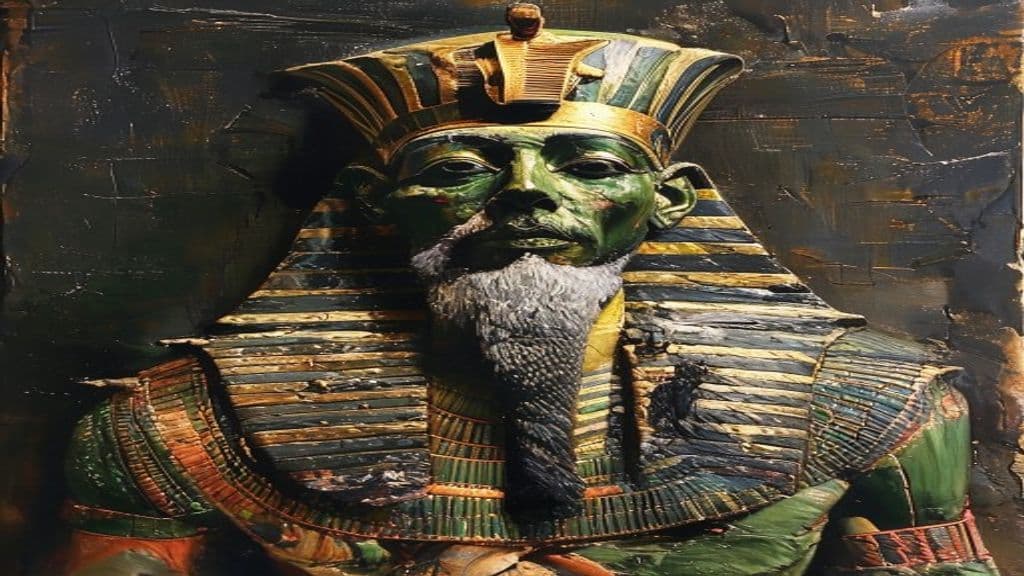
The Atef crown features curly ostrich feathers on each side, with a slight flare toward the base.
As an inanimate object, the Atef does not possess abilities or behaviors.
Weaknesses
- UnknownUnknown
Wards
- UnknownUnknown
Am-heh
Am-heh is an Egyptian underworld deity described in modern summaries as a terrifying devourer who dwells in a lake of fire and threatens beings in the netherworld. He is portrayed in sources as a minor underworld god sometimes correlated with the devourer-figure Ammit and is said in one account to be repelled only by the god Atum.
Anchiroe
Anchiroe (also rendered Achiroë, Anchirrhoë, or Anchinoë) is a figure in Greek myth described as a daughter of the river-god Nilus and the wife of the Egyptian king Belus; she is presented as the mother of Aegyptus and Danaus and, in some accounts, of Cepheus and Phineus. The sources treat her as a genealogical/maternal ancestor rather than an active supernatural agent.
Ankh
A symbol representing life in ancient Egyptian cosmology, often associated with eternal life and resurrection. (Note: - Power tier should be Ancient (not Primordial), as it's a symbol representing concepts in ancient Egyptian cosmology. - Abilities description is too vague; consider specifying how the Ankh affects or)
Book of Caverns (Egyptian tradition)
The Book of Caverns is an ancient Egyptian text that describes Ra's journey through the underworld, Duat. It does not describe a specific supernatural entity but mentions interactions between Ra and the residents of the underworld. (Note: 1. Power tier should be Ancient (deity-level) since it describes a journey of the sun god Ra and interactions between him and other deities. 2. Origin story needs clarification that the Book of Cavern)
Book of Thoth
A collection of ancient Egyptian texts attributed to and believed to be created by the god Thoth, holding significant knowledge and magical power. (Note: 1. Power tier: Primordial (given its association with a deity-level entity like Thoth) 2. Appearance: While some illustrations depict it as an ornate book, the source does not explicitly describe appe)
Book of the Earth
Ancient Egyptian funerary text associated with Aker, a deity possibly connected to time, the sun, and creation. (Note: 1. Power tier should be Ancient (deity-level) instead of Primordial (cosmic). 2. Abilities section is missing; source material does not mention any powers or behaviors. 3. No sensory cues, wards, or w)
Buchis
The deification of the kꜣ (ka) of the war god Montu, incarnated as a sacred bull in Egyptian mythology. (Note: - Remove "Greater" power tier; no information in source material supports this level of power. - Add sensory cues (e.g., distinctive markings, specific sounds) related to sacred bulls' selection and w)
Cynocephalics
In Egyptian tradition, cynocephalics are human beings with dog's heads. (Note: 1. The power tier should be Primordial, given the fact that cynocephalics are described as a widely attested mythical phenomenon existing in many different forms and contexts. 2. Add an origin story b)
Egyptian Pool
A symbolic representation of water in Egyptian mythology, depicted as a rectangular shape with seven equally spaced vertical zigzag lines. (Note: 1. Power tier should be "Minor Spirit" since the Egyptian Pool appears to be more of a symbolic representation without explicit abilities or behaviors. 2. Origin story should mention that it is not pr)
Egyptian Supernatural Beings
In Egyptian mythology, various supernatural entities inhabit different realms, including gods, goddesses, demons (uncertain), and spirits. They are considered Primordial beings, with cosmic-level powers. (Note: 1. Remove the claim that demons are considered Primordial beings (Source 1 does not mention this). 2. Update the power tier to Ancient, as Egyptian gods have cosmic-level powers but the text describes)
Gengen-Wer
Gengen-Wer (also Negeg-Wer) is an Egyptian mythological avian figure presented in secondary summaries as a celestial goose associated with the origin of life; sources describe it either as bearing or guarding a cosmic egg from which creation emerged and note a minor textual appearance in Chapter 59 of the Book of the Dead.
Hennu (Seker's Underworld Barque)
In Egyptian mythology, the Hennu is a symbolic entity representing Seker of Memphis's underworld journey. (Note: * Power tier: Lesser (not Greater), as it's an aspect of Seker and doesn't possess deity-level powers. * Origin story: Clarify that the Hennu represents a part of Seker's journey, rather than being "a)
Community Record
- [1]Wikipedia: Atefwiki