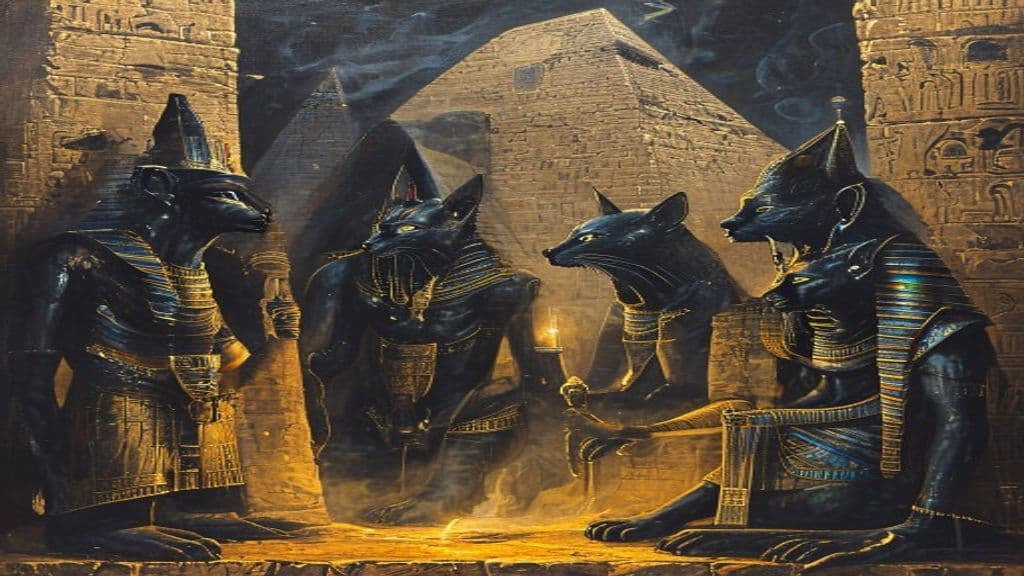
In Egyptian mythology, the creation story revolves around the primordial gods Atum and Ra. The world was created from chaos, with various deities emerging to govern different aspects of reality.
Egyptian supernatural beings often appear in human or animal form. They may be associated with sacred animals like cats or scarabs, which are imbued with their powers. Incense and sacred oils can signal their presence.
Egyptian gods possess immense power over natural elements, shapeshifting, and control over the forces of nature. Some deities, like Isis, have magical abilities to heal and protect. Others, like Anubis, are associated with death and the afterlife.
Weaknesses
- symbolicmagic spells
- ritualsacred amulets
Wards
- ritualrecitation of sacred mantras
- substanceburning incense and sacred oils

Atef Crown
Egyptian feathered white crown associated with Osiris, symbolizing his status and power. (Note: * Power tier should be Ancient, not Greater, since it's associated with a deity. * Abilities statement is accurate based on source material, but can be rephrased for clarity: "As an inanimate object, )
Nebu
An ancient Egyptian hieroglyph representing gold with phonetic value nb, associated with royalty and divine authority. (Note: 1. Power tier: Change Primordial to Ancient (since Nebu is a hieroglyph associated with royalty and divine authority, but not described as cosmic). 2. Abilities/Origin story: Add that Nebu has no know)
Thinis (Egyptian tradition)
A significant cultural and administrative center in ancient Egyptian history, mentioned as the capital city of pre-unification Upper Egypt. (Note: - Power tier should be Primordial, not Greater, since it's a significant cultural and administrative center and its decline is tied to pharaonic unification. - Abilities should be stated as "No record)
Two Ladies (Egyptian)
In ancient Egyptian tradition, the Two Ladies refer to the goddesses Wadjet and Nekhbet as national symbols of unified Egypt. (Note: - Power tier should be Ancient (not Greater), since the article describes them as "protectors" which aligns with deity-level powers. - Abilities should include specific references to their roles as pa)
Egremus
Egremus is a named mortal figure in Greek myth attested only as a combatant who fell in the war between Eumolpus and Eleusis. He is identified by the patronymic 'son of Eurynomus' and appears only in genealogical/war-list context in the cited source.
Egungun (ancestral masquerade spirits)
Egungun refers both to Yoruba masked, costumed masquerades and to the collective force of departed ancestors who manifest through those masquerades. In performance the layered costumes are treated as a dwelling for ancestor presence; egungun appear periodically—especially at annual festivals—to remember the dead, bless the community, and mediate between the living and the otherworld.
Eguzki Amandrea (Sun Mother)
Eguzki Amandrea is the Basque personification of the sun, presented in the cited corpus as a female, familial cosmic figure associated with warmth, growth, and the visible life of the world. Sources frame the sun as an animate, gendered celestial body embedded in a kinship-like cosmology with Earth and the Moon.
Egyptian Pool
A symbolic representation of water in Egyptian mythology, depicted as a rectangular shape with seven equally spaced vertical zigzag lines. (Note: 1. Power tier should be "Minor Spirit" since the Egyptian Pool appears to be more of a symbolic representation without explicit abilities or behaviors. 2. Origin story should mention that it is not pr)
Egyptian goddesses
A category of divine female figures in ancient Egyptian religion who embody, sustain, or control particular natural forces, social roles, cosmic functions, or ritual powers. They are objects of cultic worship with temples, priesthoods, hymns, prayers, and magical spells that maintain their functions within maat.
Eheieh (Ehyeh Asher Ehyeh)
Eheieh (Hebrew: אֶהְיֶה אֲשֶׁר אֶהְיֶה, Ehyeh Asher Ehyeh) is a biblical divine self-designation rendered in English as variants of "I Am that I Am" or "I will be what I will be." In later Jewish esoteric (Kabbalistic) discourse the name is associated with the highest Sephirah, Keter, and denotes the primal self-manifestation or mode of being from which emanation and sustenance proceed.
Eidyia (Idyia)
Eidyia (also Idyia) is an Oceanid—daughter of the Titans Oceanus and Tethys—named in Greek genealogies as the wife of Aeëtes of Colchis and mother of Medea, Chalciope, and Absyrtus. She is a local nymphly figure associated with Colchis/Aia on the eastern Black Sea and is primarily attested in sources as a genealogical link rather than as an active mythic agent.
Eight Immortals (八仙; Bā Xiān)
The Eight Immortals are a group of legendary xian (immortals) in Chinese mythology and popular Taoist-related religion, portrayed as once-human figures who attained transcendence. They function as exemplars of Taoist immortality, patrons of varied social roles, and popular auspicious figures in art, ritual cults, qigong, and martial arts.
Community Record
- [1]The Egyptian Book of the Dead. Wikipedia: The Egyptian Book of the Dead (2022)wiki