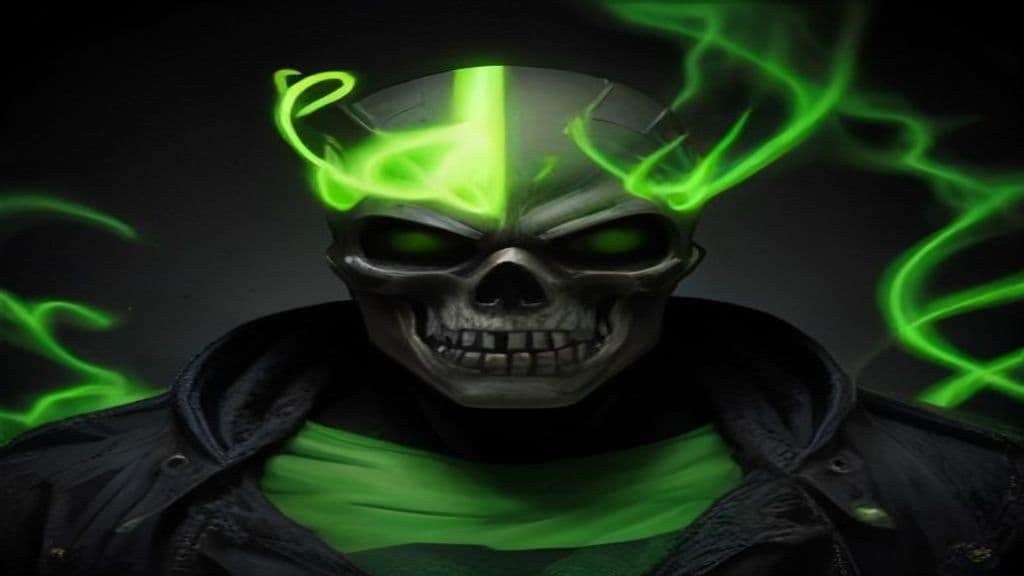
The Atomic Skull identity has been held by multiple individuals in DC Comics continuity. The first, Albert Michaels, is introduced as a S.T.A.R. Labs scientist/administrator who used a radium-powered device intended to harness a neural disorder and later adopted the Atomic Skull persona, becoming leader of the criminal organization SKULL. A later incarnation, Joseph Martin, was a student at S.T.A.R. Labs who gained powers when the Dominators detonated a gene-bomb; the blast granted him superhuman abilities and altered his flesh, after which he assumed the Atomic Skull identity. Continuity reboots (e.g., New 52) retell these origins with variations (for example, a New 52 Albert Michaels exposure that melts his face and 'reveals his radioactive skull').
Appearances vary by incarnation and continuity. Albert Michaels is commonly depicted in a distinctive yellow-and-green costume with a skull-themed visor/mask through which he projects energy, and he has used a sleek skull-shaped hovercraft; in New 52 material his face was shown as melted away to reveal a radioactive skull. Joseph Martin's body was described as having its flesh become invisible after gene-bomb exposure; later portrayals show a radiating, often purple-energized form capable of emitting energy blasts from hands or mouth.
Powers differ between incarnations and across reboots. Albert Michaels uses technology and a visor to project powerful energy bolts variously described in sources as 'unique brainwaves,' 'heat vision,' or 'radioactive energy'; he is also a brilliant scientist and criminal leader who employs technological devices. Joseph Martin gained superhuman strength, stamina, and durability after the Dominators' gene-bomb, emits dangerous levels of radiation, and later learned to project blasts of purple atomic energy from his hands or mouth. In one storyline (Underworld Unleashed) Joseph Martin accepted enhanced powers from the demon Neron in exchange for his soul, an event that temporarily altered his mental state and abilities. Behavioral notes include recurring antagonism toward Superman (motivated by resentment, delusion, or criminal intent) and episodic narrative variations in which the character is incapacitated, briefly reformed, or manipulated by other powers.
Weaknesses
- conditionvulnerability to intervention by other superpowered entities or specialized powers
- otherongoing physiological toll from radiation exposure (radiation damages the host in some continuities)
Wards
None recorded.
Absorbing Man
A fictional Marvel Comics character (Carl "Crusher" Creel) whose body acquires the physical properties of materials or energies he touches. Debuting in Journey into Mystery #114 (March 1965), created by Stan Lee and Jack Kirby, he is presented as a mortal supervillain/occasional antihero who challenges heroes such as Thor, Hulk, Spider-Man, and the Avengers.
Ace the Bat-Hound
Ace the Bat-Hound is a fictional canine companion and crime‑fighting ally in American superhero comic books published by DC Comics. Primarily a trained, loyal dog partnered with Batman and allied animal heroes, Ace appears in multiple continuities with varying breeds and occasional fantastical variants.
Agents of Atlas
Agents of Atlas is a fictional superhero team published by Marvel Comics, retroactively presented as a 1950s era group of operatives and reconstituted in modern storylines; the roster mixes human, nonhuman, mythic and technological characters and has served as an operative body connected to the Atlas Foundation.
Air Wave
Air Wave is a fictional costumed superhero identity from DC Comics, a human mantle borne by several members of the Jordan family (Lawrence 'Larry' Jordan, Helen Jordan, Harold Jordan) and later a separate individual listed as Harold Levey. The persona centers on radio- and signal-themed equipment and, in later incarnations, metahuman energy-transmutation powers used in genre superhero narratives from the Golden Age onward.
Amadeus Cho
A fictional Korean American human superhero from Marvel Comics characterized foremost as a super-genius ('hero of the mind') who later assumes a Hulk-like superhuman identity (the Totally Awesome Hulk) and subsequently the mantle Brawn. He operates in modern Marvel continuity, interacting with gods, heroes, and mythic locations.
America Chavez
A fictional superhero published by Marvel Comics, America Chavez is a Latina, lesbian character whose signature ability is creating star-shaped portals that allow travel across space and time. Introduced in 2011, she has been depicted as originating from the extra-temporal "Utopian Parallel" in early stories and later retconned as the product of human experimentation; she has headlined solo series and appeared in team books and the MCU film Doctor Strange in the Multiverse of Madness (2022).
Animal Man
A fictional comic-book character (Bernard "Buddy" Baker) who gains the ability to temporarily borrow the abilities of animals. Originating in 1965 as a costumed superhero, later reinterpretations (notably in the Vertigo imprint) recast him as an animal-linked avatar or elemental tied to an animal life force called the "Red."
Aquagirl
Aquagirl is a codename used by several fictional superhero characters published by DC Comics, depicted as female counterparts and allies to Aquaman and members of the wider 'Aquaman Family'. Notable bearers include Tula (an Atlantean princess/ally), Lorena Marquez (a human metahuman from San Diego), and earlier one-off figures (Lisa Morel, Selena); the name functions as a recurring title across multiple continuities and reboots.
Arrowette
Arrowette is a legacy heroic persona from American comic-book continuity (DC Comics), adopted by two related women across generations: Bonnie King (the original 'Miss Arrowette') and her daughter Suzanne 'Cissie' King-Jones. Within the fictional world she is a human, costume‑wearing archer whose identity functions as a public role, team membership, and a locus for interpersonal and moral drama rather than a supernatural being.
Ashley Kafka
Ashley Kafka is a Marvel Comics character originally introduced as a human psychiatrist who founded and directed the Ravencroft Institute for the Criminally Insane and served as an occasional ally to Spider-Man. After being killed and later reanimated via cloning technology she is transformed into the supervillain Queen Goblin following infusion with Norman Osborn's extracted 'sins', gaining enhanced physical attributes and Goblin-themed powers.
Baron Blitzkrieg
Baron Blitzkrieg is a DC Comics supervillain — a wartime-era German officer (Baron Reiter) transformed by scientific experimentation into an enhanced, militarized antagonist who opposes heroes such as Wonder Woman, Superman, the All-Star Squadron, and the Justice Society of America. He functions as both an individual powered combatant and a leader of criminal/paramilitary groups (e.g., Shadowspire) across World War II and modern comic continuity.
Bart Allen
Bart Allen is a fictional DC Comics speedster: a super-powered superhero from the Flash family legacy who has appeared as Impulse, Kid Flash, and briefly as the Flash. Originating in 30th-century lineage stories, he is characterized by Speed Force-derived super-speed, rapid aging/metabolic issues, and apprenticeship within an intergenerational hero tradition.
Community Record
- [1]Atomic Skull — Wikipedia. Wikipedia, 'Atomic Skull'wiki
- [2]Atomic Skull — Wikidata. Wikidata entry Q3543409other
- [3]A Dreamer Lost in a Dream (archive) — search-confirmation. Archive holdings consulted for relevance (no Atomic Skull content found)other
- [4]Accordion Noir 2008-12-05 (archive) — search-confirmation. Archive holdings consulted for relevance (no Atomic Skull content found)other
- [5]CIA Reading Room document (archive) — search-confirmation. Archive holdings consulted for relevance (no Atomic Skull content found)other