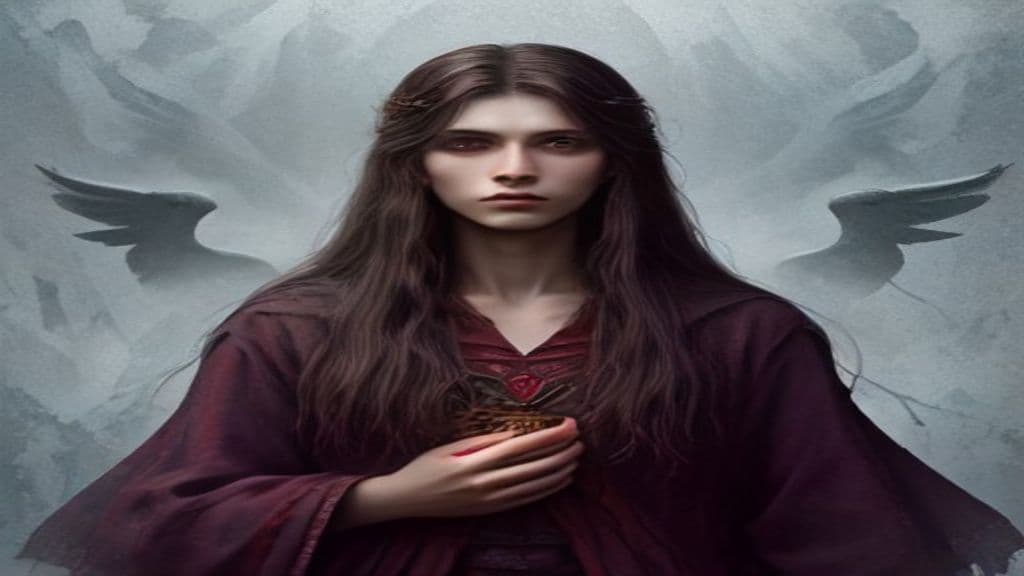
Auseklis does not have a single coherent origin narrative in the surviving material; his identity is reconstructed from recurring motifs in Latvian dainas and later scholarly synthesis. From those motifs he emerges as a named youthful member of the heavenly household—one of the Dieva dēli—linked etymologically to the dawn (root aus- + suffix -eklis) and situated in comparative Indo‑European frameworks of dawn/stellar personifications.
Surviving sources characterize Auseklis primarily by age and emblematic representation rather than detailed anthropomorphic features: he is described as 'very young' in the daina-derived tradition and in scholarly summaries. Iconographically his name is attached to an eight-pointed isogonal star (octagram) that functions as his visual emblem. Narrative motifs also associate him with a horse, described in some accounts as bought by him or given to him by the Sun, indicating a companion animal in story contexts.
Dainas and scholarly summaries attribute to Auseklis social and ritualized functions among sky beings rather than overtly hostile supernatural powers. He acts as an attendant to the Sun deity (Saule), helper in the so-called 'heavenly bath house', and a suitor/participant in the 'celestial wedding' drama—sometimes competing with Mēness (the Moon) over the Sun's daughter. Sources do not ascribe to him traditions of possession, explicit harmful magic, shapeshifting, or direct attacks on humans; the emphasis is on familial, courtship, and household roles within the mythic sky.
Weaknesses
- otherNo specific weaknesses recorded in available sources
Wards
- symbolEight-pointed star (Auseklis octagram) — emblem associated with Auseklis; documented usage as one of the protective 'crosses' drawn against the malevolent spirit Lietuvēns (drawn without lifting the hand).
- symbolPentagram — recorded alongside the Auseklis octagram as another protective sign used against Lietuvēns (also to be drawn without lifting the hand).
Bangpūtys
Bangpūtys is a reconstructed masculine sea-and-storm deity from Lithuanian mythology. Known from very scanty sources, modern mythologists portray him as an austere, vindictive master of winds and the sea and as the reconstructed father-figure of the cardinal wind-gods.
Aura (paranormal)
Auras are described in modern esoteric and New Age sources as subtle, nonmaterial emanations or energy fields that surround living beings and objects, presented as part of a 'subtle body' and used diagnostically to indicate health, personality, or moral/spiritual state. The concept was popularized in late-19th/early-20th-century Western occultism (notably Theosophy) and later adapted by New Age and holistic-health practitioners; scientific investigation finds no reproducible evidence for literal aural perception and offers physical explanations for photographic effects often labeled as 'auras.'
Aurboða
Aurboða is a jötunn (giantess) in Norse mythology attested as the wife of the jötunn Gymir and mother of the jötunn Gerðr; the name also appears separately as one of the nine maidens in the poem Fjölsvinnsmál. Her name is debated etymologically as either 'gravel-bidder' (aurr + boða) or, in an alternative reading, 'gold-bidder' (aur + boða).
Aureily
No evidence in the provided sources supports treating 'Aureily' as a folkloric or supernatural entity. The string appears in the sources either as part of Latin-derived numismatic terminology ('aureus' / 'aurei' — a Roman gold coin) or as a contemporary image-credit/creator name in commercial media; neither source presents origin, appearance, powers, or ritual material for an entity called 'Aureily'.
Aurnavabha
Aurnavabha (also attested as Aurṇavābha) is a name occurring in Vedic hymnic material (Rigveda) and later cited in bibliographic/theosophical indexes as a Vedic commentator. The sources present the name as textual/authorial rather than as an independently attested supernatural being.
Aurora (Sleeping Beauty)
Aurora is the princess protagonist of the Sleeping Beauty tale as popularized in Charles Perrault's literary tradition and later by the 1959 Disney film and stage/ballet adaptations. She is a mortal royal whose fate is determined by the interventions of beneficent and maleficent fairies, most notably being placed under a death-sleep curse that is altered to a prolonged enchanted sleep.
Aurvandill
Aurvandill is a figure attested in medieval Germanic onomastics and Norse narrative, most famously remembered in an Old Norse tale where Thor carries him across icy rivers and his frozen toe is cast into the sky as the star called Aurvandils-tá. Comparative linguistic study reconstructs a Common Germanic name associated with dawn or the morning star.
Austri, Vestri, Norðri and Suðri
A quartet of named dwarfs in Old Norse cosmology positioned at the four cardinal points who are described in medieval sources as holding up the sky after the gods made heaven from Ymir’s skull. They function as structural/cosmogonic supports and are attested in the Prose Edda and the Dvergatal of Völuspá, with echoes in skaldic kennings and in later scholarly interpretation linking their role to roof-beam terminology.
Autochthe
Autochthe (Ancient Greek: Αὐτόχθη) is a minor mythological princess of the Perseid line, named in classical genealogies as a daughter of Perseus and Andromeda. In some traditions she is said to have married Aegeus of Athens and borne daughters but no sons, and her chief narrative role is as a dynastic connector between ruling houses (Argos/Mycenae and Athens).
Autochthon (ancient Greece)
In ancient Greek myth and civic ideology, an autochthon is an 'earth-born' person or people—literally generated by the soil of a place—to claim the deepest form of indigenous origin and thereby political legitimacy. The term functions as a social-mythic category grounding territorial belonging and priority rather than as an independently acting supernatural creature.
Autolycus
Autolycus is a mythic Greek trickster-thief, son most commonly of Hermes, famed for cunning, theft, and the ability to alter the appearance of stolen goods; he is a legendary ancestor and occasional tutor within the heroic age rather than an impersonal spirit or cult deity.
Automate
Automate is a named figure in Ancient Greek mythic genealogy, one of the Danaids (daughters of Danaus). In mythographic summaries (following Apollodorus and later compilations) she is said to have killed the mythical Egyptian king Busiris, who had been betrothed to her. Her name in Ancient Greek is glossed as 'acting of one's own will, of oneself.'
Community Record
- [1]Auseklis (Wikipedia). Wikipedia contributors. 'Auseklis.' Wikipedia, The Free Encyclopedia.wiki
- [2]SOVIET MERCHANT SHIPS (SANITIZED): CIA reading room document (mentions ship named AUSEKLIS). Central Intelligence Agency (declassified list), archive entry noting a merchant ship named AUSEKLIS (1954).other
- [3]Lastångfartyget AUSEKLIS av Riga liggande i Limhamn i aug. 1951 (archive photo listing). Archive photographic listing for a ship named AUSEKLIS (1951).other
- [4]Latvian Folk Symbols Cookie-Cutters (Thingiverse/Archive note). Archive entry referencing Latvian folk symbols including the octagram associated with Auseklis.other