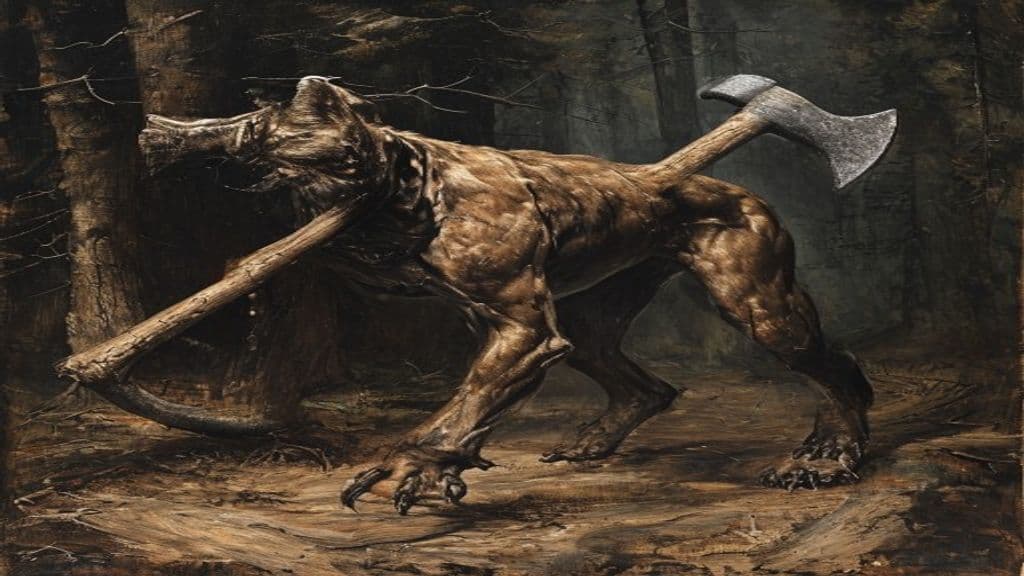
The Axehandle Hound originates in lumbercamp tall-tales and frontier yarns of Minnesota and Wisconsin. Framed as one of the 'fearsome critters' told around camp, it functions as a humorous explanatory creature and a device for hazing newcomers rather than as part of any religious cosmology. Tales present it as arising from the material culture and social practices of timber camps — an imaginative answer to missing, chewed, or ruined axe handles.
Described as a dog-like canine with a handle-shaped body and a head shaped like an axe blade, the creature is further noted to have short, stubby legs. Sources liken its overall silhouette to a woodcutter's axe or to a sausage-like body capped by an axe-head; no precise dimensions or coloration are given in the tradition.
Primarily a nocturnal pest: it travels from camp to camp searching for and consuming the handles of axes left unattended. Accounts emphasize nuisance behavior rather than lethal danger — it is noted for stealing or subsisting on axe handles but not for attacking people. Folklore records a specific material preference/aversion: the Axehandle Hound is said to strongly dislike axe handles made from red oak.
Weaknesses
- substancered oak (axe handles made from red oak are said to be disliked)
- conditionattended tools (axes kept attended or not left out reduce attraction)
Wards
- substanceuse red oak handles (traditional practical deterrent cited in folklore)
- conditionkeep axe handles attended (practical prevention by not leaving handles unattended)
Avernus
In Roman tradition, Avernus is a volcanic crater near Cumae (Cuma) in Italy associated with the underworld. (Note: 1. Power tier: Given that there are no reported interactions or abilities associated with Avernus as an entity, it should be classified as a Minor Spirit. 2. Appearance: There is no distinct physical )
Averruncus
Averruncus (also Auruncus) is an ancient Roman divine name/agent associated with averting harm. Attested in Roman antiquarian discussion as a power invoked to ward off disaster to people and harvests, Averruncus appears both as a specialized protective function and as an indigitamentum (a ritual name or aspect) applied to greater gods to secure their local, protective action.
Aveta
Aveta is a local maternal deity attested in Roman-period Gaul, chiefly among the Treveri around Augusta Treverorum (Trier). She is represented in altars and terracotta votive figurines emphasizing motherhood and fertility; some scholars interpret associated evidence as indicating links with springs and healing.
Awarikus (Warikas)
Awarikus (also rendered Warikas) was a historical king of the Neo‑Hittite/Luwian polity Ḫiyawa (Adanawa/ancient Adana in Cilicia) who reigned in the mid–late 8th century BCE (c. 738–709 BCE). He is attested in Hieroglyphic Luwian, Phoenician, and Neo‑Assyrian (Akkadian) sources as a local ruler who entered vassalage and treaty relations with the Neo‑Assyrian Empire and undertook fortification and administrative projects within his realm.
Awesome Android
A large artificial lifeform from Marvel Comics, created by the Mad Thinker from ape DNA and unstable molecules and animated by a microcomputer and solar power. Initially an obedient, limited‑intelligence instrument, the being later attains sentience in stories and pursues legal recognition as 'Awesome Andy.'
Awilix
Awilix is a principal deity of the Postclassic Kʼicheʼ Maya centered at Qʼumarkaj, serving as a lunar and night-associated patron of the Nijaʼibʼ lineage. The deity is linked with the moon, night, the Underworld, sickness and death, and is a patron of the Mesoamerican ballgame; sources record both feminine and possibly masculine identifications.
Axia
Axia (Ancient Greek: Αξία) is a minor figure in Greek mythography, attested as a Minyan princess of Orchomenus whose primary role in the surviving record is genealogical and toponymic. She is cited as a daughter of King Clymenus and Budeia and sister to several named siblings; one source records that a town in Ozolian Locris was named for her.
Axioche
Axioche (Ancient Greek: Άξιόχη, romanized Axiókhē), also called Danais in some accounts, is a named woman or nymph in Greek mythic genealogies. She is principally attested as the mother of Chrysippus by King Pelops and otherwise appears only as a genealogical figure in the Peloponnesian heroic cycle.
Axius
Axius (Ancient Greek: Άξιος, Axios) is the personified river-god of the Axius (modern Vardar) in the regions variously called Macedonia / Paeonia in northern Greece. In classical genealogies he is listed among the Potamoi as a son of Oceanus and Tethys and is cited as the father of Pelagon by Periboea.
Axtya
Evil sorcerer in Zoroastrian mythology, posing intellectual challenges to humans with his riddle-crafting and solving abilities, rivaling or surpassing deities. (Note: - Power tier: Axtya should be classified as Greater (powerful regional), not Primordial (cosmic). - Abilities: Axtya poses intellectual challenges, but his ability is specifically riddle-crafting and )
Axylus
Axylus (Ancient Greek: Ἄξυλος) is a Trojan warrior featured in Homer's Iliad (Book VI). Portrayed as a wealthy and hospitable man from Arisbe, he is slain in battle by the Greek warrior Diomedes, a brief episode used by Homer to underscore themes of hospitality, mortality, and the costs of war.
Ay Ata
Ay Ata (Ay Dede) is the personified Moon in Turkic myth and traditional Tengrism, commonly glossed as 'Moon Father.' He is paired with the sun-being (Gun Ana / Kün Ana) in a layered sky cosmology and figures in folk tales, epic traditions, and shamanic prayer contexts.
Community Record
- [1]Axehandle hound - Wikipedia. Wikipedia: Axehandle houndwiki
- [2]Axehandle Hound | Cryptid Wiki. Cryptid Wiki / Fandom: Axehandle Houndwiki
- [3]Axehandle Hound | Monster Wiki. Monster Wiki / Fandom: Axehandle Houndwiki
- [4]Axehandle Hound | Public Domain Super Heroes. Public Domain Super Heroes / Fandom: Axehandle Houndwiki
- [5]Wikidata: axehandle hound. Wikidata entry for axehandle houndother