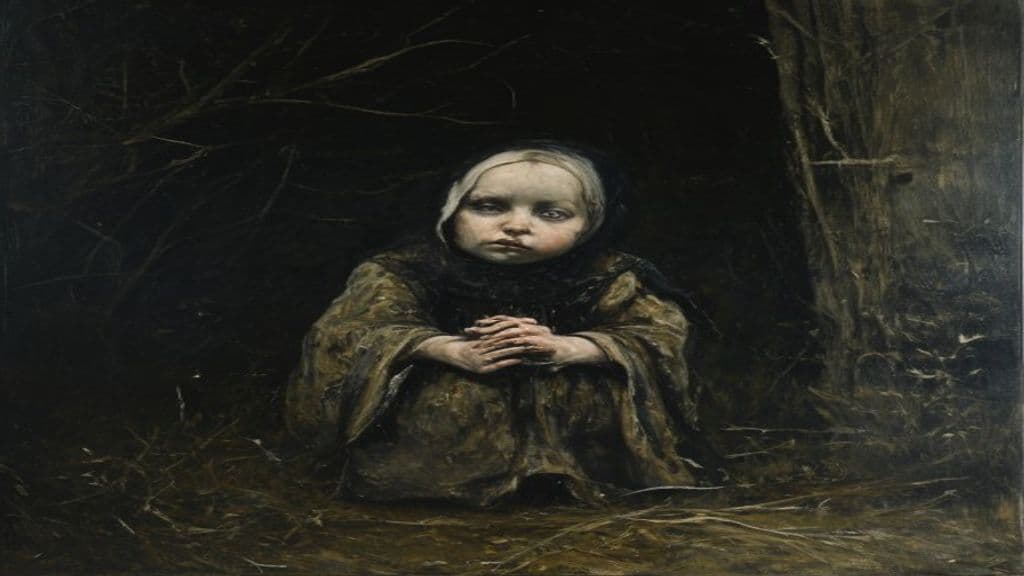
No specific origin story is mentioned in the source material.
No physical description of Babay is provided in the source material.
Babay abducts children who do not sleep at night or misbehave, suggesting an association with punishment and discipline.
Baalat Gebal
Baalat Gebal (Phoenician bʿlt gbl, "Lady of Byblos") is the tutelary goddess and principal civic deity of the ancient Phoenician city of Byblos. Her long-lived temple at the city's center and attestations in Egyptian, Akkadian (Amarna), and later Greek sources show her role as city-protector, focal point of royal veneration, and an object of cross-cultural identification with foreign goddesses.
Baalshamin
Baalshamin (literally "Lord of Heaven[s]") is a Northwest Semitic theonym/title used across the Levant and adjacent regions to denote a supreme sky/heavenly lord. Depending on time and place it functions as an epithet of other deities (notably Hadad/Baal) or as a distinct civic/sky deity associated with weather, lightning, and sometimes solar aspects; attested in inscriptions from Ugarit, Phoenicia, Safaitic Arabia, Palmyra, Nabataea, and in treaty and stele texts.
Baatar Bayan
The name Baatar Bayan was requested for documentation, but the provided source material contains no mention of this entity or of Mongolian mountain guardian spirits. No folkloric details (origin, appearance, abilities, or rituals) can be derived from the supplied document.
Baba Marta
Baba Marta (Bulgarian: Баба Марта, 'Granny March') is a Bulgarian folkloric personification of the transition from winter to spring. Celebrated on March 1, she is pictured as a feisty grandmother whose mood is said to affect late-winter weather; communal customs (martenitsi) exchanged on her day symbolize health and good fortune.
Baba Yaga
Baba Yaga is an ambivalent female figure of East Slavic folktale tradition, depicted variously as a fearsome, child-eating crone or as a helpful, maternal donor. She is associated with the deep forest, a hut described as standing on chicken legs, and the motific accoutrements of a mortar and pestle.
Babalon
A central goddess-figure in the Thelemic system founded by Aleister Crowley; simultaneously an archetypal Great Mother/Binah, a sacralized principle of liberated female sexuality, a ritual vessel (the Grail), and an office manifested historically as the "Scarlet Woman."
Babi
Babi (also Baba) is the ancient Egyptian deification or divine personification of the hamadryas baboon, associated in funerary and mythic texts with the netherworld, posthumous judgment, and sexual virility. Texts portray him as a violent, meat‑eating figure who could devour the unjust after judgment, while some funerary spells also appropriate his virile power positively for the dead.
Babi Ngepet
In Indonesian mythology, the Babi Ngepet is a boar demon associated with malevolent intentions towards humans. (Note: * Power tier: Downgrade to Ancient (deity-level) as there's no indication of Primordial powers. * Abilities: Specify what malevolent intentions towards humans implies, e.g., ability to curse or cause )
Baboon
Baboon refers to primates of the genus Papio (family Cercopithecidae). The sources treat baboons as living Old World monkeys with distinct anatomy, complex social systems, omnivorous diets, and a primarily African (and partly Arabian) distribution.
Babr-e Bayān
Babr-e Bayān is the name of a legendary suit or armor associated with the Iranian hero Rostam in Persian epic tradition. In most accounts it is an extraordinary protective garment (sometimes said to be made from a slain creature’s hide) that confers invulnerability when worn.
Baby Train
A modern urban legend that humorously explains a local baby boom by attributing it to an early-morning train whistle (or similar repetitive noise) that wakes residents who then have sex. It is a narrative motif circulating in English-language media and folkloric collections rather than a supernatural being.
Baby Wildebeest
Baby Wildebeest is a fictional character from DC Comics' New Teen Titans series: a juvenile, wildebeest-themed created host-body who serves as an adopted child-member of the Teen Titans, noted for great strength and durability. Introduced in 1992, the character was killed during Infinite Crisis and later appeared briefly as a Black Lantern in Blackest Night.
Community Record
- [1]