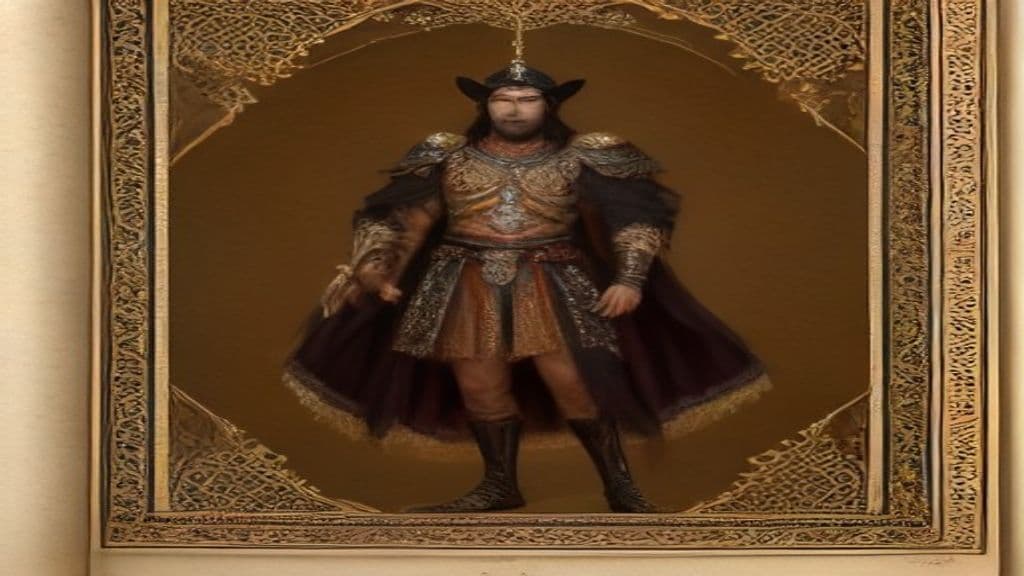
Accounts vary across epic interpolations and later traditions. In Shahnameh-derived interpolated verses and related epic material the item is presented as Rostam’s named outer suit worn in war. Some verses report the suit as made from the skin of a leopard (hence the alternative name Palangineh). In other interpolated or later narratives (reported in encyclopedic summaries) Rostam is said, at age fourteen in an account, to have slain a dragon called Babr-e Bayān in India — a sea-dwelling creature that came ashore only one day a week — and to have fashioned the suit from its hide. Sogdian texts and later tumar prose sometimes record or echo these variant origin tales. The element “Babr” is attested as meaning “tiger” in Middle Persian; “Bayān” is of uncertain origin and may represent a place-name or a proper name attached to the creature or object in different traditions.
The suit is described in the sources as a dark, hairy outer garment or armor. In leopard-skin accounts it is explicitly a feline-hide garment (Palangineh); in dragon-origin variants it is the hide of the slain monster. It functions as the outermost layer of Rostam’s layered defenses, placed last over other armorial garments such as the zereh and jowshan/gabr.
Sources ascribe a number of preternatural defensive properties to the suit: it is described as invulnerable (against fire, water, and ordinary weapons). It functions as Rostam’s ultimate layer of protection in battle, conferring near-complete protection when worn. The suit is treated as an empowering object rather than an autonomous agent; no sourced accounts attribute independent action or consciousness to it.
Weaknesses
- otherNo recorded weaknesses in the provided sources
Wards
- otherNo recorded wards or counter-rituals in the provided sources
Biderafsh
Biderafsh is a Turanian heroic warrior and envoy attested in the Iran–Turan cycle of epic literature (notably the Shahnameh) who bears a name meaning 'with unfurled banner.' In the Goshtasp–Arjasp episode he delivers a threatening letter, fights in Arjasp's army, kills Zarir, and is in turn slain by the Iranian hero Esfandiar (attested in Shahnameh and earlier Middle Persian and Islamic-era sources).
Davāzdah Rokh
Davāzdah Rokh (Persian: دوازده رخ, 'Twelve Combats') is a narrative episode in Ferdowsi's Shahnameh describing a sequence of single combats between Iranian and Turanian champions during Kay Khosrow's campaign; it is also locally anchored to the Zibad / Kuh-Zibad region in Greater Khorasan.
Fariburz (Shahnameh)
Fariburz is a legendary Iranian prince and warrior in Ferdowsi’s Shahnameh, a son of King Kay Kavus and brother of Siyâvash who appears as a recurrent Kayanian court hero in episodes such as the Mazandaran (Bahman’s fortress) campaign and the First 'Joust of the Rooks'. He is a human martial figure within the epic, not a supernatural being.
Farânak
Farânak is a human female character in the Persian epic Shâhnâmeh, attested as the wife of Abtin and the mother of the hero-king Fereydun. Her name derives from Persian terms meaning 'butterfly' and by extension is linguistically associated with the Persian lynx/caracal; however, the cited sources present her as a mortal figure within epic genealogy rather than a supernatural being.
Gordāfarīd
Gordāfarīd (Persian: گردآفريد) is a human heroine in Ferdowsi’s Shāhnāmeh (The Book of Kings). A warrior of the White Fortress (Dezh-e Sepid), she dons armour, sallies forth to challenge the Turanian commander Sohrab, delays the enemy advance, is defeated in single combat, and is spared by Sohrab; modern scholarship and performers treat her as a lasting symbol of female courage and prudence in Persian epic.
Kai Khosrow
Kai Khosrow is a legendary Kayanian king in Persian epic tradition, chiefly known from the Shahnameh and related material. He is remembered as the rightful heir who returns from exile, avenges his father Siavash, and rules Iran while repeatedly opposing the Turanian king Afrasiab.
Babi
Babi (also Baba) is the ancient Egyptian deification or divine personification of the hamadryas baboon, associated in funerary and mythic texts with the netherworld, posthumous judgment, and sexual virility. Texts portray him as a violent, meat‑eating figure who could devour the unjust after judgment, while some funerary spells also appropriate his virile power positively for the dead.
Babi Ngepet
In Indonesian mythology, the Babi Ngepet is a boar demon associated with malevolent intentions towards humans. (Note: * Power tier: Downgrade to Ancient (deity-level) as there's no indication of Primordial powers. * Abilities: Specify what malevolent intentions towards humans implies, e.g., ability to curse or cause )
Baboon
Baboon refers to primates of the genus Papio (family Cercopithecidae). The sources treat baboons as living Old World monkeys with distinct anatomy, complex social systems, omnivorous diets, and a primarily African (and partly Arabian) distribution.
Baby Train
A modern urban legend that humorously explains a local baby boom by attributing it to an early-morning train whistle (or similar repetitive noise) that wakes residents who then have sex. It is a narrative motif circulating in English-language media and folkloric collections rather than a supernatural being.
Baby Wildebeest
Baby Wildebeest is a fictional character from DC Comics' New Teen Titans series: a juvenile, wildebeest-themed created host-body who serves as an adopted child-member of the Teen Titans, noted for great strength and durability. Introduced in 1992, the character was killed during Infinite Crisis and later appeared briefly as a Black Lantern in Blackest Night.
Babys
Babys (Ancient Greek: Βάβυς, Bábus) is a sparsely attested figure in Greek mythology identified in available sources as the brother of the Phrygian satyr Marsyas; surviving references associate him only fragmentarily with a flute and place him within the Marsyas–Apollo musical contest tradition.
Community Record
- [1]Babr-e Bayān. Wikipedia: Babr-e Bayānwiki
- [2]Babr-e Bayan - Wikidata. Wikidata entry for Babr-e Bayānother
- [3]Seven Epic Poems – Bibliographia Iranica. Bibliographia Iranica: Seven Epic Poems (context for epic interpolations and related traditions)other
- [4]Palang: The Persian Leopard That Shaped Iran’s Poetry, Mythology and Folklore for Centuries. Article on palang (leopard) in Persian poetic and symbolic usage (context for Palangineh name)other
- [5]Archive: Dragons for CNC pack (context files). Archive materials on dragon motifs (context for dragon-origin variant; not primary attestation of Babr-e Bayān)other