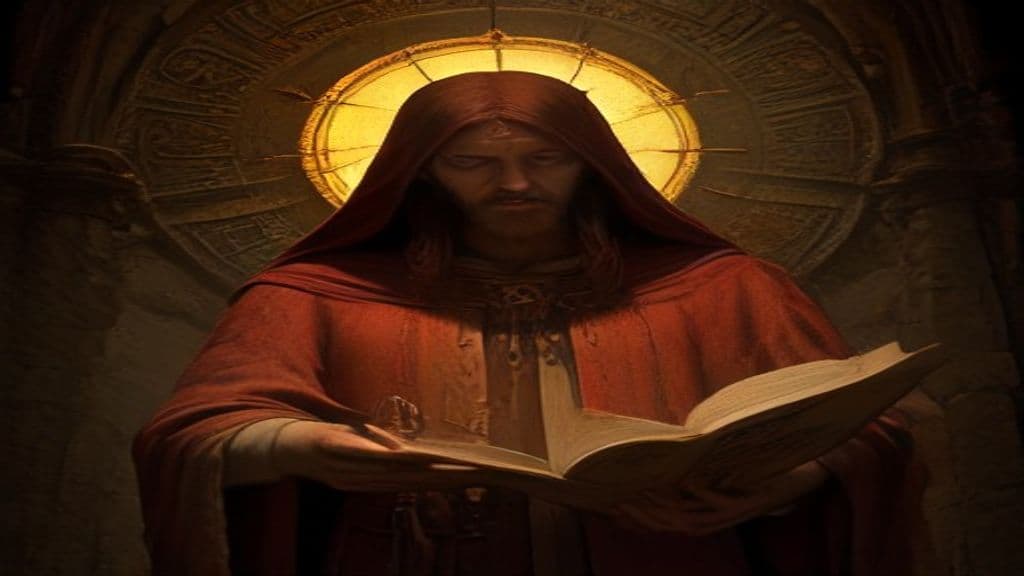
The figure of Balthazar arises from the Nativity episode in the Christian Gospel tradition in which magoi (Greek: μάγοι), translated as wise men or kings, travel from the East to visit the newborn Jesus. The Gospel account describes unnamed magi bringing gifts; the specific personal names (including Balthazar alongside Caspar and Melchior) are later Western attributions that developed in Christian tradition and art. Onomastic scholarship and name dictionaries cited in Western sources connect the name Balthazar to an Akkadian theophoric form (Bel-shar-uzur, 'Bel protects the King'), a linguistic lineage proposed in studies of the given name rather than an element of the biblical narrative itself.
Scripture does not provide a canonical physical description of Balthazar. Later Western liturgical practice and artistic iconography represent him variably as one of three regal visitors; depictions differ across time and place. The supplied sources note the absence of a consistent ethnographic or canonical description and treat visual portrayals as part of diverse artistic tradition rather than authoritative physical detail.
The sourced material treats Balthazar as a magus or wise man in the narrative role of seeker and gift-bearer; it does not ascribe unique supernatural powers, such as healing or demonic agency, to him. Any characterization of magi as learned men, astrologers, or wise visitors reflects narrative function in the Nativity story rather than documented magical abilities in the provided sources.
Balius and Xanthus
A paired set of exceptional, traditionally immortal horses from Greek myth, often given by gods to heroes and famed as the chariot steeds of Achilles. They are noted for divine parentage variants, great speed and endurance, emotional responsiveness, and — in one Homeric episode — a momentary prophetic speech granted by a goddess.
Balkan sworn virgins
A culturally recognized gender role in parts of the western Balkans in which people assigned female at birth take an irrevocable vow of celibacy and are socially recognized to live as men, acquiring male privileges and responsibilities within patrilineal customary law.
Ball-tailed cat
A North American "fearsome critter" from woodsmen's tall tales c. turn of the 20th century: a large catlike predator with an exceedingly long tail terminating in a solid, bulbous "ball" used as a club. The creature functions as occupational folklore—an entertaining hazard-story variant on known felids rather than part of a formal cosmology.
Baloma
In Trobriand Islanders' belief as reported by Bronisław Malinowski, baloma are the spirits of deceased lineage members who act to produce new members of a matrilineal line; they are credited with impregnating women (often described as occurring while bathing in the sea) and thereby sustaining matrilineal descent.
Balor
Balor is a leader of the Fomorians in the Irish Mythological Cycle, portrayed in medieval texts as a formidable war‑champion and in later folklore as a one‑eyed giant/tyrant whose baleful eye causes great destruction; he is killed by his grandson Lugh in the battle narratives and in folktale variants. Scholarly readings link his name to a Common Celtic root meaning 'the flashing one,' which has informed interpretations of him as a personified destructive natural force.
Balrog
In J. R. R. Tolkien's legendarium, a Balrog is a Maiar spirit corrupted into a warlike, fire-associated servant of the Vala Melkor (Morgoth). Balrogs appear as towering, shadowed figures wreathed in fire and wielding fiery whips and weapons; in Tolkien's later conception they are rare, exceptionally powerful beings whose defeat generally required opponents of comparable metaphysical order.
Baltic Mythology
A complex pantheon of gods, spirits, and supernatural beings in ancient Baltic cultures. (Note: 1. Power tier: Change to "Ancient" as Primordial implies a cosmic entity, which is not supported by the source material. 2. Origin story: Specify that the connection with nature and inspiration from t)
Banba
Banba (modern spelling Banbha) is a matron goddess of Ireland in Irish mythology, daughter of Delbáeth and Ernmas of the Tuatha Dé Danann. She forms a triad of matronal personifications of the island with her sisters Ériu and Fódla, is associated with sovereignty and the land, and appears in origin and heroic narratives linked to specific Irish landscapes.
Bandicoot
A group of more than 20 species of small to medium-sized, largely nocturnal, omnivorous marsupials (order Peramelemorphia) endemic to the Australia–New Guinea region. The English name is an Anglicised borrowing ultimately from Telugu and was historically applied to unrelated Indian rodents before being transferred to Australasian marsupials.
Bandua
Bandua is a theonym attested in Roman‑period epigraphic sources from north‑west Iberia (Galaico‑Lusitanian area). The name appears with many localizing epithets and is reconstructed by scholars as a local tutelary or protective divine figure (or a set of closely related local figures) with occasional Roman syncretism to Mars.
Banebdjedet
An ancient Egyptian ram deity worshipped at Mendes (Djedet), understood as the local 'Ba' or soul‑manifestation tied to fertility, virility, and aspects of rulership; depicted commonly as a ram or ram‑headed man and sometimes as a four‑headed ram representing multiple Bas of the sun god.
Bangpūtys
Bangpūtys is a reconstructed masculine sea-and-storm deity from Lithuanian mythology. Known from very scanty sources, modern mythologists portray him as an austere, vindictive master of winds and the sea and as the reconstructed father-figure of the cardinal wind-gods.
Community Record
- [1]Balthazar (magus) — Wikipedia. "Balthazar, also called BalthasarBalthassar, and Bithisarea, was, according to Western Christian tradition, one of the three biblical Magi (also known as wise men or kings) along with Caspar and Melchior who visited the infant Jesus after he was born."wiki
- [2]Balthazar (given name) — Wikipedia. "Balthazar (also spelled BalthasarBalthassarBalthazaar or Baltazar), from Akkadian 𒂗𒈗𒋀 Bel-shar-uzur, meaning 'Bel protects the King' is the name commonly attributed to Balthazar (magus), one of the Three Wise Men, at least in the west."wiki
- [3]Balthazar — Wikipedia (disambiguation/general page). Entry listing cultural and media usages of the name Balthazar and its appearances beyond strictly liturgical contexts.wiki
- [4]The Wise Men in The Christmas Story - WhyChristmas.com. Discussion of the Magi as wise men from the East who journey to visit the newborn Jesus and are identified in later tradition as named figures.other