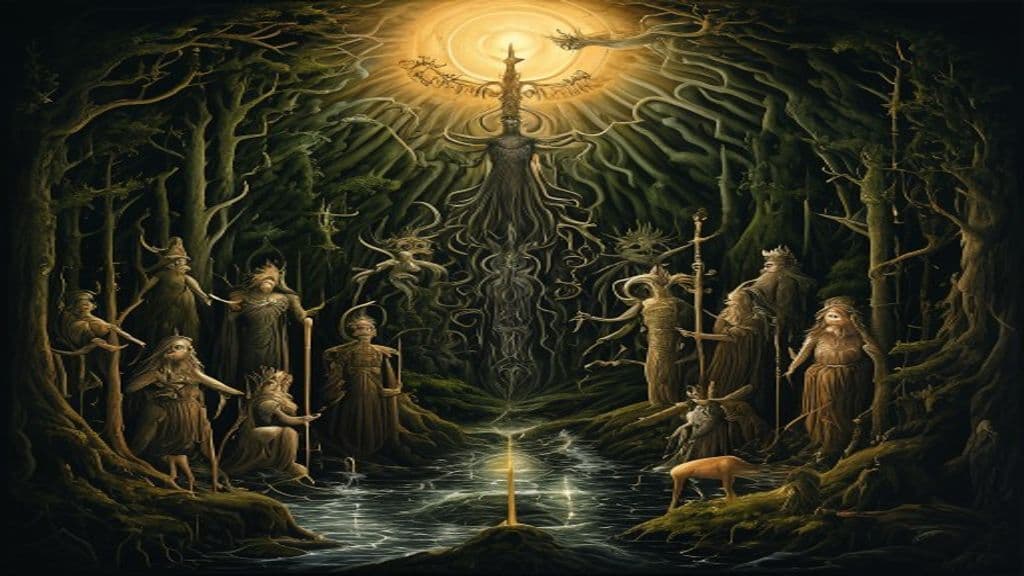
The Baltic mythological system likely developed from a deep connection with nature, drawing inspiration from the natural world and the lives of ancient Baltic peoples.
Baltic mythology entities were believed to have played a significant role in shaping the lives of ancient Baltic peoples, influencing various aspects of their culture, such as agriculture, hunting, and spiritual practices.
Arevakhach’
The Armenian eternity sign is an ancient national symbol representing the Armenians' spiritual and celestial connection. It appears as a geometric figure on khachkars and church walls, embodying the significance of faith and symbolism in Armenian tradition. (Note: - Power tier: Primordial (as it's described as an "ancient" national symbol, but there's no indication that it's deity-level) - Appearance: Not enough detail is provided; the source material only ment)
Blue Stone (Russia)
A type of sacred stone in Slavic tradition, held significant spiritual significance and venerated through simple rituals. (Note: - Power tier should be Lesser (since they don't have major hallows and are venerated in a simpler way). - Abilities: "Venerated through simple rituals" is vague; clarify that these rituals include pou)
Celtic Sacred Trees
In Celtic tradition, sacred trees are imbued with spiritual significance and serve as symbols, conduits for medicinal properties, or abodes for nature spirits. (Note: 1. Power tier is uncertain; the source material does not explicitly describe the trees' power level. 2. Abilities should be more specific; instead of stating they "possess symbolic significance and se)
Lupae
In Roman tradition, Lupae refers to a female wolf or prostitute symbolizing fertility and protection. (Note: - Power tier: Change to Ancient (deity-level) as Lupae's abilities and symbolism suggest a higher level of power than Primordial. - Abilities: Clarify that Lupae is associated with fertility and prote)
Orko (Basque Thunder God)
Deity associated with thunder and the forces of nature in ancient Basque mythology. (Note: * Power tier: Greater (not Ancient), as there's no indication of deity-level powers. * Abilities: Specify exactly what abilities related to weather control are associated with Orko, instead of making )
Supernatural Beings in Slavic Tradition
In the Slavic tradition, supernatural beings are a part of the natural world, existing alongside humans and other entities. They have a unique relationship with nature, reflecting an interconnected worldview. (Note: 1. The power tier should be Primordial, as it is implied that these supernatural beings are a fundamental part of the natural world and not limited by human regional boundaries. 2. Remove "Their abili)
Tursaansydän
An ancient, swastika-like symbol in Finnish tradition associated with protection, good luck, and blessings. (Note: - Power tier should be Lowered from Primordial to Ancient, as it is described as an "ancient symbol" and not cosmic in power. - No sensory cues or weaknesses are mentioned in the source material; add )
Balor
Balor is a leader of the Fomorians in the Irish Mythological Cycle, portrayed in medieval texts as a formidable war‑champion and in later folklore as a one‑eyed giant/tyrant whose baleful eye causes great destruction; he is killed by his grandson Lugh in the battle narratives and in folktale variants. Scholarly readings link his name to a Common Celtic root meaning 'the flashing one,' which has informed interpretations of him as a personified destructive natural force.
Balrog
In J. R. R. Tolkien's legendarium, a Balrog is a Maiar spirit corrupted into a warlike, fire-associated servant of the Vala Melkor (Morgoth). Balrogs appear as towering, shadowed figures wreathed in fire and wielding fiery whips and weapons; in Tolkien's later conception they are rare, exceptionally powerful beings whose defeat generally required opponents of comparable metaphysical order.
Balthazar (Magus)
Balthazar is the traditional Western Christian name attributed to one of the three Magi—wise men or kings—who visited the infant Jesus in the Nativity narrative. The name appears in later Western tradition and liturgical/ artistic treatments of the Christmas story rather than in the Gospel text itself.
Banba
Banba (modern spelling Banbha) is a matron goddess of Ireland in Irish mythology, daughter of Delbáeth and Ernmas of the Tuatha Dé Danann. She forms a triad of matronal personifications of the island with her sisters Ériu and Fódla, is associated with sovereignty and the land, and appears in origin and heroic narratives linked to specific Irish landscapes.
Bandicoot
A group of more than 20 species of small to medium-sized, largely nocturnal, omnivorous marsupials (order Peramelemorphia) endemic to the Australia–New Guinea region. The English name is an Anglicised borrowing ultimately from Telugu and was historically applied to unrelated Indian rodents before being transferred to Australasian marsupials.
Community Record
- [1]Baltic Mythologywiki