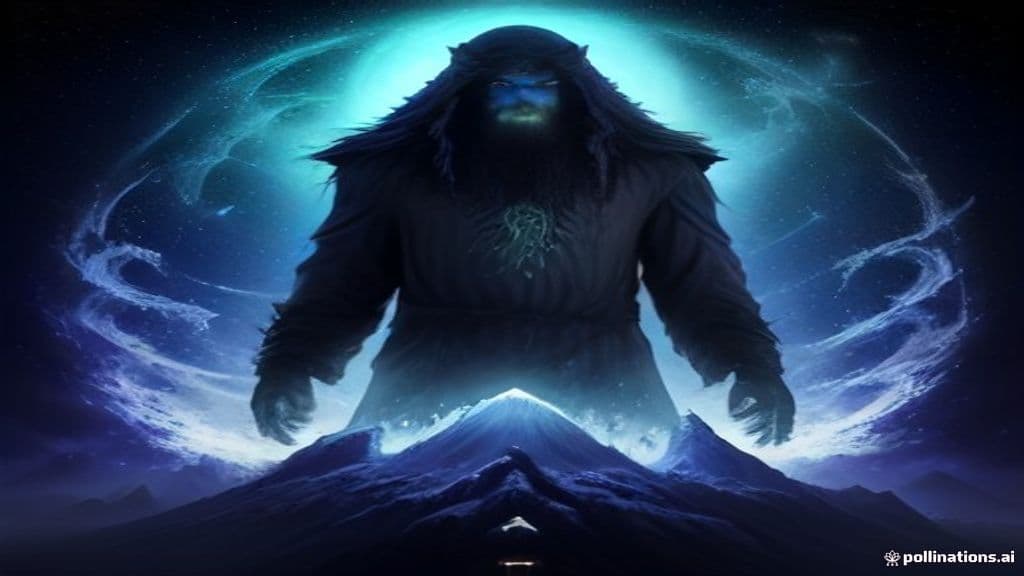
The Qurʾān (Q 27:82) states that when 'the Word is fulfilled' God will 'produce from the earth a beast' (dābbah) that will speak to people. This concise scriptural statement is the origin of the figure. All fuller narratives about the Beast's form, instruments, timing, and sequence derive from later hadith, tafsīr, and apocalyptic writings; these later accounts are diverse and sometimes conflicting, and some classical commentators warned that the Qurʾān itself specifies only emergence from the earth and speech.
The Qurʾān gives no physical description beyond its production 'from the earth.' Later traditions present widely varying appearances: some Sunni tafsīr and apocalyptic reports describe an extraordinary composite, frightening creature; other accounts portray a human or human‑like speaking figure. Shiʿi sources include both animal‑like and human‑like descriptions and in some readings identify the Beast with known eschatological persons (e.g., figures associated with the Mahdī or Ali in particular interpretive strands). Classical exegetes cautioned that these details are not fixed by the Qurʾān and that transmitted reports conflict.
The Qurʾān's sole attributed function is that the Beast will speak to people when the Word is fulfilled (Q 27:82). Later hadith and apocalyptic literature ascribe expanded roles: speaking to humanity about their lack of certain belief in God's signs and, in some reports, distinguishing believers from unbelievers. Certain later narratives report that the Beast bears instruments such as the staff of Moses and the seal of Solomon and uses such tokens to identify people according to faith; these items and functions are attested only in some post‑Qurʾānic traditions and are not specified in the Qurʾān itself. Modern and classical interpreters also offer symbolic or nonliteral readings (e.g., reading the Beast as a human debater or as a sign rather than a literal creature).
Weaknesses
- otherNo Quranic or reliable traditional sources specify weaknesses
Wards
- otherNo Quranic or reliable traditional protective wards are specified in the provided sources
Bear
A real-world animal (family Ursidae) widely distributed across the Northern Hemisphere and present in cultural names and symbols; the provided sources treat 'bear' as a zoological taxon and cultural referent rather than a single mythological or supernatural being.
Bear Lake Monster
A lake‑monster legend associated with Bear Lake on the Utah–Idaho border, attested in 19th‑century settler newspapers and later local reports. Descriptions and reports vary widely; the creature functions in sources as a local legendary animal, a subject of publicity and tourism, and an element of regional identity rather than a codified supernatural being.
Bearers of the Throne (ḥamlat al‑arsh)
The ḥamlat al‑arsh are a class of angels in Islamic textual tradition whose primary role is to carry or support God’s Throne (al‑ʿArsh). Descriptions vary across transmissions, emphasizing their cosmic scale, proximity to the divine Throne, and symbolic features drawn from a range of hadith and exegetical reports.
Beast Boy (Garfield Mark "Gar" Logan)
Beast Boy is a fictional superhero from DC Comics (first appearance Doom Patrol #99, November 1965), a human named Garfield Mark "Gar" Logan who acquired the ability to transform into any animal after an experimental medical procedure. He is portrayed as a youthful team member of Doom Patrol and Teen Titans, often providing comic relief while coping with deep personal trauma.
Beast of Bodmin
A modern British cryptid associated with reports of a non-native large cat prowling Bodmin Moor, Cornwall. Treated variously as an escaped or released large felid blamed for livestock damage and as a piece of contemporary folklore amplified by media, books and popular culture.
Beast of Bray Road
A contemporary North American cryptid localized to Walworth County, Wisconsin, described in witness reports and popular media as a wolf-like, humanoid or hybrid creature associated with Bray Road and surrounding rural areas. It exists both as reported phenomenon and as a piece of local folklore and popular-culture storytelling.
Beatrice Portinari
Beatrice (Bice) di Folco Portinari appears in Dante Alighieri's works as the personified embodiment of beatific love, divine grace, and theological vision who intercedes for and ultimately guides the pilgrim from human reason into Paradise. Historically she may be a Florentine woman documented in late 13th-century records, but the literary Beatrice is primarily a theological and allegorical figure within Dante's poetic cosmology.
Beauty (Once Upon a Time)
A television-episode–centred portrayal of Belle (the 'Beauty' archetype) from Once Upon a Time (Season 7, Episode 4). The episode follows Belle's life with Rumpelstiltskin/Mr. Gold, her understanding of a prophecy that interprets 'sunset' as her death, her peaceful passing after years at the Edge of Realms, and a later vision of her spirit seen by a comatose Weaver.
Bebop and Rocksteady
Bebop and Rocksteady are a paired antagonistic duo from the Teenage Mutant Ninja Turtles franchise: two humanoid mutants—commonly a warthog (Bebop) and a rhinoceros (Rocksteady)—created to serve as Shredder's muscle. They function narratively as physically imposing but often incompetent henchmen whose loyalties and brute force drive many episodic conflicts.
Bebryces
The Bebryces (Greek: Βέβρυκες) are a legendary people or tribe attested in Greek mythographic and geographic tradition, primarily located in Bithynia (northwestern Anatolia). They appear in heroic-age narratives as local rulers and warriors—not as supernatural beings—and are associated with episodes involving Heracles, the Argonauts, and named kings such as Amycus and Mygdon.
Beburos
Beburos is a named angel attested in the Greek Apocalypse of Ezra (Revelation of Esdras) as one of nine heavenly beings who will "govern at the end of the world." The figure is non‑canonical and known primarily from this apocryphal source and modern reference glossaries that reproduce the roster.
Beckumia
No evidence in the provided scientific and paleontological sources identifies Beckumia as a folkloric or supernatural entity. The supplied documents instead concern mammalian clades and paleontological taxa; therefore no folkloric attributes for Beckumia can be supported from these sources.
Community Record
- [1]Beast of the Earth. Wikipedia, 'Beast of the Earth'.wiki
- [2]Wikidata entry: Beast of the Earth. Wikidata Q3093462.other
- [3]Qurʾān 27:82 (as cited in sources). Qurʾān 27:82 quoted in secondary summaries.other
- [4]Archive and scholarly summaries (collected excerpts). Summaries of tafsīr and apocalyptic elaborations as presented in secondary literature and the provided source excerpts.other