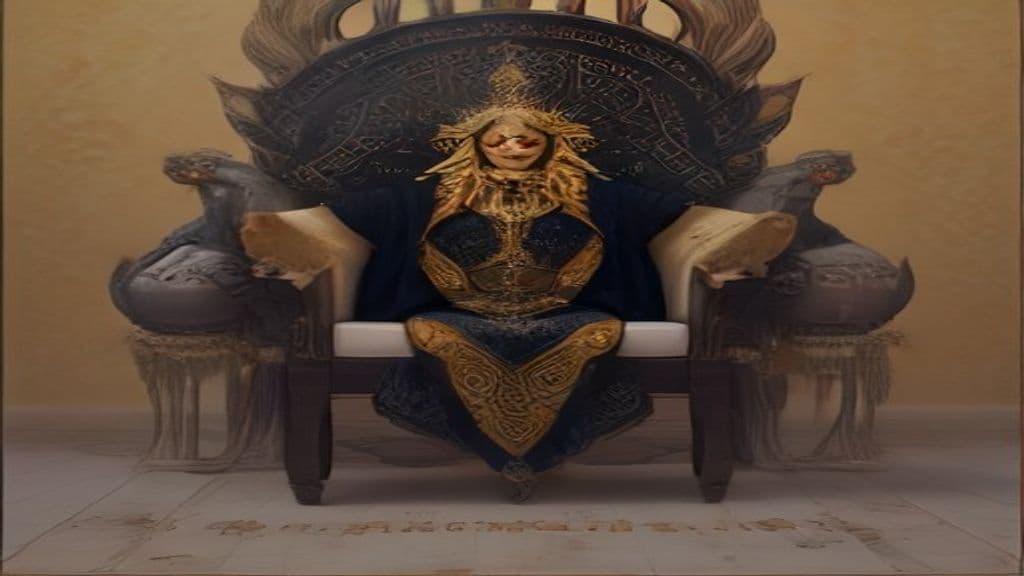
Multiple transmitted reports offer differing notes on origins. One reported authority, Muqatil ibn Sulayman, is cited as saying the throne‑bearers were the first angels created. Other narrations present them as created from distinct elements (variously listed as light, fire, water, and mercy in some transmissions reported via Ibn Abi al‑Izz). These accounts appear in exegetical and hadith literature rather than a single unified cosmogony.
Accounts differ across sources. Some traditions (as preserved in summaries quoting al‑Suyuti via Wahb ibn Munabbih and al‑Bayhaqi) describe anthropomorphic or compound forms with four faces — human, bull, vulture, and lion — echoing a tetramorph motif. Other hadith variants attribute four faces and six wings, or four wings. A narration reported from At‑Targhib wat‑Tarhib (quoted in the summaries) describes them shaped like a rooster, "with their feet on the earth and their nape supporting the Throne of God in the highest sky." Hyperbolic size imagery appears in a hadith quoted in Ibn Abi al‑Izz (via Abu Dawud al‑Sijistani) stating they are so large that a journey from their earlobes to their shoulders would take seven hundred years. These differing details are preserved as variant transmissions rather than a single definitive iconography.
Sources consistently present their primary, recurring function as bearing or supporting al‑ʿArsh (the Throne of God). Some reports emphasize ontological primacy (e.g., being the first angels created, per Muqatil ibn Sulayman). A transmitted tradition attributed to Ibn Abbas states their number is normally four and increases to eight at the Day of Resurrection. Al‑Suyuti (quoting Ibn al‑Mubarak) records at least one narration that includes the archangel Israfil among those counted as bearers, indicating some fluidity in angelic roles across reports. Beyond serving the Throne, the supplied materials do not ascribe combative, interactive, or human‑level functions.
Abraham
Abraham (originally Abram) is the foundational patriarchal ancestor in the Hebrew Bible whose life establishes a covenantal relationship between his family/people and God. He functions as an exemplar of faith, the progenitor of promised descendants, and a narrative anchor for claims of land, blessing, and communal identity in later religious traditions.
Abraham (Ibrāhīm) in Islam
Ibrāhīm (Abraham) in Islam is a human prophet and messenger chosen by God, a paradigm of pure monotheism (hanīf), patriarchal ancestor to later peoples and prophets, and traditionally regarded as having helped establish the Kaʿbah with his son Ismāʿīl. He is called Khalīl Allāh ('Friend of God') and is central to rites commemorated in Hajj and Eid al‑Adha.
Adam (ʾĀdam)
In Islamic theology Adam (Arabic: آدم, ʾĀdam) is presented as the first human being and the first prophet (nabī), created by God from earth/clay, granted life by God's spirit, placed in a paradisal Garden, taught knowledge (the "Names"), tested by divine command, tempted by Iblīs, and ultimately sent to live and die on Earth while remaining eligible for repentance and forgiveness.
Allah
Allah is the Arabic-language term for the singular monotheistic God of the Abrahamic tradition as used in Islamic theology and by Arabic-speaking Jews and Christians. Linguistically related to other West Semitic divine names, the term in Islamic usage functions as God's unique proper name (Lafẓ al-Jalālah) and denotes the transcendent creator and sovereign of the universe.
Al‑Yasa (Elisha)
Al‑Yasa (Elisha) is a prophetic figure attested in Abrahamic scriptural traditions. In the Hebrew Bible he is described as an Israelite prophet and 'wonder‑worker'; later traditions in Christianity and Islam also recognize him among the line of prophets.
Archangel
An archangel is a ranked heavenly messenger in Abrahamic and related religious literatures, understood in many traditions as a high‑level angelic agent charged with carrying out divine missions. The term and ranked office are framed by Greek etymology (archángelos, 'chief messenger') and by medieval Christian angelology (notably Pseudo‑Dionysius), while named figures such as Michael, Gabriel, and Raphael appear across Jewish, Christian, and Islamic texts and liturgies.
Asiya bint Muzāḥim (Asiya)
Asiya is the Qur'anic figure presented as the wife of the Pharaoh in the era of Moses who secretly embraced monotheism, adopted and preserved the infant Moses, and is venerated in Islamic tradition as an exemplary righteous woman promised a house in Paradise for her faith and steadfastness.
Azrael
Azrael is the canonical angel of death in Islamic tradition and appears earlier in apocryphal Christian literature; portrayed as a high‑ranking, God‑ordained psychopomp who removes and transports souls, keeps a register of human fates, and acts only under divine command. In some extra‑Quranic and exegetical accounts he is depicted with vast, awe‑inspiring physical attributes and in a few apocryphal Christian texts he is associated with punitive afterlife functions.
Bibi Seshanbe
Persian holy angel associated with saving and curing people, particularly the poor and desperate. (Note: - The power_tier should be Greater, as Bibi Seshanbe is described as a "holy angel" which typically suggests deity-level abilities. - The summary mentions she is associated with saving and curing peop)
Bonga/Bong
Mythological figure from Bengali mythology considered the progenitor of the Bengalis, with conflicting accounts in Hindu and Muslim literature. (Note: 1. Power tier: Primordial is likely an overestimation given the conflicting descriptions and lack of clear abilities. 2. Appearance: Should be stated as "No physical description provided" instead of ")
Cherub
In Abrahamic religious literatures a cherub (Hebrew kərūḇ, pl. kərūḇīm; English cherub/cherubim) is a class of exalted celestial being associated with the divine presence, guardianship of sacred space, and service near God. Descriptions range from the composite, winged hybrid creatures of prophetic visions and Near Eastern art to later Western artistic renderings as chubby winged putti; their rank and appearance vary across Jewish, Christian, and Islamic traditions.
Devil
A cross-cultural mythic personification of evil and hostile forces, used in religious, literary, and popular contexts to explain temptation, moral corruption, disease, death, and misfortune. Its exact cosmological status varies by tradition, ranging from an independent principle of evil to a created being that became evil or a symbolic embodiment of human wickedness.
Community Record
- [1]Bearers of the Throne (Wikipedia). Wikipedia, 'Bearers of the Throne' (summary of hadith and exegetical traditions)wiki
- [2]Throne of God in Islam (Wikipedia). Wikipedia, 'Throne of God in Islam' (context on al‑ʿArsh and its primacy among creations)wiki
- [3]Quoted hadith material and exegetical summaries (as cited in research notes). Wikidata entry Q60789490 and associated referenced summaries (compilation of variant hadith reports including transmissions via al‑Suyuti, Wahb ibn Munabbih, al‑Bayhaqi, Ibn Abi al‑Izz quoting Abu Dawud, Ibn Abbas, Muqatil ibn Sulayman, al‑Suyuti quoting Ibn al‑Mubarak, At‑Targhib wat‑Tarhib)other