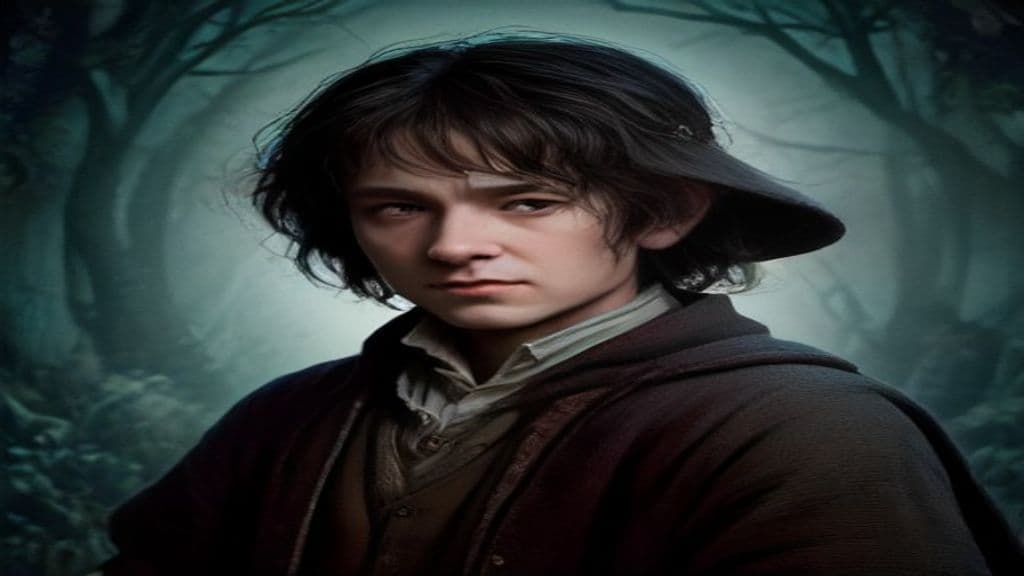
Born in the Third Age year 2890 to Bungo Baggins and Belladonna Took, Bilbo is a hobbit of the Shire who is drawn from comfortable domestic life into a quest when the wizard Gandalf recruits him to serve as 'burglar' for Thorin Oakenshield's company of Dwarves. The quest leads him through the Misty Mountains (where he encounters Gollum and acquires a magic ring), to the Lonely Mountain to confront Smaug the dragon, and back to the Shire; later in life he retires to Rivendell and ultimately sails from the Grey Havens to the West after the events of The Lord of the Rings. Within Tolkien's narrative framing, Bilbo is also the purported author or translator of material collected in the Red Book of Westmarch.
The supplied sources describe Bilbo primarily by age and social aspect rather than detailed physical features: at the start of The Hobbit he is 'a hobbit in comfortable middle age' and by The Lord of the Rings' opening he is very old (eleventy-one at his birthday party) and later 'very old, but peaceful, and sleepy.' The provided excerpts do not supply an extended physical description beyond these life-stage characterizations and his status as a Hobbit of the Shire.
Bilbo is an able and resourceful Hobbit rather than a supernatural being. He functions as the company's burglar on the quest, demonstrating stealth (sneaking into Smaug's lair and stealing a cup), cunning (his riddling contest with Gollum), observation (noticing Smaug's vulnerable gap), literacy and songwriting (credited in the conceit as author/translator of poems and songs in the Red Book). He possesses a magic ring that renders him invisible and — as described in the sources — prolongs his life and delays outward signs of aging while also producing dependence and psychological effects; after relinquishing the ring he shows rapid aging. These effects are described in the narrative sources as properties of the ring's prolonged possession.
Weaknesses
- conditiondependence on the Ring
- conditionmortality/aging (the Ring delays but does not prevent age; relinquishing it causes accelerated aging)
Wards
None recorded.

Celeborn
Celeborn is a fictional Elven lord in J. R. R. Tolkien's Middle-earth legendarium, husband and co-ruler with Galadriel of Lothlórien. He functions as a regional ruler and counselor of the Galadhrim and appears in narratives concerning the Fellowship's stay in Lothlórien.
Elrond
Elrond is a named fictional individual in J. R. R. Tolkien's Middle-earth legendarium: a Peredhil ('Half-elven') who served as master of Rivendell (Imladris), bearer of the Elven ring Vilya, counselor and refuge-giver across the Second and Third Ages, and a figure bridging the great ages of Tolkien's world.
Galadriel
Galadriel is a fictional Elven ruler in J. R. R. Tolkien's legendarium: a royal Elf of both the Noldor and the Teleri, famed as the 'mightiest and fairest of all the Elves that remained in Middle-earth.' She appears across the First, Second, and Third Ages as a leader of her people, keeper of one of the Three Rings (Nenya), and a moral tester confronted with the temptation of the One Ring.
Legolas
Legolas is a Sindar Elf of the Woodland Realm in J. R. R. Tolkien's legendarium: son of King Thranduil, a member of the Fellowship of the Ring, an exceptional archer and scout, and a narrative embodiment of Elvish perception, longevity, and sea-longing.
Tuor and Idril
Tuor Eladar (also Ulmondil) and Idril Celebrindal are legendary mortal figures of Tolkien's First Age: Tuor, a Man chosen and guided by the Vala Ulmo, and Idril, a High‑Elf princess of Gondolin. Their union produces Eärendil and a lineage pivotal to later Ages; together they survive the Fall of Gondolin and sail West in a ship built by Tuor.
Warg
A large, malevolent wolf-like being whose modern fictional form was popularized by J. R. R. Tolkien as an intelligent, war‑capable wolf-race allied with Orcs; the term derives from Old Norse vargr and Old English wearh, words that blur natural wolf, outlawry, and destructive agency.
Bigthan and Teresh
Bigthan and Teresh are named human court officials—described as eunuchs or chamberlains—in the Book of Esther (Esther 2:21–23). They conspired to assassinate King Ahasuerus; Mordecai exposed the plot, the conspirators were apprehended and executed, and the incident becomes a pivotal narrative device in Esther's account and later commentary.
Bihram (Bihram Rabba)
Bihram, often called Bihram Rabba ('Bihram the Great'), is an uthra (celestial being) in Mandaean cosmology who presides over the masbuta (baptism) and is invoked in Mandaean masbuta prayers; he also appears as an agent in mythic narratives such as the Book of John.
Bijan and Manijeh (Persian tradition)
Legendary figures from the Persian epic poem Shahnameh, embodying ideals of love, loyalty, and constancy. (Note: 1. Power tier should be Lowered to Ancient (deity-level) as they are figures from a legendary love story in an epic poem, but their abilities are symbolic ideals rather than cosmic or universe-changin)
Billina
Billina is an anthropomorphic, speaking hen introduced in L. Frank Baum's Ozma of Oz who becomes Dorothy Gale's animal companion in the Land of Oz. Portrayed as spunky, talkative, and domestically ordinary, she plays a decisive narrative role when one of her eggs proves lethal to the Nome King within Baum's story-world.
Billingr
Billingr is a named paternal figure in Old Norse sources, best attested as the father of a maiden whose household prevents Odin from consummating a nocturnal rendezvous (Hávamál stanzas 96–102). Manuscript and kenning evidence leave his taxonomic identity (dwarf or jötunn) ambiguous.
Billy Blind
Billy Blind is a named household spirit from English and Lowland Scottish ballad tradition who appears as an advising helper in Child ballads, providing information, revelation, and stratagems that enable protagonists to resolve enchantment, identity, and childbirth crises. Attestations are narrative (ballads) and later literary/television adaptations draw on his advising role.
Community Record
- [1]Bilbo Baggins (Wikipedia). Wikipedia, 'Bilbo Baggins' article (accessed via provided research notes)wiki
- [2]Bilbo Baggins (Valar Guild entry). Valarguild 'Bilbo Baggins' entry (birthdate and biographical details)other
- [3]Hobbit - The True Story (Archive recording). Archive item 'Hobbit - The True Story' (contextual and promotional material referencing the adventure)other
- [4]The Ballad of Bilbo Baggins (Wikipedia). Wikipedia, 'The Ballad of Bilbo Baggins' (notes on cultural reception and adaptation)wiki
- [5]LOTRO: The Further Adventures of Bilbo Baggins — Contains Moderate Peril (blog). Contains Moderate Peril blog post referenced in research notes (adaptation/representation in games)other