
The label combines Old Norse vargr and Old English wearh — terms historically applied both to wolves and to social/legal categories of outcast or outlaw. In Norse mythic background, prominent wolves such as Fenrir, Sköll, and Hati embody cosmic destructive roles; Tolkien and later fantasy authors drew on these linguistic and mythic associations to conceive 'wargs' as intelligent, malevolent wolves used in war and aligned with hostile humanoids. The synthesis of animal, outlaw, and destructive senses into a semi-intelligent war-beast is a literary development most clearly visible in Tolkien's works.
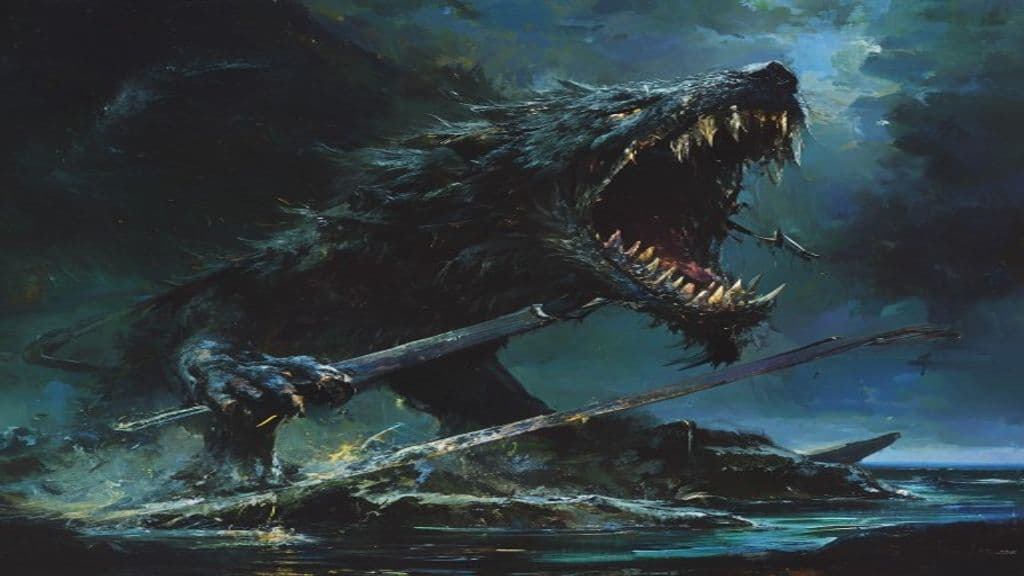
Described in the cited materials as distinctly large wolf-like creatures. In Tolkien's narratives they are larger-than-normal wolves capable of bearing Orcs as riders into battle. No detailed anatomical or coloration schema is given in the supplied sources beyond being 'particularly large' and wolf-like.
In Tolkien's depiction wargs are semi-intelligent or personified animals: they can speak (notably in The Hobbit), plan or take part in coordinated raids, and serve as mounts for Orcs in organized attacks. They are portrayed as malevolent, aggressive toward protagonists, and capable of organized cooperation with hostile humanoids. In gaming adaptations (e.g., Dungeons & Dragons derivatives) related forms (worgs) are given language abilities and speak their own tongue as well as Goblin and Common.
Weaknesses
- otherfire
- otherlanguage/communication
Wards
- otheruse of fire
- otherknowledge of language
Fenrir
The monstrous wolf son of Loki, bound by the gods with a magical ribbon until Ragnarök — when he will break free and swallow Odin, and the world.

Werewolf
A figure of European folklore of a human who can change into a wolf or wolf–human hybrid, variously portrayed as voluntary shapeshifter, cursed afflicted person, or clinical delusion (lycanthropy). Belief in werewolves was entwined with medieval and early modern witchcraft accusations and persisted into Gothic and popular fiction.
Bilbo Baggins
Bilbo Baggins is a fictional Hobbit character in J. R. R. Tolkien's legendarium, protagonist of The Hobbit and a supporting figure in The Lord of the Rings; within Tolkien's conceit he is also presented as the in-world author/translator of parts of the Red Book of Westmarch.
Elrond
Elrond is a named fictional individual in J. R. R. Tolkien's Middle-earth legendarium: a Peredhil ('Half-elven') who served as master of Rivendell (Imladris), bearer of the Elven ring Vilya, counselor and refuge-giver across the Second and Third Ages, and a figure bridging the great ages of Tolkien's world.
Galadriel
Galadriel is a fictional Elven ruler in J. R. R. Tolkien's legendarium: a royal Elf of both the Noldor and the Teleri, famed as the 'mightiest and fairest of all the Elves that remained in Middle-earth.' She appears across the First, Second, and Third Ages as a leader of her people, keeper of one of the Three Rings (Nenya), and a moral tester confronted with the temptation of the One Ring.
Legolas
Legolas is a Sindar Elf of the Woodland Realm in J. R. R. Tolkien's legendarium: son of King Thranduil, a member of the Fellowship of the Ring, an exceptional archer and scout, and a narrative embodiment of Elvish perception, longevity, and sea-longing.
Tuor and Idril
Tuor Eladar (also Ulmondil) and Idril Celebrindal are legendary mortal figures of Tolkien's First Age: Tuor, a Man chosen and guided by the Vala Ulmo, and Idril, a High‑Elf princess of Gondolin. Their union produces Eärendil and a lineage pivotal to later Ages; together they survive the Fall of Gondolin and sail West in a ship built by Tuor.
Wakȟáŋ Tȟáŋka
Lakota term for the Great Sacred or Great Mystery that names the sacred power or quality immanent in all things; sometimes rendered in English as "Great Spirit" but better understood as a pervasive sacredness or, in some historical usages, as a mysterious collective of sacred beings.
Waldgeist (Woodwight / "Wildnisgeist")
A modern analytical label proposed for poltergeist-like phenomena occurring in wooded locations; described in the cited literature as producing physical disturbances (thrown stones, raps, lights, odors, apports) in forested tracts and sometimes overlapping in report-pattern with non-sighting cryptid (Bigfoot) encounters. The term also appears in contemporary culture as a reused compound name but lacks a documented traditional folkloric corpus within the supplied sources.
Wandjina
The Wandjina (also Wanjina, Wondjina; sometimes listed as Gulingi) are ancestral cloud-and-rain spirit-beings of the Wanjina Wunggurr cultural bloc in northwestern Australia. They are depicted prominently in Kimberley rock art, some paintings of which date to approximately 4,000 years ago, and are integrated in a local cosmology that includes the creator-being Wunngurr (analogous to the Rainbow Serpent).
Wanjina Wunggurr (unverified)
Insufficient sourced information available in the provided material to describe Wanjina Wunggurr. The only confirmed fact from the source is that the Worrorra (Worora) are an Aboriginal Australian people of the Kimberley region; no reliable details about Wanjina Wunggurr are present in the supplied source.
Watcher
Watcher is a polyvalent label applied across religious, literary, and technical domains to beings or systems defined primarily by observation, surveillance, or guarding. In the supplied sources it names an apocryphal class of angels (the Grigori), a localized monstrous guardian in Tolkien's fiction (the Watcher in the Water), a race of cosmic observers in Marvel Comics, and various monitoring programs in computing.
Water deity
A water deity is a god or goddess associated with water or specific bodies of water (sea, ocean, great river, spring, or well). The term is a functional, comparative category used by scholars to group diverse culture-specific divine figures whose primary domain is water.
Way (wayob)
Way (plural wayob) is a Yucatec Maya term denoting a human-linked animal-being tied to sleep; it can mean a person who transforms into an animal while asleep (a Mesoamerican nagual) or the animal transformation/companion itself. Wayob appear in Classic Maya iconography (marked by a special hieroglyph) and are recorded in later Yucatec usage and museum interpretation as both harmful nocturnal agents and as ritual companions for rulers on journeys to the Otherworld.
Community Record
- [1]Warg. Wikipedia, 'Warg' article summarizing Old Norse/Old English etymology, Tolkien usage, and later adaptationswiki
- [2]Warg (Wikidata). Wikidata entry for 'warg' (items related to Tolkien's creatures)other
- [3]Warg Rider (artistic depiction). Gallery depiction of orcs riding large wolves (warg riders) used as visual support for Tolkien-derived portrayalsother
- [4]Stack Exchange discussion: origin of Tolkien wargs. Community Q&A addressing origins and appearances of wargs in Tolkien's works (supplementary commentary)other