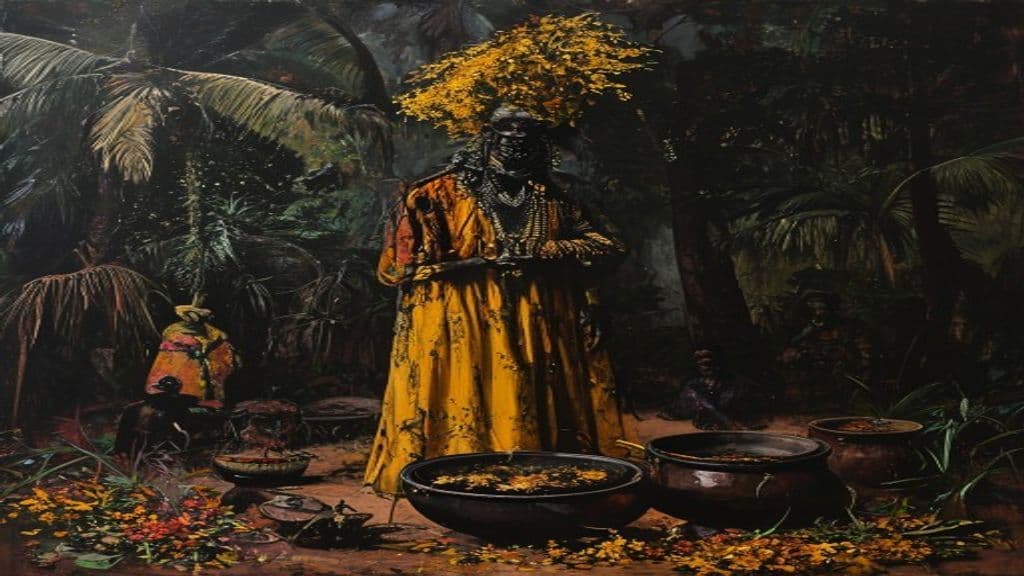
The term birongo (bilongo) derives from Kikongo bilongo, a word for ingredients of magical use; in Venezuela the word expanded to designate a body of folk medicine, ritual knowledge, and magico‑religious practice brought by Central African (notably Kongo) cultural forms and maintained in Afro‑Venezuelan coastal communities. Over time these practices syncretized with Catholic saint veneration (e.g., Malembe/San Juan Congo mapped onto Saint John and other saints) and local ritual institutions (cofradías, mayordomos), producing a lived therapeutic and communal religious system in regions such as Barlovento and the southern coast of Lake Maracaibo.
Birongo is not an anthropomorphic entity; the term refers to ritual practices, materia (herbal mixtures, nganga‑like cauldrons), roles (curanderos, ensalmaderos, mediums), and communal ritual forms (drumming, singing, velaciones). Sources provide no single bodily description because Birongo denotes a tradition and its paraphernalia rather than a personified spirit.
As a ritual system Birongo's operative techniques include diagnosing and treating spiritual and physical afflictions (e.g., mal de ojo) through herbal preparations (baths, teas), tobacco divination, prayer, and soothsaying; invoking ancestors and Catholic saints in syncretic configurations; producing trance and spirit‑possession during drumming rituals (ranging from light trance to full possession, often with screaming, dancing, and tingling sensations); and organizing communal rites (velaciones, week‑long festivals) under cofradía and mayordomo leadership. Material paraphernalia such as nganga‑like vessels, libations (liquor), tobacco smoke, perfumes, offerings, and occasional animal sacrifice are used to encourage spirit engagement and effect therapeutic change.
Weaknesses
- ritualRequirement for ritual preparation (herbal head‑washing and structured ritual leadership)
- ritualNeed for communal controls (drumming, singing, mayordomo organization) to regulate trance and possession
- ritualDiagnostic prerequisites (tobacco divination and mediumship) to correctly identify afflictions before treatment
Wards
- ritualHerbal head‑washing (initiation purification)
- ritualHerbal baths and washes (preventative and healing use)
- ritualTobacco divination (diagnostic/preventative)
- ritualDrumming and singing (used to engage and regulate spirit interaction)
- ritualLibations and tobacco smoke (employed during protection and ritual management)
- ritualOfferings and occasional animal sacrifice (to connect patient with spirits and stabilize interactions)
Binah (בינה)
Binah (Hebrew: בִּינָה Bīnā, "understanding") is the third sephirah on the Kabbalistic Tree of Life, a non-personal divine attribute that receives, contains and structures the undifferentiated creative impulse (Chokmah). It functions as an intellectual/metaphysical principle in Kabbalistic cosmology and psychology rather than as an independent, anthropomorphic spirit.
Binbōgami
A kami of poverty in Japanese folklore said to inhabit people or houses and bring sustained lack, misfortune, and domestic hardship. Treated as a negotiable household spirit, it can be driven off, lured away, temporarily enshrined, or transformed by hospitality according to regional tales and ritual advice.
Bindus
Bindus is an Illyrian theonym attested in Roman-period votive inscriptions from the Iapodes/Dardanian area (1st–3rd centuries CE). Epigraphic and iconographic evidence associates Bindus with springs, streams and maritime motifs and links the deity to the Roman Neptune in local syncretic cult practice.
Binette
Binette is documented in the provided sources as a family name appearing in contemporary Francophone/Canadian contexts (film credits, television broadcast, bibliographic records). The available materials do not treat Binette as a supernatural being or provide folkloric, mythological, or etymological information about the name.
Binot
Binot is attested in the provided sources as a French personal and family name, notably borne by the early 16th-century navigator Binot Paulmier, sieur de Gonneville. The documentation consists of archival, bibliographic, and encyclopedic references; no source in the packet presents Binot as a supernatural or folkloric entity.
Birds of Prey (team)
A fictional ensemble of costumed crimefighters originating in American comic books and adapted into television and film; the team name designates a cooperative superhero/vigilante franchise within the DC Comics media universe rather than a supernatural being.
Biróg
Biróg (also Biroge, Birog of the Mountain) is a female supernatural helper in Irish narrative tradition who aids Mac Cinnfhaelaidh/Cian in gaining access to the imprisoned Ethniu and rescues the surviving infant of that union; later retellings variably portray her as a leanan sídhe (female familiar spirit), a filidh (poet/seer), or a druidess.
Bisan
A female Malay/Jakun nature spirit who presides over camphor-bearing trees. She signals the presence of camphor by cicada-like song, is jealous of those seeking the resource, and must be propitiated or confused to allow harvest.
Biscione
The Biscione is a heraldic charge — a stylized large grass-snake (Italian biscione) depicted with a small human figure in its mouth — used as a dynastic and civic emblem associated chiefly with the Visconti and Sforza of Milan and later municipal and corporate identities. In the provided sources it functions as an emblematic device rather than a narrated supernatural being.
Bisclavret
A named nobleman in Marie de France’s lai who periodically transforms into a wolf for three days each week; the tale treats his condition as a distinct, non‑typical form of shape‑change tied to hidden clothing and resolved through royal investigation and recovery of those garments.
Bishop Karas (Sorial Ayad Sorial)
Bishop Karas (born Sorial Ayad Sorial, 1955–2002) was a Coptic Orthodox monk, abbot, and the first bishop of the Coptic Orthodox Church in the United States to head its first monastery outside Egypt. He is documented as a historical ecclesiastical figure known for monastic leadership, pastoral care, and ascetic practice.
Bishops (mammal)
Bishops is an extinct genus of Early Cretaceous mammal from Australia (type species Bishops whitmorei), named in honour of Dr Barry Bishop. Within the supplied corpus there is no documentation of a supernatural or folkloric entity called 'Bishops'; references to "Bishop" otherwise refer to people or ecclesiastical offices.
Community Record
- [1]Birongo (Wikipedia). Wikipedia: 'The term "birongo" comes from the Kikongo word "bilongo"...' and sections on practices, mediumship, and regional distribution.wiki
- [2]Wikidata entry: Birongo (Q18643884). Wikidata record referenced in source notes (place name homonym noted but not used as primary religious source).other