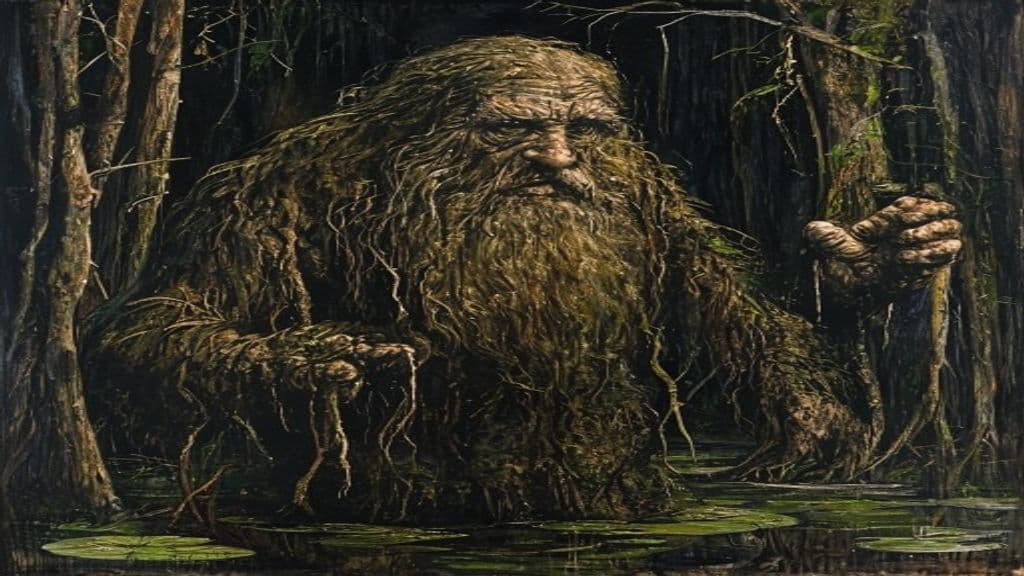
Bolotnik originates in folk conceptions of swamps as liminal, dangerous zones inhabited by spirits and 'demons'. In later, Christianized layers of the tradition, bolotniks were often grouped with other evil beings and explained as fallen angels thrown from heaven or creations of Satan; the sources present this as a post‑conversion explanatory layer rather than a single unified origin narrative.
Accounts vary by region. Common descriptions portray a swamp‑dweller often appearing as a man or old man bearing features associated with marsh life (for example, greenish beard and long hair, and a body covered in dirt and algae). Regional variants include a dirty, fat, eyeless creature said to sit motionless at the swamp bottom (Vitebsk Governorate), and the Polish błotnik depicted as a pitch‑black man carrying a lantern. Female counterparts (bolotnitsa/bolotnaya baba) are sometimes described separately and may overlap with rusalka or swamp‑hag imagery.
Folkloric behaviors ascribed to the bolotnik focus on luring and drowning: it entices people and animals toward swamp edges and grabs victims by the feet to drag them into the depths. It is said to mimic animal and bird sounds (quacking, mooing, gurgling, screaming), to grow stupefying herbs near the swamp (ledum is given as an example), and to produce pale lights on the water's surface. Regional accounts also ascribe to swamp spirits the power to curse building logs carried through swamps so houses built from them bring misfortune. Bolotniks are described as perishing if their swamps are drained and when swamps freeze over in winter. Local belief holds that bolotniks are not afraid of thunderbolts because thunderbolt power is lost upon contact with the swamp surface.
Weaknesses
- conditiondraining or drying of the swamp (folkloric belief that bolotnik perishes when its swamp is drained)
- conditionfreezing of the swamp in winter (folkloric belief that bolotniks perish when swamps freeze over)
Wards
- conditiondrain the swamp (landscape alteration cited in sources as causing bolotniks to perish)
- otheravoid approaching swamp edges and avoid nighttime behaviors that attract attention (e.g., playing a shepherd's pipe at night) — noted as preventive behavior rather than formal ritual
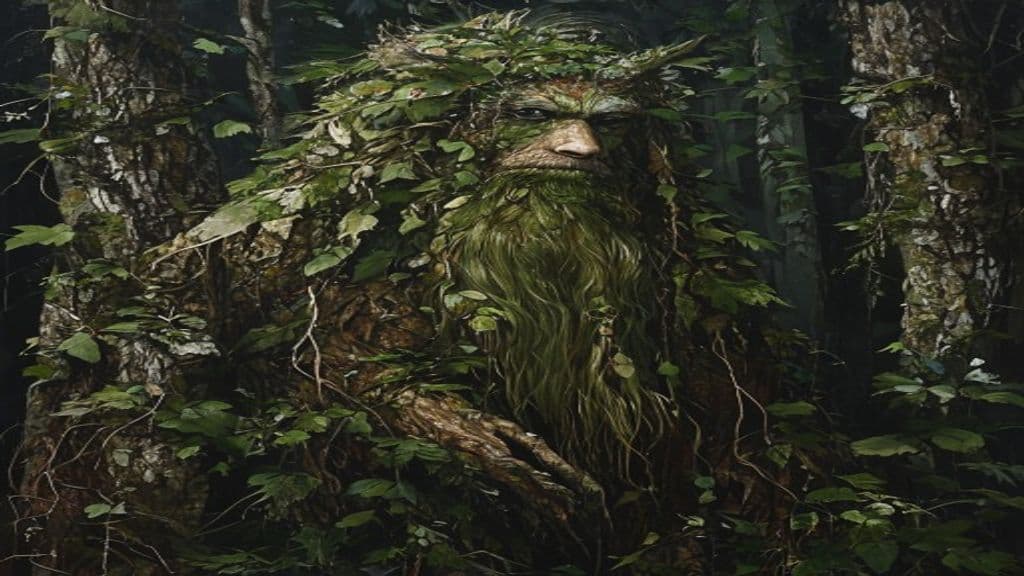
Leshy
A tutelary forest being in Slavic folklore; an embodied, territorial power of the woods that can protect, mislead, or punish humans depending on their behaviour toward the forest. Highly variable in form and described across many regional variants and names.

Chort
A chort is an anthropomorphic malign spirit figure in Slavic folk tradition that occupies a liminal space between older Slavic demonology and Christian notions of the devil. Depending on region and narrative function it appears as numerous lesser malignant spirits, a trickster antagonist who tempts or is tricked by humans, or as a cover-term for 'unclean forces' credited with various negative creations in the world.
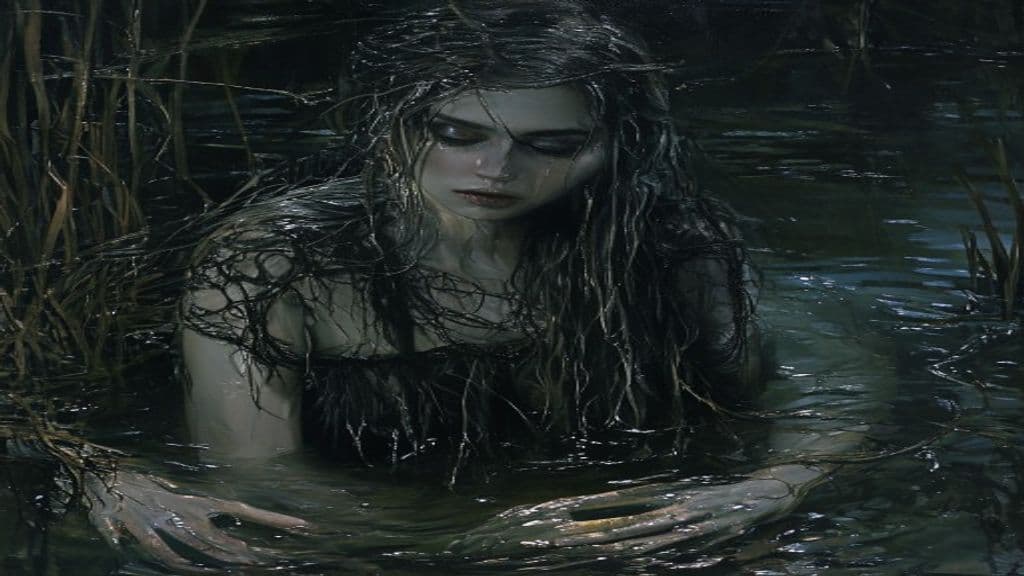
Rusalka
Water spirits in Slavic folklore — the spirits of young women who died by drowning or suicide, bound to rivers and lakes. Beautiful and dangerous, they can bewitch men to their deaths.
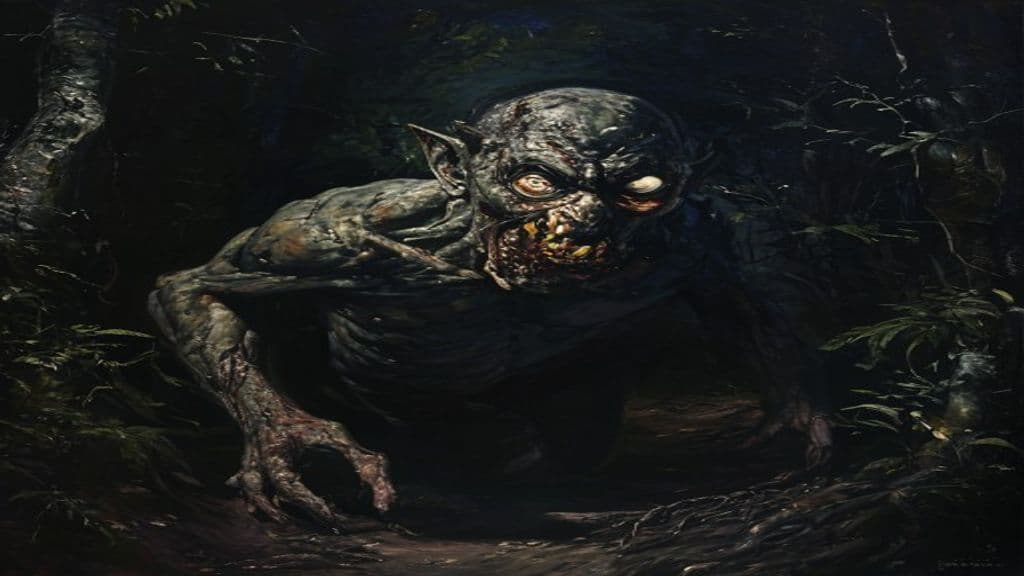
Pishacha
Flesh-eating spirits of Hindu mythology that haunt cremation grounds and are associated with disease, madness, and possession. The lowest class of demon in the Vedic hierarchy.
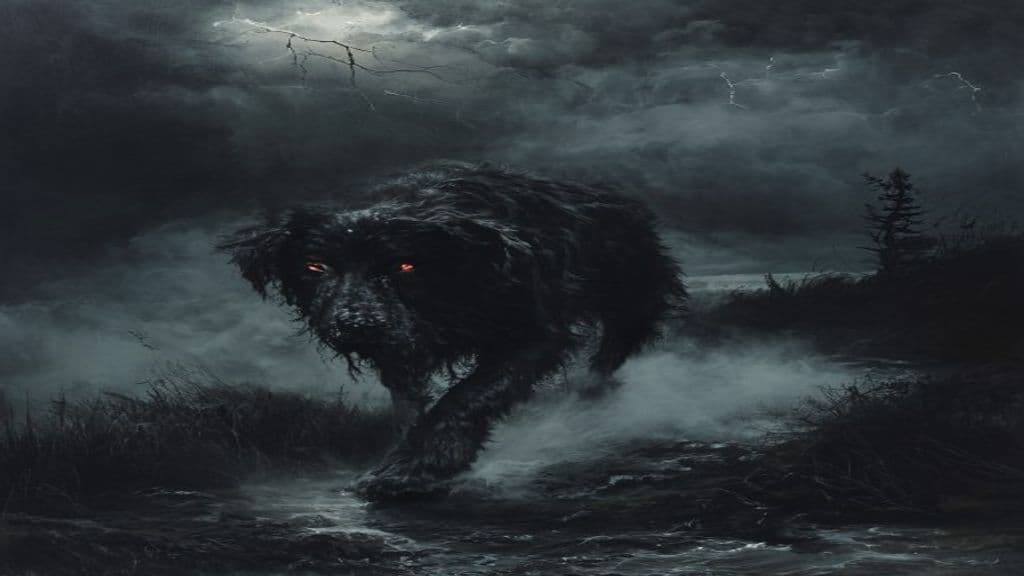
Black Shuck
A spectral black dog of East Anglian legend, with glowing red or green eyes. Its appearance is an omen of death. Its howl has been heard on clifftops during storms for centuries.
Blud
Blud is a Slavic concept that functions both as a supernatural agent said to cause physical disorientation—leading people to wander "aimlessly around and round"—and as a lexical term in church discourse denoting illicit sexual desire or moral deviation, which clerics attributed to the Devil.
Likhoradka
A female spirit in Slavic (particularly Russian) popular belief who personifies fever and sickness. Traditionally portrayed as an agentive being that can possess people or bring disease by touch or kiss; the term likhoradka later lexicalized in modern Russian to mean 'fever'.
Nocnitsa
A Slavic night spirit or 'night hag' that torments sleepers—especially children—by visiting at night, producing nightmares or sensations of pressure on the chest, and in some accounts drawing life energy from victims.
Saint Nedelya
In Slavic folk‑Orthodox belief, Saint Nedelya is the personification of Sunday/the Week as a female sacred presence who embodies the day's sanctity and enforces prohibitions against working on Sunday. The figure appears in ethnographic and folkloric sources across several Slavic regions and is syncretically related to named saints such as Anastasia/Kyriakia and to apocryphal texts that sacralize the day.
Bolas
Bolas are a physical throwing weapon consisting of weights connected by cords, used historically and traditionally to entangle the legs of animals (and occasionally humans) at a distance. They appear in multiple regional traditions—notably in southern South America among Tehuelche and gauchos, in Mapuche and Inca military contexts, and in Inuit bird-hunting practice—under a variety of local names and constructions.
Bolbe
In Ancient Greek mythology Bolbe (Βόλβη) is a localized lake goddess or nymph identified with the Macedonian lake of the same name (modern Lake Volvi). She is described as beautiful and is attested as mother of freshwater nymphs (Limnades) and, in one source, as mother of Olynthus by Heracles.
Bolg
The supplied sources do not document Bolg as a traditional supernatural being. Available references identify 'Bolg' primarily as a proper name in modern popular culture (a Middle-earth character in J. R. R. Tolkien's fiction) and as an ordinary lexical item in other contexts (e.g., Irish 'bolg' meaning 'belly'). No ethnographic or folkloric description of a supernatural entity named Bolg is present in the provided materials.
Bolivar Trask
Bolivar Trask is a fictional human character from Marvel Comics and adaptations. A scientist, anthropologist, and industrialist, he initiates large-scale technological programs (most famously the Sentinels) intended to detect and control mutants; his projects and decisions catalyze major human–mutant conflicts across multiple continuities.
Bolti
Bolti (attested variant boulti) is a commercial/vernacular name applied to the Nile tilapia (a cichlid fish). In the available sources it is attested as a name for a food/aquaculture species, not as a supernatural being.
Bon-Puri
A type of narrative or story recited during shamanic rituals on Jeju Island in Korea, used for spiritual and healing purposes. (Note: - Remove "Minor Spirit" power tier designation as it is not supported by the source material; Bon-Puri's nature and abilities don't align with the described power tiers. - Add a description of the app)
Bona Dea
Bona Dea (Latin: "Good Goddess") is an honorific Roman goddess and protective cult figure primarily associated with married women, fertility, healing, and the welfare of the Roman people. Her cult employed a respectful pseudonym, female-exclusive rites, and a polyvalent identity that was variously conflated with other earth/fertility and prophetic goddesses in Roman literary tradition.
Bonadona i Altemir
Bonadona i Altemir are a pair of processional giants (gegants) associated with the town of Premià de Dalt in Catalonia. They function as civic effigies carried in public processions and local festivals, part of the municipality's intangible cultural traditions.
Community Record
- [1]Bolotnik — Wikipedia. Wikipedia contributors. "Bolotnik." Wikipedia, The Free Encyclopedia. https://en.wikipedia.org/wiki/Bolotnikwiki
- [2]Wikidata entry: bolotnik. Wikidata. "bolotnik (Q4090908)." http://www.wikidata.org/entity/Q4090908wiki