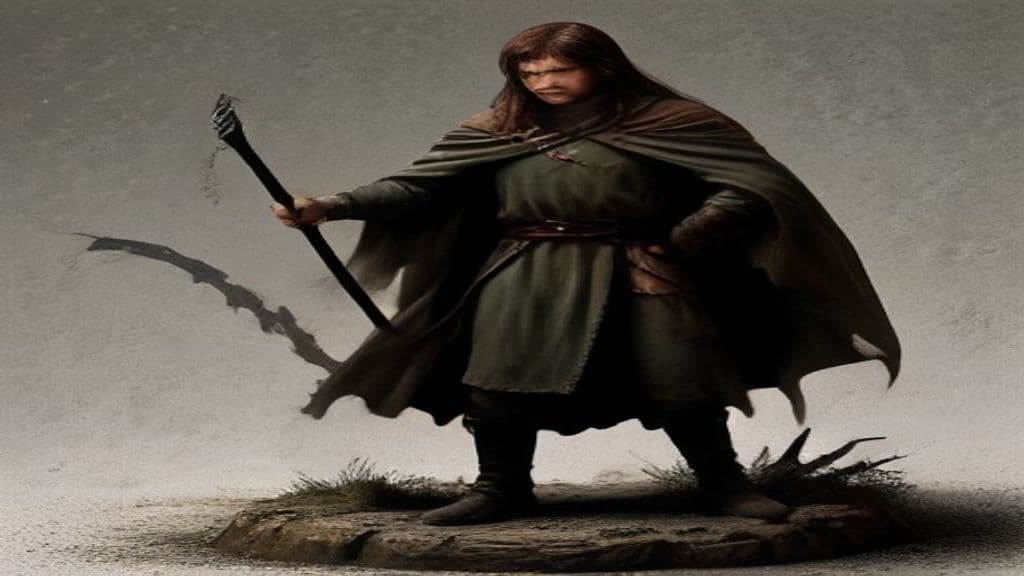
Boromir is the elder son of Denethor II, Steward of Gondor, and Finduilas, and the elder brother of Faramir; he is raised as a favored scion and military leader of Gondor and is heir apparent to his father's stewardship. Within the narrative of The Lord of the Rings he is selected to represent Gondor at the Council of Elrond and becomes a member of the Fellowship of the Ring (sources identify Denethor II and his familial relations and Boromir's role as heir and commander).
Sources describe Boromir as a man of great stamina, physical strength, and a forceful, commanding presence; he is widely admired as a commander in Gondor's army and is the favourite of his father. Specific details such as precise height, hair colour, or dress are not provided in the supplied summaries beyond his depiction as a strong Gondorian noble (he also appears in later adaptations such as animated and live-action films, radio, and game versions, which are adaptations of the primary narrative).
Boromir's capacities are martial and leadership-based: he is a skilled and respected military commander with endurance and strength, and he exhibits command presence and persuasive force. Psychologically he is patriotic, proud, and susceptible to the Ring's temptation; he argues for using the One Ring to defend Gondor, attempts to seize it from Frodo, immediately repents that betrayal, and redeems himself by fighting to protect Merry and Pippin, in which he is mortally wounded by orc-arrows.
Weaknesses
- conditionsusceptibility to the Ring's temptation
- conditionpride and patriotic desperation
Wards
- othernone (no known magical wards applicable; interpersonal vigilance and command measures described in narrative)

Celeborn
Celeborn is a fictional Elven lord in J. R. R. Tolkien's Middle-earth legendarium, husband and co-ruler with Galadriel of Lothlórien. He functions as a regional ruler and counselor of the Galadhrim and appears in narratives concerning the Fellowship's stay in Lothlórien.
Finwë and Míriel
Principal Elven figures in J. R. R. Tolkien's legendarium: Finwë, first King of the Noldor, and his first wife Míriel, famed for creative craft. Their personal choices — Míriel's voluntary relinquishment of embodied life and Finwë's remarriage and later murder — provoke adjudication by the Valar and have far-reaching legal and historical consequences in the history of the Eldar.
Gandalf
Gandalf is a central protagonist in J. R. R. Tolkien's legendarium (The Hobbit; The Lord of the Rings). Within that fictional cosmology he is one of the Istari — incarnated Maiar spirits — sent to Middle-earth to oppose Sauron; he functions primarily as a guiding counselor who also acts directly in exceptional combat or magical need and bears the Elven Ring Narya.
Boreads
The Boreads (Greek Βορεάδαι, Boreádai) are the two wind-born brothers Zetes and Calaïs in Greek myth, sons of Boreas; famed as swift, winged Argonauts who rescued the blind seer Phineus from the Harpies and whose fate is told in variant traditions.
Boreas
Boreas is the ancient Greek personification and god of the cold north wind, storms, and winter; a member of the Anemoi who is both a meteorological force and an independent divine agent active in myth and civic cult (notably Athens). He is associated with Thrace as his homeland and with the mythical Hyperborea beyond the north wind.
Borimir
Borimir is a South Slavic masculine given name formed from Slavic elements meaning 'battle' (boj/bor-) and 'peace/world' (mir). The name appears in contemporary use in South Slavic regions and in online cultural contexts; there is no evidence in the provided sources that Borimir denotes any supernatural being.
Borjgali
Symbol in Georgian tradition representing the sun and eternity, with no supernatural connotations. (Note: 1. Power tier: Lower the power tier to Lesser, as there's no indication of cosmic or deity-level abilities. 2. Abilities: Remove "supernatural" from the description, but keep in mind that the entity h)
Boroboroton
A tsukumogami yōkai that is an animate, tattered futon which comes to life at night. Traditional accounts describe it as rising, throwing its former owner from bed, and attempting to twine around the sleeper's head and neck in revenge for neglect; alternative accounts depict it joining other tsukumogami in noisy gatherings.
Borr
Borr (Old Norse Borr, Börr, Burr; anglicized Bor/Bör/Bur) is a scarcely attested figure in Old Norse theogony: the son of Búri, husband of Bestla, and father of Odin, Vili, and Vé. He appears by name in verse 4 of the Völuspá and in chapter 6 of Gylfaginning but is otherwise functionally an ancestral name with no preserved deeds or attributes in the supplied sources.
Bors
Bors is the name of two related knights in medieval Arthurian literature (father and son), introduced in the 13th‑century Lancelot‑Grail prose cycle and preserved in later retellings such as Malory's Le Morte d'Arthur. The younger Bors de Ganis is notable as one of the three questing knights (with Galahad and Perceval) who achieve the vision of the Holy Grail and as a model of Christian chivalric virtue; the name also appears in modern datasets as a toponym for a commune in Charente, France.
Boruta
Boruta (called "Devil Boruta" in the cited source) is a folkloric character from Polish mythology, folklore, and literature associated with the town of Łęczyca. The available source frames Boruta as a local legendary figure but provides no extended ethnographic detail.
Borysthenes
Borysthenes is the ancient Greek name for the Dnieper River and its personified river-god in classical accounts. In Greek literary and antiquarian sources the name denotes both the physically fertile river near Pontic Olbia and a local river-divinity invoked in genealogies and place‑names.
Community Record
- [1]Boromir - Wikipedia. Wikipedia contributors, 'Boromir,' Wikipedia, https://en.wikipedia.org/wiki/Boromirwiki
- [2]Boromir - Wikidata. Wikidata entry Q219504, http://www.wikidata.org/entity/Q219504wiki
- [3]Lord of the Rings: The Fellowship of the Ring (narrative summaries and analyses). Film/narrative synopsis and commentary (adaptation and analysis), https://www.tk421.net/lotr/film/fotr/31.htmlliterary
- [4]Boromir descriptive reception and adaptations (archive examples). Archive record noting adaptations and reception materials, https://archive.org/details/wvngqdxtbr5ckkhvzr86x59hzxv5mmefsub75gy5other
- [5]Boromir personality statistics (fan-source reception). OpenPsychometrics character stats entry for Boromir, https://openpsychometrics.org/tests/characters/stats/LOTR/3/other