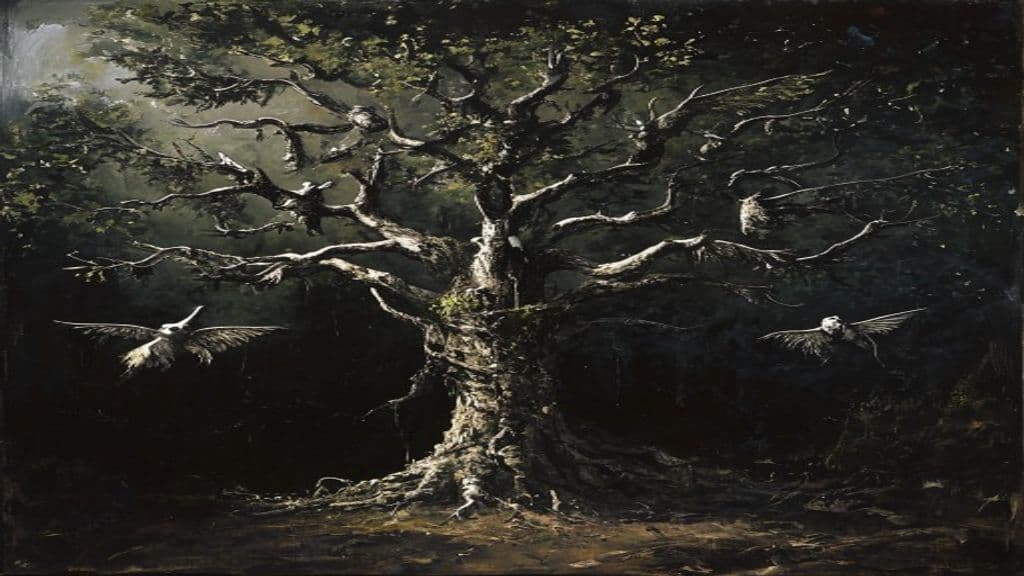
The Borjgali is typically represented with seven rotating wings over a tree of life, which can be used to create various shapes and variations.
No supernatural abilities are associated with the Borjgali; it represents profound concepts through its creation of multiple shapes and variations.
Dali (Goddess)
Patron deity of hoofed wild mountain animals in Georgian mythology, associated with hunting and the natural world. (Note: 1. Power tier should be Greater, not Ancient, given that Dali's abilities are deity-level but not cosmic. 2. Origin story could benefit from a more direct quote or clearer summary of how she is introd)
Georgian Mythology (Overview)
A general overview of Georgian mythology, its history, and cultural context. No specific supernatural entity is mentioned. (Note: - Remove the entire article as it does not refer to a specific supernatural entity - Power tier should be "Primordial" or left blank since there is no specific entity mentioned)
Bora people
The Bora are an indigenous Amazonian people living in the upper Amazon basin (Peru, Colombia, Brazil). They speak the Bora language, maintain an animist worldview in which spirit presences permeate the environment, and have a deep ethnoecological knowledge of rainforest plants. Historical disruptions (notably the rubber boom) and contemporary pressures such as illegal logging have strongly affected their population and settlements.
Bordoisila
The storm deity of spring in Assamese tradition — Bordoisila is the daughter of Brahma who visits her mother's home at the end of winter, and whose journey back creates the violent pre-monsoon storms of April and May. She is a goddess-spirit propitiated in Assam for thousands of years.
Boreads
The Boreads (Greek Βορεάδαι, Boreádai) are the two wind-born brothers Zetes and Calaïs in Greek myth, sons of Boreas; famed as swift, winged Argonauts who rescued the blind seer Phineus from the Harpies and whose fate is told in variant traditions.
Boreas
Boreas is the ancient Greek personification and god of the cold north wind, storms, and winter; a member of the Anemoi who is both a meteorological force and an independent divine agent active in myth and civic cult (notably Athens). He is associated with Thrace as his homeland and with the mythical Hyperborea beyond the north wind.
Borimir
Borimir is a South Slavic masculine given name formed from Slavic elements meaning 'battle' (boj/bor-) and 'peace/world' (mir). The name appears in contemporary use in South Slavic regions and in online cultural contexts; there is no evidence in the provided sources that Borimir denotes any supernatural being.
Boroboroton
A tsukumogami yōkai that is an animate, tattered futon which comes to life at night. Traditional accounts describe it as rising, throwing its former owner from bed, and attempting to twine around the sleeper's head and neck in revenge for neglect; alternative accounts depict it joining other tsukumogami in noisy gatherings.
Boromir
Boromir is a mortal nobleman and warrior of Gondor in J. R. R. Tolkien's legendarium. He serves as heir-apparent to the Steward of Gondor, joins the Fellowship of the Ring, succumbs briefly to temptation over the One Ring, repents, and dies heroically defending his companions.
Borr
Borr (Old Norse Borr, Börr, Burr; anglicized Bor/Bör/Bur) is a scarcely attested figure in Old Norse theogony: the son of Búri, husband of Bestla, and father of Odin, Vili, and Vé. He appears by name in verse 4 of the Völuspá and in chapter 6 of Gylfaginning but is otherwise functionally an ancestral name with no preserved deeds or attributes in the supplied sources.
Bors
Bors is the name of two related knights in medieval Arthurian literature (father and son), introduced in the 13th‑century Lancelot‑Grail prose cycle and preserved in later retellings such as Malory's Le Morte d'Arthur. The younger Bors de Ganis is notable as one of the three questing knights (with Galahad and Perceval) who achieve the vision of the Holy Grail and as a model of Christian chivalric virtue; the name also appears in modern datasets as a toponym for a commune in Charente, France.
Boruta
Boruta (called "Devil Boruta" in the cited source) is a folkloric character from Polish mythology, folklore, and literature associated with the town of Łęczyca. The available source frames Boruta as a local legendary figure but provides no extended ethnographic detail.
Community Record
- [1]