
In the surviving Norse corpus Borr is presented genealogically: he is the son of the ancestor Búri, husband of the jötunn Bestla, and father of the three brothers Odin, Vili, and Vé. The primary attestations named in the supplied material place Borr in the theogonic past (creation/mythic time) and list him as progenitor of the gods who later slay the primeval being Ymir and shape the world; the sources do not describe Borr's own birth beyond his parentage, nor do they relate actions by Borr himself. Later scholars (e.g., Grimm, Finnur Magnússon) have proposed symbolic identifications (comparisons to Mannus or readings as a mountain/earth figure), but these are interpretive and not documented in the primary attestations referenced here. Rudolf Simek is quoted noting the unclear nature of Borr's origins in the record.
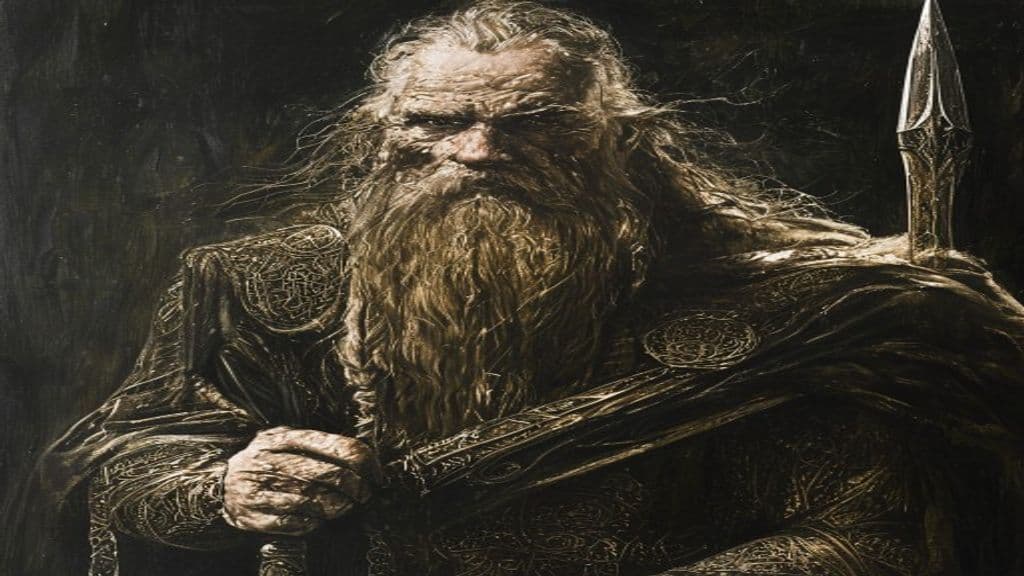
No physical description of Borr is preserved in the supplied texts. The Völuspá and Gylfaginning mention his name in genealogical context but provide no depiction of his form, clothing, age, or other traits. Any modern artistic portrayals or reconstructions fall outside the primary material summarized in the provided sources.
The supplied sources attribute no active deeds, powers, or behaviors to Borr. His recorded role is genealogical: he fathers Odin, Vili, and Vé, who are credited in other passages with killing Ymir and creating the world. Odin is occasionally called 'Borr's son' in skaldic and eddaic usage referenced by secondary summaries, but the texts do not report Borr exercising authority, magical faculties, or interactions beyond his place in descent. Scholarly suggestions that he may symbolically represent natural features or concepts are interpretive rather than direct attestations.
Weaknesses
- othernone attested in primary sources
Wards
- othernone attested in primary sources

Bestla
Bestla is a jötunn (giantess) in Old Norse mythic genealogies, attested as the mother of Odin, Vili, and Vé by the giant Borr. She functions primarily as a maternal progenitor in the medieval Icelandic corpus (Poetic Edda, Prose Edda, and skaldic verse), and surviving references to her are sparse and fragmentary.
Odin
Odin (Old Norse: Óðinn) is the chief god of the Norse (Æsir) pantheon, a multifaceted deity associated with wisdom obtained by sacrifice, poetic inspiration, death and warfare, and rulership over the hall Valhöll where chosen slain warriors (einherjar) dwell. He appears throughout Germanic tradition from Roman-era accounts through the Viking Age and in later folklore as leader of the Wild Hunt.
Eggþér
A jötunn figure in the Old Norse poem Völuspá who sits upon a mound striking a harp and is portrayed as joyful at the onset of Ragnarök; presented as the herder associated with a female jötunn of Járnviðr who raises wolves descended from Fenrir.
Elf
An elf is a humanoid supernatural being from Germanic folklore, especially prominent in North Germanic (Norse/Icelandic) myth and in later early-modern Scottish and Scandinavian belief. Elves are typically depicted as magically powerful and unusually beautiful, ambivalent toward humans and capable of helping or harming them.
Glasir
Glasir is a named tree or grove in Old Norse mythic geography that stands before the doors of Valhalla in Asgard; its foliage is described as red gold and it functions in skaldic and Eddic poetry as a kenning for gold.
Boreas
Boreas is the ancient Greek personification and god of the cold north wind, storms, and winter; a member of the Anemoi who is both a meteorological force and an independent divine agent active in myth and civic cult (notably Athens). He is associated with Thrace as his homeland and with the mythical Hyperborea beyond the north wind.
Borimir
Borimir is a South Slavic masculine given name formed from Slavic elements meaning 'battle' (boj/bor-) and 'peace/world' (mir). The name appears in contemporary use in South Slavic regions and in online cultural contexts; there is no evidence in the provided sources that Borimir denotes any supernatural being.
Borjgali
Symbol in Georgian tradition representing the sun and eternity, with no supernatural connotations. (Note: 1. Power tier: Lower the power tier to Lesser, as there's no indication of cosmic or deity-level abilities. 2. Abilities: Remove "supernatural" from the description, but keep in mind that the entity h)
Boroboroton
A tsukumogami yōkai that is an animate, tattered futon which comes to life at night. Traditional accounts describe it as rising, throwing its former owner from bed, and attempting to twine around the sleeper's head and neck in revenge for neglect; alternative accounts depict it joining other tsukumogami in noisy gatherings.
Boromir
Boromir is a mortal nobleman and warrior of Gondor in J. R. R. Tolkien's legendarium. He serves as heir-apparent to the Steward of Gondor, joins the Fellowship of the Ring, succumbs briefly to temptation over the One Ring, repents, and dies heroically defending his companions.
Bors
Bors is the name of two related knights in medieval Arthurian literature (father and son), introduced in the 13th‑century Lancelot‑Grail prose cycle and preserved in later retellings such as Malory's Le Morte d'Arthur. The younger Bors de Ganis is notable as one of the three questing knights (with Galahad and Perceval) who achieve the vision of the Holy Grail and as a model of Christian chivalric virtue; the name also appears in modern datasets as a toponym for a commune in Charente, France.
Boruta
Boruta (called "Devil Boruta" in the cited source) is a folkloric character from Polish mythology, folklore, and literature associated with the town of Łęczyca. The available source frames Boruta as a local legendary figure but provides no extended ethnographic detail.
Borysthenes
Borysthenes is the ancient Greek name for the Dnieper River and its personified river-god in classical accounts. In Greek literary and antiquarian sources the name denotes both the physically fertile river near Pontic Olbia and a local river-divinity invoked in genealogies and place‑names.
Borysthenis
Borysthenis (Ancient Greek Βορυσθενίς) is a theonym recorded in Greek discourse with two distinct usages: (1) as the name of one of a localized triad of Muses described as daughters of Apollo (sisters Apollonis and Cephisso), and (2) as an epithet applied to the Scythian earth-and-water goddess Api, indicating her status as 'daughter of the god of the Borysthenēs (Dnipro) river.'
Community Record
- [1]Borr. Wikipedia: Borr (accessed via supplied research notes)wiki
- [2]The Sons of Borr (image caption). MyNDIR image caption summarizing the killing of Ymir by the sons of Borr (Odin, Vili, Vé)literary