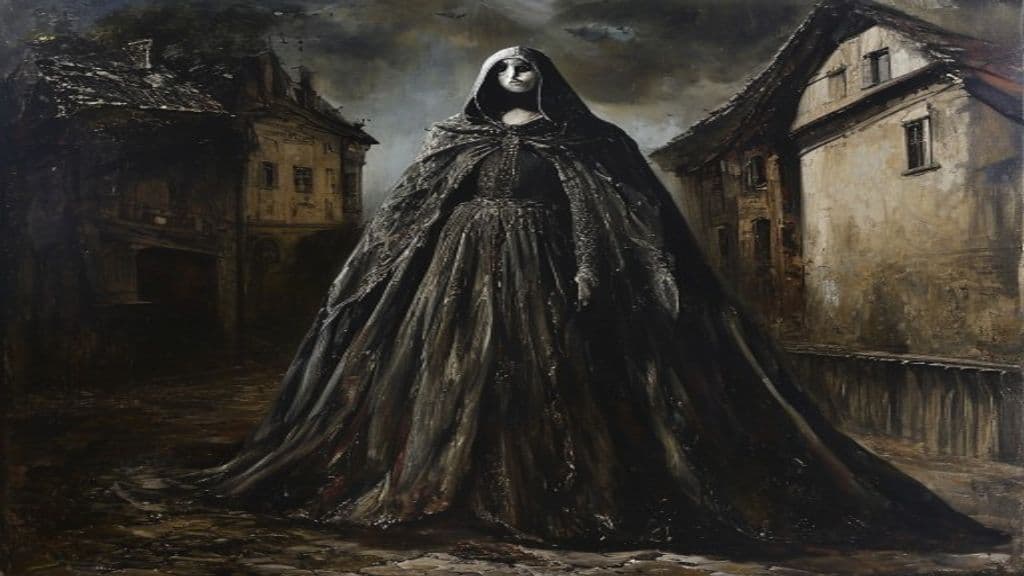
The provided source identifies Boruta as a fictional character from Polish mythology, folklore, and literature associated with the town of Łęczyca. The consulted material does not supply a creation or origin narrative, genealogical placement, or cosmological account for Boruta; it only records his existence in regional folkloric and literary contexts.
The available source does not give any physical description, dress, or characteristic features for Boruta. No reliable visual or descriptive data are recorded in the cited material.
The cited material refers to the figure as "Devil Boruta" but does not document specific powers, behaviors, or typical interactions with humans. The source provides no accounts of abilities, tactics, or deeds attributable to Boruta.
Lakanica
A traditional Polish folkloric field or meadow spirit described as a shy, elusive creature that can appear in human female form. It is presented in sources as part of the broader family of Western Slavic nature spirits related to ovily/rusalki but lacks detailed folkloric accounts in the supplied material.
Leshy
A tutelary forest being in Slavic folklore; an embodied, territorial power of the woods that can protect, mislead, or punish humans depending on their behaviour toward the forest. Highly variable in form and described across many regional variants and names.
Raróg
A Slavic fire-associated avian supernatural being variously described in Czech, Polish, Ukrainian, and Russian summary sources as a fiery falcon or dragon and, in some Polish accounts, as a tiny pocketable bird that brings happiness. It is connected to domestic fire and treated in popular reference as part of the broader fire-bird motif in Eurasian myth.
Rübezahl
Rübezahl is a folkloric mountain spirit of the Giant Mountains (Riesengebirge/Krkonoše/Karkonosze). He appears in German, Czech and Polish traditions as a capricious mountain lord, weather-controller, treasure-guardian and tester of human behaviour, alternately depicted as giant, gnome, woodwose or disguised wanderer.
Boroboroton
A tsukumogami yōkai that is an animate, tattered futon which comes to life at night. Traditional accounts describe it as rising, throwing its former owner from bed, and attempting to twine around the sleeper's head and neck in revenge for neglect; alternative accounts depict it joining other tsukumogami in noisy gatherings.
Boromir
Boromir is a mortal nobleman and warrior of Gondor in J. R. R. Tolkien's legendarium. He serves as heir-apparent to the Steward of Gondor, joins the Fellowship of the Ring, succumbs briefly to temptation over the One Ring, repents, and dies heroically defending his companions.
Borr
Borr (Old Norse Borr, Börr, Burr; anglicized Bor/Bör/Bur) is a scarcely attested figure in Old Norse theogony: the son of Búri, husband of Bestla, and father of Odin, Vili, and Vé. He appears by name in verse 4 of the Völuspá and in chapter 6 of Gylfaginning but is otherwise functionally an ancestral name with no preserved deeds or attributes in the supplied sources.
Bors
Bors is the name of two related knights in medieval Arthurian literature (father and son), introduced in the 13th‑century Lancelot‑Grail prose cycle and preserved in later retellings such as Malory's Le Morte d'Arthur. The younger Bors de Ganis is notable as one of the three questing knights (with Galahad and Perceval) who achieve the vision of the Holy Grail and as a model of Christian chivalric virtue; the name also appears in modern datasets as a toponym for a commune in Charente, France.
Borysthenes
Borysthenes is the ancient Greek name for the Dnieper River and its personified river-god in classical accounts. In Greek literary and antiquarian sources the name denotes both the physically fertile river near Pontic Olbia and a local river-divinity invoked in genealogies and place‑names.
Borysthenis
Borysthenis (Ancient Greek Βορυσθενίς) is a theonym recorded in Greek discourse with two distinct usages: (1) as the name of one of a localized triad of Muses described as daughters of Apollo (sisters Apollonis and Cephisso), and (2) as an epithet applied to the Scythian earth-and-water goddess Api, indicating her status as 'daughter of the god of the Borysthenēs (Dnipro) river.'
Borzu Nama
A legendary hero from the Shahnameh epic cycle, embodying strength and courage. (Note: * Power tier should be Primordial (as it's a legendary hero from an epic cycle with no clear supernatural abilities). * Summary is accurate. * Appearance: No information available in source material, )
Bosom of Abraham
In Jewish tradition, the Bosom of Abraham is a concept representing a state or location within Sheol where righteous individuals await redemption after death. (Note: * Power tier should be Primordial (as it's a concept within Sheol, which is often described as a cosmic realm) * Origin story needs more context from source material; association with Abraham's righte)
Community Record
- [1]Devil Boruta. Wikipedia contributors. "Devil Boruta." Wikipedia, The Free Encyclopedia. https://en.wikipedia.org/wiki/Devil_Borutawiki