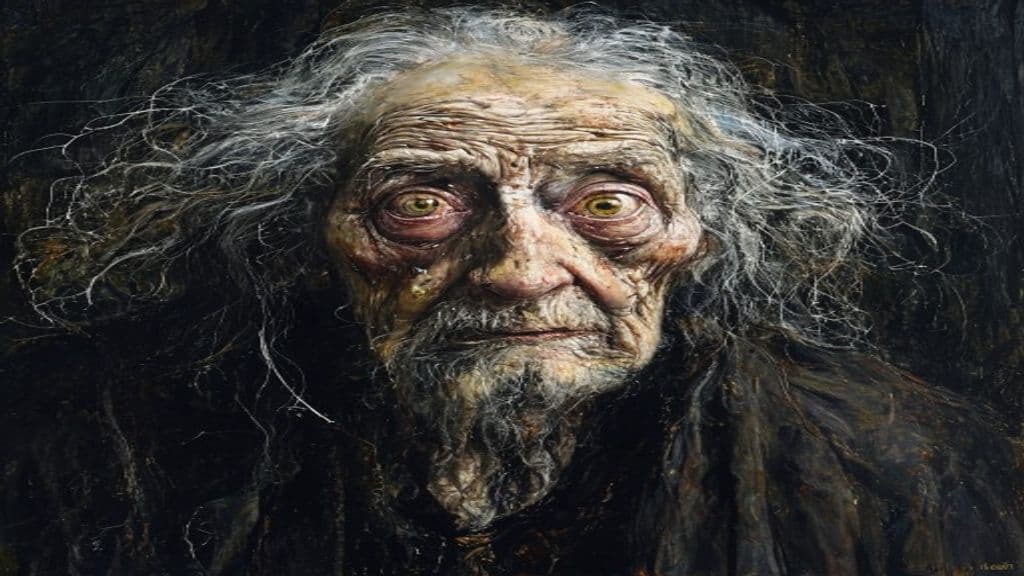
The Buschgroßmutter appears in regional folktales as an ancient woman-of-the-woods figure tied to moss and underwood traditions. Nineteenth-century mythologists such as Jacob Grimm, Wilhelm Mannhardt and Ludwig Bechstein sometimes treated her as a leader or queen of the moss-people and compared her with figures like Hulda or Bertha; early twentieth-century scholarship revised this interpretation, recasting her in many accounts as a more primitive forest spirit or demon. These scholarly debates reflect attempts to situate the Buschgroßmutter in comparative mythology, but the folkloric tradition itself presents her primarily as an old forest matriarch who enforces and encodes local forest norms.
Folktales describe her as extremely old—"as old as the hills"—and small, stooped or ducked, wrinkled and ugly. Common motifs include dishevelled white hair (often described as shaggy or full of lice), large or staring eyes (Transylvanian variants are said to have "large fiery eyes"), and sometimes an "iron head." She is often shown with peasant implements: a gnarled stick or crutch, an apron or a basket on her back, and at times travels in a small cart or waggon. Feet may be described as overgrown with moss and her gait wavering; Transylvanian tales additionally report very large teeth and accounts that her head can be "as cold as ice."
The Buschgroßmutter's behaviour is ambivalent in the record: she may reward respectful helpers and punish mockery or transgression. Rewarded actions include allowing people to comb or remove lice from her hair, after which helpers may receive folkloric gifts (attested variants include a never-ending clew of yarn, a spindle covered with many strands, or leaves that will turn to gold if kept). If mocked, sneered at, or otherwise offended she is said to take revenge by "breathing on" offenders (causing illnesses such as a rash), by perching oppressively on people, by driving off or frightening woodcutters, by stealing milk or spoiling berry-pickers' harvests, or by hitting sleeping herdsmen with a crutch. She is also used to explain natural phenomena—spring and autumn mountain fogs are said to be her cooking, and veiled mountains before April hailstorms signal her climbing over them. On certain liminal "holy nights" she travels with daughters or a retinue in a cart.
Weaknesses
- conditionavoidance and respectful conduct
- conditionnot mocking or cussing (helpers must not profane or rewards may vanish)
Wards
- ritualforest etiquette / avoidance on holy nights
- otherserving her (combing/lousing her hair) which may secure favour
Abraun
Abraun is an attested name in German-language plant-legend scholarship (Der abraun, ein beitrag zur pflanzensagenkunde, 1916) and a short database entry (Wikidata) labels it as a spirit from German mythology. Surviving accessible documentation is extremely limited: the principal academic treatment is a 1916 contribution to pflanzensagenkunde (plant-saga studies), but the excerpts available here contain only bibliographic metadata and do not record tales, descriptions, or rituals.
Alp
A German-speaking folkloric figure associated with nocturnal disturbance of sleepers. Historically tied to the broader Germanic family of 'elves' and treated variously as an eerie nature-being in medieval glosses and as a male nocturnal spirit in later folk accounts that sits on sleepers' chests and causes nightmares (Alptraum) and 'elf-pressure' (Alpdruck).
Aufhocker
The Aufhocker is a German folkloric shapeshifting 'pressure' or 'perching' spirit that leaps upon the backs or shoulders of solitary travelers, weighing them down with each step until victims become exhausted, incapacitated, or—in some variants—killed. It is associated with liminal places (bridges, crossroads, hollow paths, cemeteries) and exists in multiple narrative roles including punitive agent, nightmare embodiment, and theriomorphic attacker.
Bergmönch
A German mountain spirit associated with pits and mines; described as a hooded, giant figure who aids favored miners and punishes those who offend him or violate mining-community mores. He appears in mining locales and may manifest as a monk-like giant, a miner, a horse, or become invisible.
Bieresel
A German household/local spirit associated with beer, breweries, inns and cellars, the Bieresel alternates between helping by performing chores in exchange for a nightly portion of beer and causing mischief or harm when neglected; some regional variants in Thuringia and former German‑speaking Bohemia depict street‑roaming, aufhocken behavior.
Drak
The Drak is a household spirit in German folklore, attested under several regional names and frequently identified with the kobold or the devil (Teufel). Surviving references are brief and primarily classificatory, indicating a household-associated supernatural figure with variable local naming and associations.
Elwetritsch
A regional legendary chimera reported in southwestern Germany (especially the Palatinate): a bird‑like, chicken‑sized imaginary creature assembled from parts of different animals and embedded in local mock‑hunts and folk identity. One scholarly interpretation traces the modern motif to a linguistic and cultural miniaturization of older night‑pressure spirits (Albdrude/Albdruck), though this continuity is presented in sources as an interpretation rather than uncontested fact.
Erdhenne
The Erdhenne (German: 'Earth Hen') is a German house spirit from Alpine, Upper Palatinate, and Bavarian folk tradition that usually remains unseen but communicates by loud clucking to warn households of danger. When it becomes visible it is regarded as an omen of death—tradition records death within a year, often of the person it shows itself to.
Ewiger Jäger
A spectral huntsman from German, Belgian and Pennsylvania Dutch folklore condemned to an unending hunt. Usually portrayed as a formerly human hunter bound by oath, curse, sacrilege, or a dying injunction to pursue quarry ceaselessly, the figure is a local variant of the European wild hunt motif.
Feldgeister
Feldgeister are a class of German agricultural spirits or 'field spirits' associated with cereal crops, harvest processes and weather. The category groups many named local types (animal, human, and hybrid forms) implicated both in fertility of fields and in hazards such as child-stealing, illness, spoilage and storm phenomena.
Feuermann
A German-language folkloric luminous apparition described as a "fire man" or "fiery ghost," known in regional dialects by several synonymous names that emphasize burning, glowing, or flickering qualities. The Feuermann is presented in the supplied sources primarily as a named class of luminous phenomenon rather than through detailed narratives, rituals, or functions.
Klabautermann
A ship-bound household/ship spirit from North Sea and Baltic coastal folklore (Frisian, German, Dutch) that aids sailors and fishermen in work and warns of a ship's doom; normally unseen and helpful, its visible appearance is traditionally an ill omen.
Community Record
- [1]Buschgroßmutter. Wikipedia contributors, 'Buschgroßmutter,' Wikipedia, The Free Encyclopedia.wiki
- [2]Buschgroßmutter (Wikidata). Wikidata entry Q27698487other
- [3]Die Waldgeister und ihre Sippe. Wilhelm Mannhardt, Die Waldgeister und ihre Sippe (table of contents and authorial framing cited in scholarship on moss-people traditions).academic