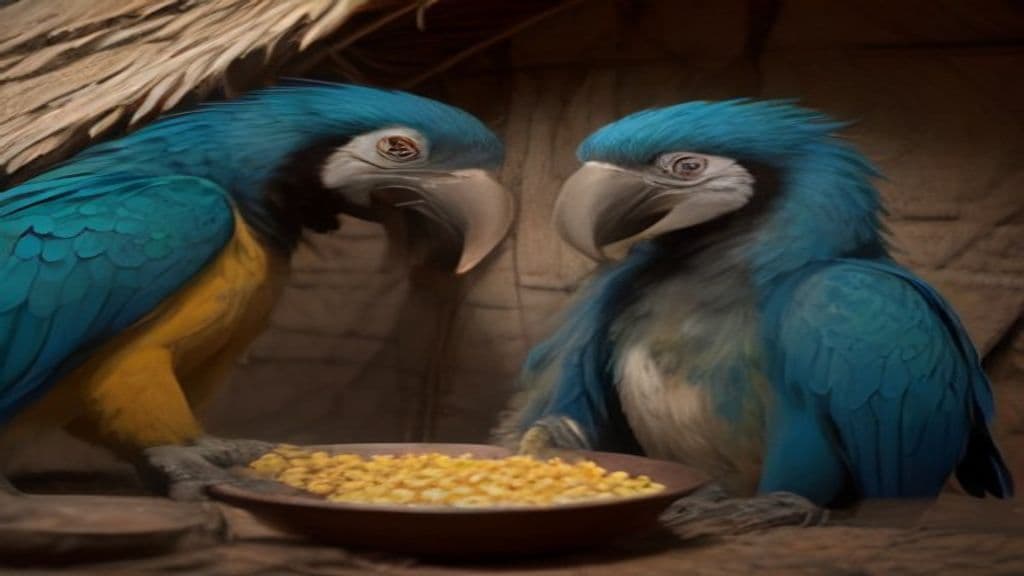
The ethnonym Cañari (Kichwa: Kañari) is reported in available sources to derive from kan (“snake”) and ara (“macaw”), explanations that either read the name literally as indicating ancestral identity with those animals or indicate that snakes and macaws were considered sacred and emblematic in Cañari material culture and stories. Separately, Cañari oral tradition as recorded in secondary summaries contains a flood myth: after a great deluge two brothers survived on a high mountain; later their repaired hut was found provisioned each day by two female beings with macaw faces, and one brother married the younger of these macaw‑faced women, whose offspring repopulated the world. The sources treat the macaw‑faced women as figures within Cañari myth rather than equating the ethnonym itself with a single named spirit (Wikipedia: "Cañari"; Cañari language entry).
The only explicit mythic appearance attested in the provided sources is that of two female beings described as having macaw faces while otherwise acting in human‑like ways (preparing food, repairing a hut, entering into marriage with a human). Beyond this episode, the corpus contains no consistent iconography or morphological description of a singular supernatural being called "Cañari," and no other consistent physical traits are recorded in the supplied materials (Wikipedia: "Cañari").
Within the flood myth episode preserved in secondary summaries, the macaw‑faced female beings repaired the brothers' hut and stocked it with prepared food each day, enabling survival; one such being married a human survivor, and their progeny repopulated the world. No wider catalogue of powers, recurring behaviors, magical capacities, or standardized interactions for an entity named "Cañari" is attested in the provided sources.
Cavalcante de' Cavalcanti
A historical Florentine nobleman depicted by Dante in Inferno Canto X as a damned soul among the heretics in the sixth circle of Hell; in the poem he briefly speaks to the pilgrim, expressing concern for his son Guido. His placement and condition are literary devices within Dante's moral-theological topography rather than folkloric hauntings.
Cavall (Cafall)
Cavall (Middle Welsh cauall; modern Cafall) is a named animal in medieval Welsh Arthurian tradition, best attested as King Arthur's favourite hunting hound who takes part in the great boar-hunts and whose pawprint is said to be impressed in a stone at Carn Cabal. The figure appears in narrative sources (notably Culhwch and Olwen) and in the Wonders of Britain section of Historia Brittonum.
Cavern deities of the underworld
A class of ancient Egyptian minor, place-bound divine beings dwelling in the caverns of the Duat. They are recorded as punitive creatures that punish and devour wicked souls but are also shown in funerary contexts as beings who, if propitiated by offerings and spells, can be pacified and render aid to the deceased.
Cayster (Caystrus / Küçük Menderes)
Cayster is primarily attested as a geographic river in western Anatolia (modern Küçük Menderes) that flows westward to the Aegean near Pamucak beach by Selçuk. In one cataloging entry the name is also labeled as a “river god of Asia Minor,” indicating at least a classificatory or personifying tradition, but the available sources supply no mythic narratives, cultic details, or iconography for a deity figure.
Caystrus
Caystrus is the ancient name of a river in western Asia Minor (modern Küçük Menderes) and the personified river-god associated with that watercourse in local ancient summaries. Attested in geographic and mythological reference summaries, Caystrus functions as a local river-deity tied to place and to civic genealogy (a son described as an autochthon is said to give the name of Ephesus).
Caïssa
Caïssa is a literary personification and poetic invention associated with the game of chess, originating in Renaissance and later European poetry. Presented as a dryad- or nymph-like figure (Vida's Schacchia; Jones's Caïssa), she functions in literature and modern chess commentary as an emblematic patron or metaphor for luck and inspiration in the game rather than a claimed folk spirit.
Ceasg
A Scottish Gaelic mermaid-like being described as a woman with the upper body of a human and the tail of a grilse (young salmon). In tradition she can form marriages with humans, grant boons to those who capture her, and in some tales appears large and dangerous, able to swallow people whose rescue requires finding and destroying a special life-egg.
Cebren
Cebren (Ancient Greek: Κέβρην) is a Greek river-god (potamos) of the Troad, a divine personification of the river Kebren near ancient Troy. He is named as a son of Oceanus and Tethys and as the father of naiads such as Asterope/Hesperia and Oenone; the nearby city Cebrene took its name from him.
Cecrops I
Cecrops I is a legendary autochthonous founder‑king of Attica and the first king of Athens, portrayed as a culture‑hero who instituted marriage, burial rites, civic divisions, and cult practices. He appears in Greek tradition as human above and serpentine or fish‑tailed below, and as the mortal witness/arbitrator in the mythic contest between Athena and Poseidon over patronage of the city.
Cecrops II
Cecrops II (Ancient Greek: Κέκροψ) is a legendary or semi-legendary seventh king of Athens in Greek mytho-historical traditions. Presented as a human dynastic ruler rather than a supernatural being, he functions primarily as a node in king-lists and chronologies that organize Athenian mythic history.
Ceffyl Dŵr
A Welsh water-spirit that habitually takes the shape of a horse; tales describe it as a shapeshifting, water‑bound creature that entices or carries travellers and is associated with pools, rivers, waterfalls and stormy shores.
Celadon
Celadon is a personal name appearing for multiple distinct characters in Greek mythic lists and as a lover-shepherd figure in French pastoral romance (not a class of spirit). The pastoral Celadon in Honoré d'Urfé's L'Astrée (1627) is best known for wearing pale green ribbons, a detail that later gave rise to the European colour-name and pottery term 'celadon'.
Community Record
- [1]Cañari (Wikipedia). Wikipedia contributors, "Cañari," Wikipedia, The Free Encyclopedia, https://en.wikipedia.org/wiki/Ca%C3%B1ariwiki
- [2]Cañari language (Wikipedia). Wikipedia contributors, "Cañari language," Wikipedia, The Free Encyclopedia, https://en.wikipedia.org/wiki/Ca%C3%B1ari_languagewiki
- [3]Wikidata: Canari (commune — name match). Wikidata entry Q765745, http://www.wikidata.org/entity/Q765745other