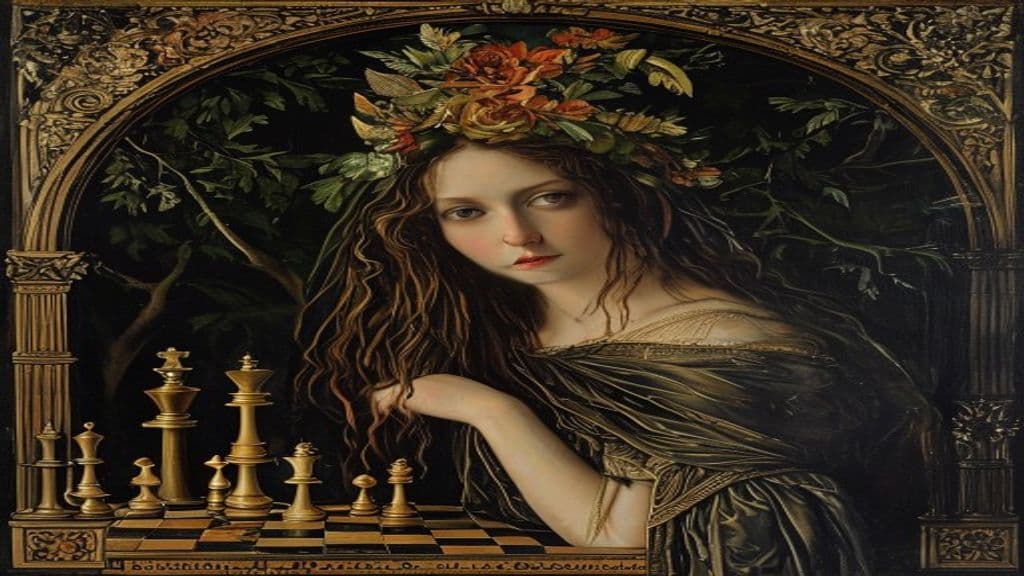
The figure appears in Hieronymus Vida's 1527 Latin poem Scacchia Ludus as a dryad of chess named 'Schacchia' placed among the gods in a Virgilian-hexameter scene of a chess game between Apollo and Mercury. In 1763 William Jones published an English poem, Caïssa or The Game at Chess, which invents a myth in which the god Mars is spurned by Caïssa and is aided by a deity named Euphron who creates chess as a gift to win her favour. Later authors and commentators adopted and adapted the name and persona; the relationship between Vida's 'Scacchia' and Jones's 'Caïssa' is described in the sources as an unproven or uncertain equivalence rather than an established identity.
Primary sources provide minimal direct visual description. Vida names a 'dryad of chess' called Schacchia, implying a classical nymph-like presence; Jones addresses Caïssa as an object of desire in his poem but gives no consistent iconography. Later cultural treatments personify Caïssa as a feminine muse or goddess of chess in illustrations and references, but the supplied sources record no single, stable physical depiction across texts.
All attributed 'powers' are literary and metaphorical. In Jones's narrative chess is created to win Caïssa's favour, framing her as the object whose approval motivates invention of the game. Modern chess commentators invoke 'Caïssa' to personify good fortune or poetic inspiration in play (for example, Garry Kasparov's remark 'Caïssa was with me' to indicate favorable circumstances). The sources do not describe literal supernatural agency (possession, direct intervention, or harm); her influence is rhetorical and emblematic within poems, commentary, and cultural products.
Weaknesses
- otherNone documented in primary sources (figure is literary/personification)
Wards
- otherNone documented in primary sources (no protective or apotropaic practices recorded)
Cauld Lad of Hylton
A localized North‑East English folk being tied to Hylton Castle, variously described as the ghost of a murdered stable boy or as a domestic brownie/elf/barghest; known for nighttime kitchen mischief, crying "I'm cauld," and being "laid" by the gift of clothing.
Cavalcante de' Cavalcanti
A historical Florentine nobleman depicted by Dante in Inferno Canto X as a damned soul among the heretics in the sixth circle of Hell; in the poem he briefly speaks to the pilgrim, expressing concern for his son Guido. His placement and condition are literary devices within Dante's moral-theological topography rather than folkloric hauntings.
Cavall (Cafall)
Cavall (Middle Welsh cauall; modern Cafall) is a named animal in medieval Welsh Arthurian tradition, best attested as King Arthur's favourite hunting hound who takes part in the great boar-hunts and whose pawprint is said to be impressed in a stone at Carn Cabal. The figure appears in narrative sources (notably Culhwch and Olwen) and in the Wonders of Britain section of Historia Brittonum.
Cavern deities of the underworld
A class of ancient Egyptian minor, place-bound divine beings dwelling in the caverns of the Duat. They are recorded as punitive creatures that punish and devour wicked souls but are also shown in funerary contexts as beings who, if propitiated by offerings and spells, can be pacified and render aid to the deceased.
Cayster (Caystrus / Küçük Menderes)
Cayster is primarily attested as a geographic river in western Anatolia (modern Küçük Menderes) that flows westward to the Aegean near Pamucak beach by Selçuk. In one cataloging entry the name is also labeled as a “river god of Asia Minor,” indicating at least a classificatory or personifying tradition, but the available sources supply no mythic narratives, cultic details, or iconography for a deity figure.
Caystrus
Caystrus is the ancient name of a river in western Asia Minor (modern Küçük Menderes) and the personified river-god associated with that watercourse in local ancient summaries. Attested in geographic and mythological reference summaries, Caystrus functions as a local river-deity tied to place and to civic genealogy (a son described as an autochthon is said to give the name of Ephesus).
Cañari (ethnonym; associated mythic figures)
Cañari (Kichwa: Kañari) is primarily an indigenous ethnonym for a pre-Columbian people of southern Ecuador; surviving secondary sources document a Cañari flood myth that includes two macaw‑faced female beings who assist human survivors rather than describing a single supernatural entity named “Cañari.”
Ceasg
A Scottish Gaelic mermaid-like being described as a woman with the upper body of a human and the tail of a grilse (young salmon). In tradition she can form marriages with humans, grant boons to those who capture her, and in some tales appears large and dangerous, able to swallow people whose rescue requires finding and destroying a special life-egg.
Cebren
Cebren (Ancient Greek: Κέβρην) is a Greek river-god (potamos) of the Troad, a divine personification of the river Kebren near ancient Troy. He is named as a son of Oceanus and Tethys and as the father of naiads such as Asterope/Hesperia and Oenone; the nearby city Cebrene took its name from him.
Cecrops I
Cecrops I is a legendary autochthonous founder‑king of Attica and the first king of Athens, portrayed as a culture‑hero who instituted marriage, burial rites, civic divisions, and cult practices. He appears in Greek tradition as human above and serpentine or fish‑tailed below, and as the mortal witness/arbitrator in the mythic contest between Athena and Poseidon over patronage of the city.
Cecrops II
Cecrops II (Ancient Greek: Κέκροψ) is a legendary or semi-legendary seventh king of Athens in Greek mytho-historical traditions. Presented as a human dynastic ruler rather than a supernatural being, he functions primarily as a node in king-lists and chronologies that organize Athenian mythic history.
Ceffyl Dŵr
A Welsh water-spirit that habitually takes the shape of a horse; tales describe it as a shapeshifting, water‑bound creature that entices or carries travellers and is associated with pools, rivers, waterfalls and stormy shores.
Community Record
- [1]Caïssa (Wikipedia). Wikipedia entry 'Caïssa'wiki
- [2]Wikidata: Caissa. Wikidata item for Caissaother
- [3]Scacchia Ludus (Vida, 1527) - archive references. Archive holdings and studies noting Hieronymus Vida's 1527 Scacchia Ludus and the naming of a dryad 'Schacchia'literary
- [4]Caïssa or The Game at Chess (William Jones, 1763) - archive references. Archive references discussing William Jones's 1763 poem 'Caïssa' and its invented myth of chess created to win Caïssa's favourliterary
- [5]Mindsports: Caïssa articles and references. Discussion of Caïssa in modern mindsports/chess culture and naming legacyother
- [6]Pronunciation and modern commentary (Chess Stack Exchange and others). Discussion of the name's pronunciation and usage in chess commentary (modern references such as Kasparov's phrasing)other
- [7]Bad Bishop 'caïssa was with me' reference. Modern commentary citing the phrase 'Caïssa was with me' as usage to indicate good luckother
- [8]Ed O'Keefe 'Caïssa' summary page. Summary of Caïssa's literary origins and later cultural usesother