
The supplied sources do not record a single cosmogonic origin tale for the ceffyl dŵr. In Welsh folkloric accounts it is presented as a water‑bound spirit or otherworldly horse associated with bodies of water and weather; comparative discussion places it within a family of Celtic water‑horse beings (e.g., Scottish each-uisge, Irish each uisce/púca, Manx glaistyn). There is no unified origin myth in the provided materials.
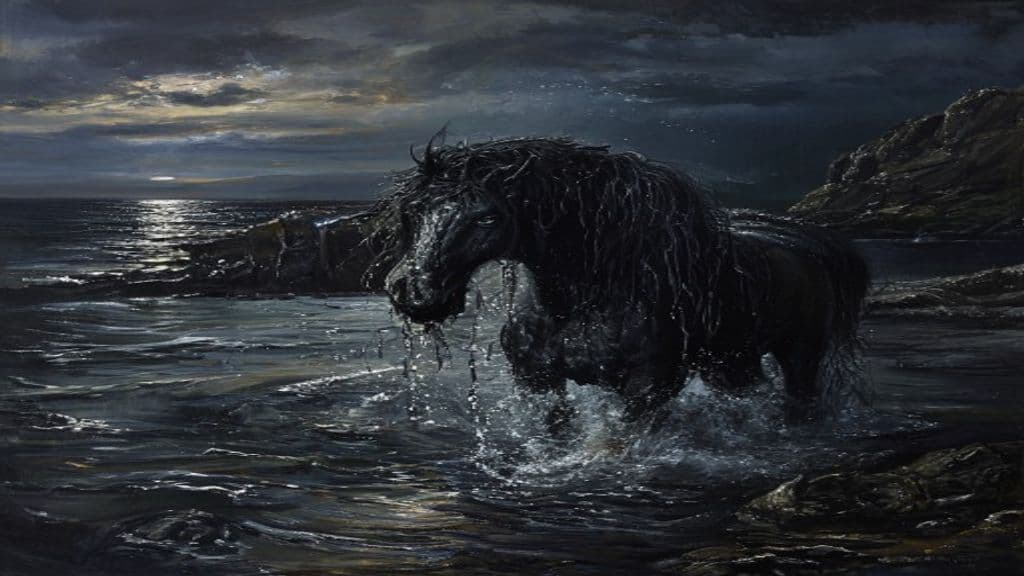
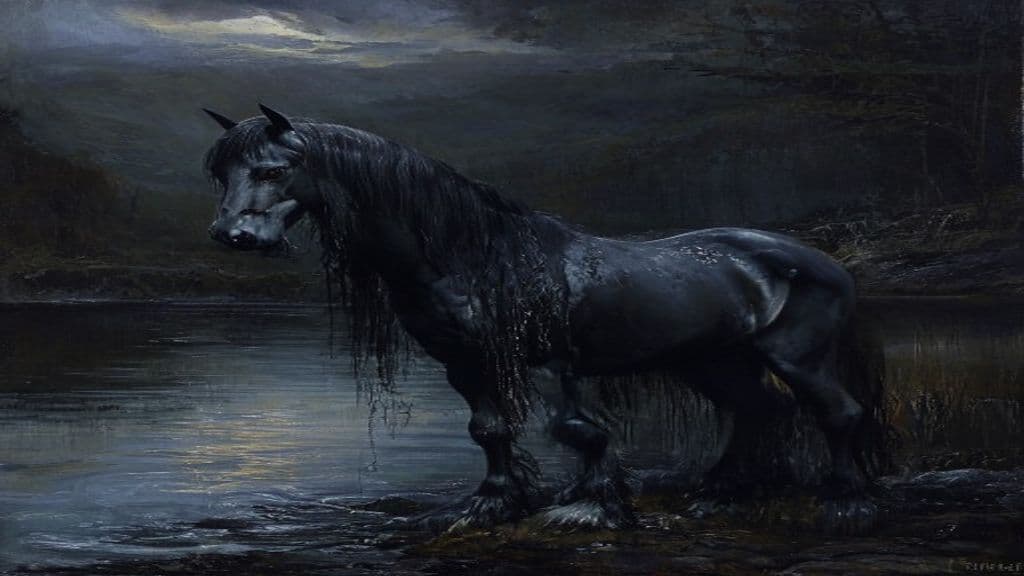
Folklore portrays the ceffyl dŵr most commonly in a horse form, with regional variation in colour and size. Descriptions include grey or black horses (sometimes with a white mane), luminescent or glowing examples, winged variants, dapple-grey or sand‑coloured forms on seashores, large chestnut or piebald animals in some areas, and at least one tale of a miniature black horse with a white mane. Aberrant features such as hooves turned the wrong way are noted in seaside sightings. Sources also record occasional shapeshifting into other animals (goat, frog) used in harmful episodes.
Across the collected accounts the ceffyl dŵr is a shapeshifter and agency-bearing water spirit. Common folkloric motifs attribute to it the power to entice travellers to mount and then carry them at extreme speed over great distances, sometimes flying into the sky and then evaporating into mist so that riders fall to their deaths. It may be captured and put to work in tales but is said to eventually escape and drag its captor to death—typically into water. Regional variation is emphasised: northern accounts tend to portray it as malevolent (fiery eyes, forbidding), while some southern accounts present it as ambivalent or occasionally helpful.
Weaknesses
- conditionclerical immunity (folkloric motif that clergymen and ministers could ride without danger)
Wards
- conditionavoidance and caution near unknown horses at water (folk preventative practice rather than a named ritual)
Each-Uisge
The most dangerous water horse in Scottish Highland folklore — haunting sea-lochs and mountain lakes, more violent than the river kelpie, known for consuming its victims whole.
Kelpie
A Scottish shape-shifting water horse that appears as a beautiful tame horse near lochs and rivers, then drowns and devours any rider foolish enough to mount it.
Aderyn y Corff
Aderyn y Corff (literally 'bird of the corpse') is a bird-like death-porter in Welsh folklore said to call outside the door of a person about to die. Described as an avian portent that may lack feathers or wings and as existing on another plane when not manifesting, it is treated in Welsh ghost lore and sometimes naturalized as a screech owl in modern accounts.
Arawn
Arawn is the ruler (king) of Annwn, the Otherworld in medieval Welsh narrative. He appears most prominently in the First Branch of the Mabinogi, where he exchanges places with the mortal Pwyll for a year and a day and is associated in folklore with the Cŵn Annwn (Hounds of Annwn) and other supernatural animals.
Coblyn (coblynau / coblynod)
A small, mine-associated Welsh spirit (plural coblynau or coblynod) that inhabits mines and quarries. Coblynau make peculiar knocking sounds used by miners to locate rich veins, imitate miners' work ineffectually while dressed in miner-like clothes, are generally considered helpful and lucky, but withdraw assistance if miners act greedily or are disrespectful.
Coblynau
Coblynau (singular coblyn) are small gnome-like mine and quarry spirits from Welsh folklore. They are reported in folkloric summaries as haunting underground workings, making knocking sounds, and—according to some miners' tales—occasionally indicating locations of ore or riches.
Geraint
Geraint is a personal name borne by overlapping human figures in Welsh and Brittonic tradition: a valiant warrior celebrated in early medieval poetry, the protagonist of the Arthurian romance Geraint and Enid, and a king of Dumnonia attested in a saints' vita. The name links heroic, courtly, and hagiographic registers rather than a supernatural taxonomy.
Gwragedd Annwn
In Welsh tradition the Gwragedd Annwn are female Otherworld fairies tied to freshwater—lakes and rivers—counted among the Tylwyth Teg. Depicted as beautiful women (often dressed in green) who live beneath lakes, they herd enchanted white cattle and occasionally cross into the human world.
Knocker
A small mine-associated spirit from British and American mining folklore, known for producing knocking sounds in underground workings that miners interpreted as warnings or communications. Variants and cognates appear across Cornwall, Devon, Wales, Staffordshire and in American mining communities (Tommyknockers).
Cebren
Cebren (Ancient Greek: Κέβρην) is a Greek river-god (potamos) of the Troad, a divine personification of the river Kebren near ancient Troy. He is named as a son of Oceanus and Tethys and as the father of naiads such as Asterope/Hesperia and Oenone; the nearby city Cebrene took its name from him.
Cecrops I
Cecrops I is a legendary autochthonous founder‑king of Attica and the first king of Athens, portrayed as a culture‑hero who instituted marriage, burial rites, civic divisions, and cult practices. He appears in Greek tradition as human above and serpentine or fish‑tailed below, and as the mortal witness/arbitrator in the mythic contest between Athena and Poseidon over patronage of the city.
Cecrops II
Cecrops II (Ancient Greek: Κέκροψ) is a legendary or semi-legendary seventh king of Athens in Greek mytho-historical traditions. Presented as a human dynastic ruler rather than a supernatural being, he functions primarily as a node in king-lists and chronologies that organize Athenian mythic history.
Celadon
Celadon is a personal name appearing for multiple distinct characters in Greek mythic lists and as a lover-shepherd figure in French pastoral romance (not a class of spirit). The pastoral Celadon in Honoré d'Urfé's L'Astrée (1627) is best known for wearing pale green ribbons, a detail that later gave rise to the European colour-name and pottery term 'celadon'.
Celaeneus
Celaeneus (Ancient Greek Κελαινεύς, romanized Kelainéus) is a named Mycenaean princely figure of the Perseid genealogies: a son of King Electryon and Anaxo, brother of Alcmena and several princes, and one of the Electryon sons killed in the feud with the sons of Pterelaus. He functions in the tradition as a mortal genealogical figure whose death helps set the stage for the exile of Amphitryon and the circumstances of Heracles' birth.
Community Record
- [1]Ceffyl Dŵr. Wikipedia, "Ceffyl Dŵr"wiki
- [2]Ceffyl Dŵr (Wikidata). Wikidata entry for Ceffyl Dŵrwiki
- [3]The Water Horse: Dangerous Horses from the Other World (Celtic Mythology Explained). Archive.org video discussing water‑horse motifsother
- [4]More tales from the Welsh hills. Collected Welsh tales (archive reference cited in research notes)folk
- [5]Myth & Magic Episode 69 (The Water Horse). Archive.org audio episode discussing mythic water‑horsesother