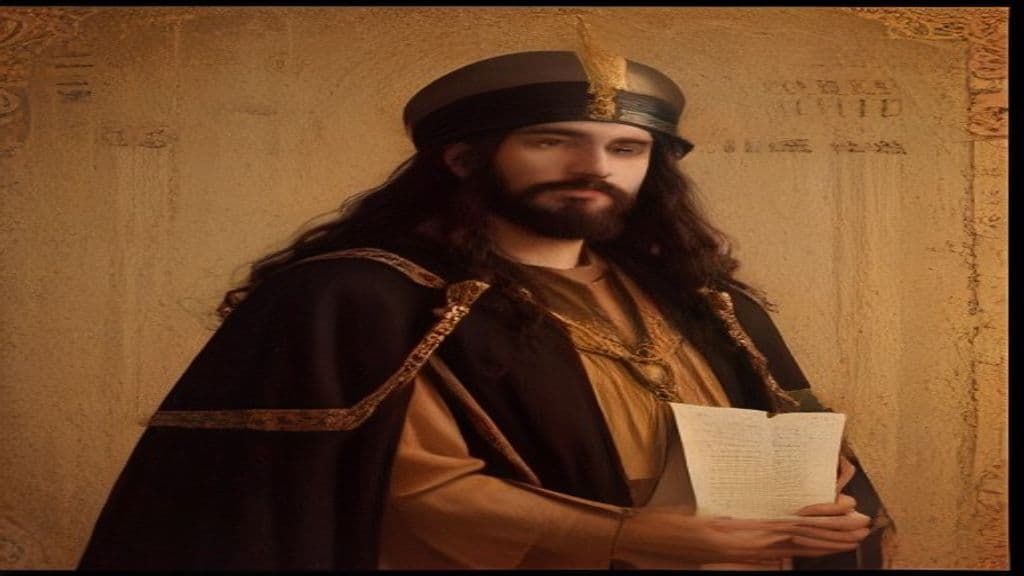
Historical sources present Caiaphas as a member of a priestly family who served as Jewish High Priest in Jerusalem during the early first century CE. New Testament narratives (the four Gospels and Acts) place him as the presiding high priest in scenes surrounding Jesus' arrest, trial before the Sanhedrin, and the early apostles' confrontations with temple authorities. Rabbinic texts preserve variant family-name forms (Kuppai, Nekifi, hakKof) and later tradition supplies linguistic plays on his name. Chronological estimates in the cited data place him roughly in the span circa 14 BCE–46 CE, but exact lifespan and dates of tenure remain uncertain in these sources.
The cited sources do not provide a personal physical description of Caiaphas. He is attested by office: as High Priest he would be associated in context with the temple and its priestly functions (i.e., the institutional vestments and settings of the high priest), but no specific details of stature, facial features, dress beyond his office, or other individual markers are recorded in the provided texts.
Sources attribute to Caiaphas institutional authority and political influence as High Priest and a leading member of the chief priests and the Sanhedrin. His recorded capacities are administrative and judicial within the temple order: presiding in councils, participating in decisions about religious and communal order, questioning and detaining accused persons, and interacting with Roman authorities indirectly through political calculation. The Gospel of John frames one of his statements about Jesus' death as a prophetic utterance within the evangelist's theological reading, but the primary sources present Caiaphas' actions as exercised through office and political deliberation rather than as independent supernatural powers.
Weaknesses
- conditionpolitical vulnerability to Roman authority
- conditiondependent on institutional support and communal legitimacy
Wards
None recorded.
Abijah of Judah
Abijah (also Abijam or Abiah) is presented in the biblical and later interpretive traditions as a short-reigning human king of Judah from the Davidic line. He is portrayed as a dynastic successor whose military actions (notably the battle at Mount Zemaraim) and moral evaluation in rabbinic literature are interpreted theologically in relation to the Davidic covenant.
Agabus
Agabus is an early Christian prophet attested in the Acts of the Apostles and later ecclesiastical tradition. He is reported in Acts to have predicted a famine and to have given a symbolic warning to Paul; later tradition lists him among the Seventy Disciples and attributes missionary activity and martyrdom to him.
Ahitophel
Ahitophel is a biblical-era human counselor to King David famed for exceptional wisdom in the Hebrew Bible and later rabbinic literature. In the biblical narrative he defects to Absalom during the prince's revolt and his counsel nearly topples David; rabbinic traditions further portray him as a gifted but morally compromised sage who misuses divinely granted knowledge.
Ananelus (Hanameel)
Ananelus, also attested in Hebrew as Hanameel, was a historical kohen who served as High Priest of the Jerusalem Temple in the late 1st century BCE. Appointed by Herod the Great in 37 BCE to fill the vacancy created by the execution of Antigonus II Mattathias, he was removed in favour of Aristobulus III and later restored; later succession events place his tenure before the appointment of Simon son of Boethus after 29 BCE. He is credited in rabbinic tradition (Mishnah, Parah 3:5) with preparing the penultimate of seven red heifers used in the post‑Exilic/Second Temple period.
Annas (Ananus)
Annas (Hebrew Ḥānān; Greek Ἅννας) was a first-century CE Jewish high priest of Judaea (AD 6–15) whose familial network and continued influence made him a central figure in priestly leadership in Jerusalem and in New Testament narratives of the Passion and early Christian episodes.
Basilides and Potamiana
Basilides and Potamiana are early Christian martyrs venerated in later tradition. Potamiana is remembered as a young virgin of Alexandria whose martyrdom and reported nocturnal appearances inspired conversions; Basilides was a court officer converted by Potamiana’s apparition, baptized, and subsequently executed.
Chrysanthus and Daria
Chrysanthus and Daria are venerated Christian martyrs of the early Church, remembered in liturgical calendars and by the cult of relics. Their legend places them in late third-century Rome, where they converted others and suffered martyrdom; their Acts survive in later Greek and Latin versions judged historically unreliable, while relics attributed to them were translated and enshrined in several medieval sites.
Eldad and Medad
Eldad and Medad are Israelite men named in Numbers 11 who prophesied within the Israelite camp while the seventy elders went to the tabernacle to receive prophetic spirit. The episode is used in biblical and later traditions to discuss the distribution of prophecy and is elaborated in rabbinic and early Christian apocryphal literature with varied prophetic attributions.
Fallen angel
A heavenly being expelled from the divine court for transgression; a cosmological status found in Second Temple Jewish, Christian and contested Islamic materials. In Enochic literature the Watchers descend to earth, corrupt humans and transmit forbidden knowledge; later Christian theology uses the motif to explain the origin of moral evil.
Golem (Jewish tradition)
An animated anthropomorphic being formed from inanimate earth (typically clay or mud) and brought to life by a human practitioner through the ritual use of Hebrew letters or divine names. In Jewish narrative and mystical contexts the golem functions as servant or protector created by rabbis, Baal Shem figures, or Kabbalists, but stories repeatedly warn that it can grow uncontrollable and must be deactivated by altering its animating inscription.
Holy Living Creatures
A class of heavenly attendants appearing in Jewish and Christian throne-vision literature (notably Ezekiel and Revelation) who perpetually worship and stand before the divine presence; later traditions (merkabah, Zohar, patristic exegesis) adapt and symbolically associate them with four archetypal forms.
Ishmael ben Fabus
Ishmael ben Fabus (also rendered Ishmael ben Phabi / Phiabi) was a historical High Priest (Kohen Gadol) of Jerusalem in the early 1st century CE. He is attested in rabbinic sources for officiating at rare Temple rites (notably the red heifer) and appears in scholarly lists and histories as holding office during a period of Roman intervention in high-priestly appointments (commonly dated c. 15–16 CE).
Community Record
- [1]Caiaphas. Wikipedia contributors, 'Caiaphas,' Wikipedia, The Free Encyclopedia.wiki
- [2]Wikidata: Caiaphas (Q211246). Wikidata entry Q211246 for Caiaphas.other
- [3]The Resurrection and the Life: Part III – Responding to the Gospel (archive references containing John 11:45–53 quotations). Archived sermon/text quoting John 11:45–53 as preserved in Gospel of John.literary
- [4]The Resurrection and the Life: Part III – Responding to the Gospel (additional archive mirror). Archived sermon/text quoting Gospel accounts and Acts referencing Caiaphas.literary
- [5]The Resurrection and the Life: Part III – Responding to the Gospel (additional archive mirror). Archived sermon/text quoting New Testament passages concerning Caiaphas and the chief priests.literary