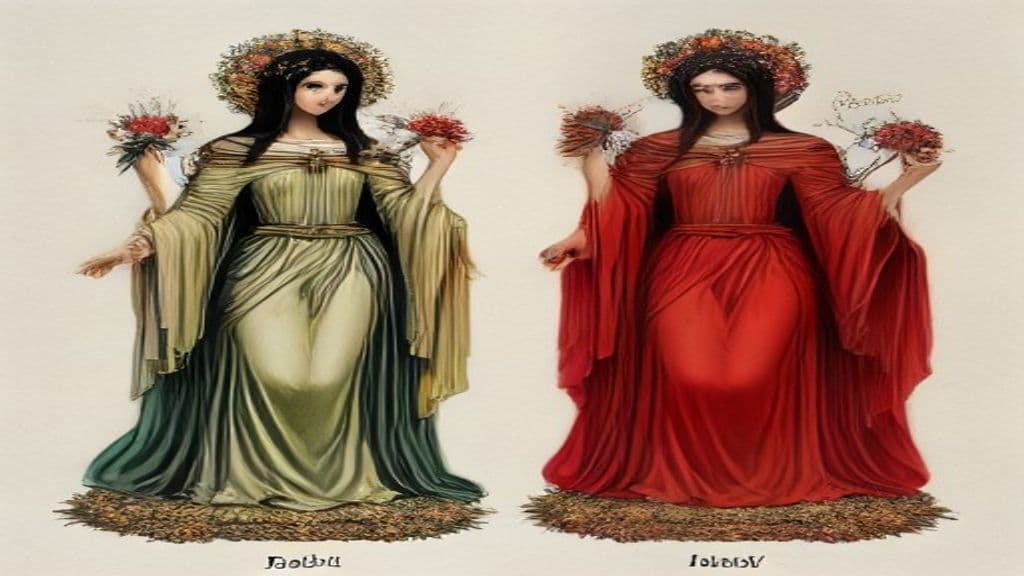
Legendary accounts place Chrysanthus as the son of an Egyptian patrician who moved from Alexandria to Rome; he converted to Christianity, vowed chastity with his wife Daria, and together they evangelized Romans. The Acts of the Martyrs relating their story exist in Greek and Latin versions (dated from the fifth century) but have been judged 'without historical value' by Johann Peter Kirsch (Catholic Encyclopedia). Traditional dating situates their martyrdom in the late third century (a conventional death date given as 283 AD) and associates their burial with a sand pit near the Via Salaria Nova in Rome. Medieval tradition reports multiple translations of their reputed relics (e.g., to Prüm in the ninth century and to Beaulieu-lès-Loches in 1011).
The supplied textual sources do not provide contemporary visual descriptions of Chrysanthus and Daria in life beyond sex and age estimates from modern study of associated remains. Scientific reporting cited places the two individuals as a male between 17 and 18 and a female between 20 and 25, with radiocarbon dating indicating an era between AD 80 and 340. Artistic treatments are mentioned in secondary literature on sacred and legendary art, but specific iconographic details are not given in the provided excerpts.
No supernatural powers are attributed to Chrysanthus and Daria in the source corpus beyond the spiritual efficacy of their example and martyrdom: their steadfastness under arrest and torture is said to have led to conversions (for instance, of a tribune named Claudius and his household in the legend). Some legendary versions include extraordinary motifs (for example, a version that states Daria's chastity was defended by a lioness), but the sources treat such elements as part of later legendary accretions. Their primary 'ability' within Christian tradition is as exemplar and intercessor within the communion of saints and as focal figures for veneration centered on their relics and liturgical commemoration.

Apsara
Celestial dancers and water nymphs of Hindu cosmology — beautiful semi-divine beings who dance at the court of Indra and, by his command, descend to earth to distract sages from excessive asceticism.

Petni
The female equivalent of the Bengali bhoot — the ghost of a young woman who died unmarried or before fulfilling her expected life. The Petni is more volatile and less predictable than the Shakchunni (married woman's ghost), driven by the particular bitterness of a life foreclosed rather than interrupted.
Agabus
Agabus is an early Christian prophet attested in the Acts of the Apostles and later ecclesiastical tradition. He is reported in Acts to have predicted a famine and to have given a symbolic warning to Paul; later tradition lists him among the Seventy Disciples and attributes missionary activity and martyrdom to him.
Annas (Ananus)
Annas (Hebrew Ḥānān; Greek Ἅννας) was a first-century CE Jewish high priest of Judaea (AD 6–15) whose familial network and continued influence made him a central figure in priestly leadership in Jerusalem and in New Testament narratives of the Passion and early Christian episodes.
Basilides and Potamiana
Basilides and Potamiana are early Christian martyrs venerated in later tradition. Potamiana is remembered as a young virgin of Alexandria whose martyrdom and reported nocturnal appearances inspired conversions; Basilides was a court officer converted by Potamiana’s apparition, baptized, and subsequently executed.
Caiaphas (Joseph ben Caiaphas)
Caiaphas (Joseph ben Caiaphas) is attested in New Testament and later Jewish sources as the Jewish High Priest in Jerusalem in the early first century CE. He functions in the Gospel narratives and Acts as a senior temple official and a leading member of the council of chief priests who weigh political and cultic interests and who are portrayed as instrumental in the arrest and trial of Jesus.
Saint Peter
Saint Peter (Simon bar Jonah; Cephas/Petros) is an early Christian apostle and leading disciple of Jesus who, in later Catholic and Orthodox tradition, is venerated as the foundational bishop of the church in Rome and a major saint. Tradition attributes to him a leadership role in the primitive Christian community, a renaming by Jesus signifying a "rock/foundation" role, and martyrdom in Rome under Nero. Relics and institutions (notably the Chair of Saint Peter) continue to anchor his symbolic authority.
Chromia
Chromia (Ancient Greek: Χρωμία, Khrōmía) is a minor mythological woman in Greek genealogies, identified as daughter of Itonus (son of Amphictyon, grandson of Deucalion) and in some traditions named as consort of Endymion and mother of Aetolus, Paeon, Epeius, and Eurycyda. The same modern lexical form 'Chromia' is also used as a name for a public blockchain platform, a Miraheze project wiki, and as the English mineral/oxide term (Cr2O3), but these are homonymous and not conflated with the mythic figure in the available sources.
Chromios
Chromios is an ancient Greek personal name attested for several human figures in classical literary and historical sources (not a single supernatural being). Attestations include Chromios of Aitna, victor in a chariot race celebrated by Pindar (Nemean I, c. 473 BCE); a warrior/captain name found in epic/Homeric indices and scholia; an Argive survivor in the tradition of the Battle of the 300 Champions; and the modern asteroid 32726 Chromios, a Jupiter Trojan named from the Greek onomastic repertoire.
Chromis
Chromis (Ancient Greek Χρόμις) is an anthroponym attested across multiple ancient Greek and Roman mythic episodes. The name is borne by several distinct minor figures — including at least one centaur at the Centauromachy and several mortal warriors in epic war-lists — rather than a single supernatural species or cult figure.
Chrysanthius of Sardis
Chrysanthius of Sardis (Ancient Greek: Χρυσάνθιος; died AD 505) was a late-antique Greek Neoplatonist philosopher and the high-priest of Lydia. A pupil in the lineage of Iamblichus via Aedesius, he is recorded as devoted to the mystical side of Neoplatonism and noted for moderation in his priestly office.
Chrysaor
Chrysaor is a figure from Greek myth born from the beheading of the Gorgon Medusa; traditionally presented as the brother of Pegasus and the father of Geryon, he functions chiefly as a genealogical and etiological link within Hesiodic and related traditions.
Chryseis
A mortal woman in Greek myth best known from Book 1 of the Iliad as the daughter of Chryses, a priest of Apollo, taken as a captive/concubine by Agamemnon; her father's supplication to Apollo and the resulting plague force Agamemnon to return her, illustrating the nexus of religious and political obligation in the epic. Later traditions give her personal names (Astynome) or rework her into medieval figures such as Cressida and, in some post-Homeric accounts, assign her children by Agamemnon.
Chryses
Chryses is a mortal Trojan priest of Apollo at the sanctuary of Chryse who appears in the opening episode of Homer’s Iliad as a suppliant seeking the return of his captive daughter. His ritual petition to Apollo leads the god to afflict the Greek army with a plague when Agamemnon dishonors him, and the eventual restitution of the daughter ends the divine punishment.
Community Record
- [1]Chrysanthus and Daria - Wikipedia. Wikipedia contributors, 'Chrysanthus and Daria,' Wikipedia, The Free Encyclopedia.wiki
- [2]Saints Chrysanthus and Daria - Wikidata. Wikidata entry Q1088478, 'Saints Chrysanthus and Daria.'other
- [3]How the Traditional Liturgy Works -- Part 1 (SS Chrysanthus & Daria). Archive.org, 'How the Traditional Liturgy Works -- Part 1 (SS Chrysanthus & Daria).' (video description references liturgical pedagogy).other
- [4]Sacred And Legendary Art, Volume 2 (contents referencing early martyrs). Archive.org, 'Sacred And Legendary Art, Volume 2' (contents listing including early martyrs and patron saints).other