
The tale is set in the Kediri period (traditionally dated to the 12th century) and locates Calon Arang in the village of Girah. She conducts nightly cemetery ceremonies and, according to the story, performed a dark cemetery rite in which she offered the sacrifice of a young girl to the goddess Durga. Her rites are said to have produced a flood and then an incurable plague on Girah. King Airlangga's army was unable to defeat her—retreating with many soldiers killed—until the royal advisor Mpu Bharadah and his disciple Mpu Bahula intervened; Bahula stole Calon Arang's magic scroll and returned it to Mpu Bharadah, who then defeated her.
Sources emphasize a fierce, frightening visage in Balinese portrayals; Calon Arang is commonly depicted as a fearsome witch with a frightening face. No consistent, detailed anthropological description (dress, height, exact bodily features) is provided in the cited materials.
Practitioner and master of harmful ritual arts and black magic who conducts cemetery ceremonies and human sacrifice (a young girl offered to Durga) that, in the tale, produce a flood and an incurable plague in Girah. Her ritual power is tied to a magic scroll that serves as a material locus of strength; when deprived of the scroll she is weakened and defeated. Her sorcery is potent enough in the story to repel and inflict heavy casualties on a royal army until ritual specialists intervene.
Weaknesses
- otherloss of magic scroll (deprivation of the scroll neutralizes her power)
- conditionconfrontation by sanctioned ritual authority (Mpu Bharadah) — ritual specialist intervention defeats her
- othersocial integration/subterfuge (use of marriage proposal by Mpu Bahula to gain access and steal the scroll)
Wards
- ritualretrieval of the magic scroll and ritual confrontation by Mpu Bharadah
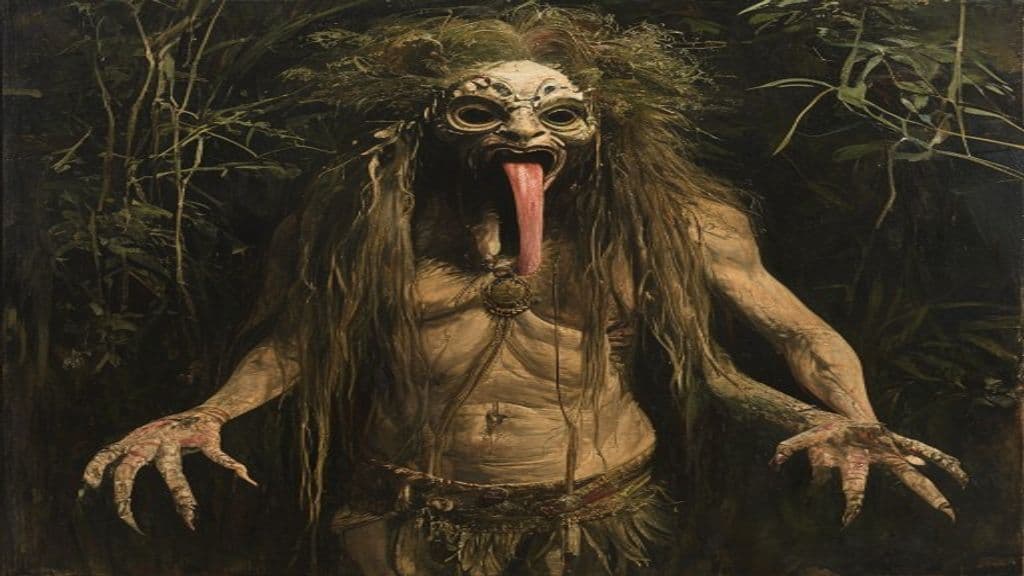
Genderuwo
Genderuwo is a Javanese/Indonesian supernatural humanoid spirit, commonly depicted in modern sources as a large, hairy, muscular creature with reddish or black skin and bulging eyes; it is described as able to appear, disappear, and assume human form. It is treated in regional folklore and popular culture as one member among many named hantu (supernatural beings) in the Malay–Indonesian mythic landscape.
Keong Emas
A princess magically transformed and contained within a golden snail shell, associated with the Panji cycle of Javanese folklore. (Note: - Power tier: Primordial (not Ancient), as it's described as a princess trapped in a magical object rather than having deity-level powers. - Abilities: Lack of information about abilities or behaviors)
Sundel Bolong
A Javanese-rooted Indonesian folkloric apparition: the vengeful ghost of a woman who died in circumstances tied to sexual stigma (pregnancy out of wedlock or death in childbirth), depicted as a white‑gowned woman with long black hair and a large hole in her back. The figure functions in folklore and modern media as a punitive revenant addressing sexual violence, social shame, and the loss of motherhood.
Wewe Gombel
Wewe Gombel is a female spirit or vengeful ghost in Javanese/Sundanese Indonesian folklore associated with the abduction and protective custody of children who are mistreated or left out at night; she is used pedagogically to warn children to stay home and to signal parental responsibility.
Calliste (Kalliste / Callistis)
Calliste (Ancient Greek Kalliste/Callistis, 'the most beautiful') is a local Aegean sea-nymph figure tied to the island called Kalliste (modern Santorini). In surviving summaries she appears as a youthful woman who was given to the Argonaut Euphemos as a clod of earth which transformed into a woman; she is also attested as a surname/epithet (Calliste/Callistis) applied to other goddesses such as Artemis in cultic contexts.
Callisto
Callisto is a figure from Greek mythology described as an Arcadian mountain nymph (Oread) whose life is altered by the Olympian gods: she is seduced by Zeus, becomes mother of Arcas, is transformed into a bear (in many accounts by Hera's jealousy), and is ultimately placed among the stars as a constellation. She functions as a nature-spirit, an ancestral/etiological figure for Arcadia, and a mythic explanation for a bear-shaped constellation.
Callithyia
Callithyia (Ancient Greek: Καλλίθυια), also called Callithoe, Callithea, or Io, is an Argive princess in Greek mytho-historical tradition described as the first priestess of Hera at Argos. She functions as a foundational, legitimating figure for the local Hera-cult rather than as a supernatural being.
Calogrenant
Calogrenant is a human knight of the Round Table from medieval Arthurian romance. First attested in Chrétien de Troyes' Yvain as the teller of the episode of the magic spring in the forest of Brocéliande, he appears in various Old French, German, Welsh, and Middle English cycles with differing fates (defeat by Esclados in the fountain episode; death on the Grail Quest in Vulgate and Malory; a gender-transformation episode in Claris et Laris).
Calu
Calu is an Etruscan theonym/epithet denoting the chthonic, dark aspect of the fire-underworld god Śuri; the name was also used as a synonym for the underworld itself. Iconography and cultic language associate Calu with darkness and lupine (wolf) attributes and link the epithet to central-Italian wolf-ritual phenomena.
Calybe
Calybe (Ancient Greek: Καλυβη, Kalybē) is a name applied to minor female personages in classical literature: a Trojan nymph named as a consort of King Laomedon and mother of Bucolion, a follower in Dionysus’ retinue in Nonnus’ Dionysiaca, and an attested occurrence as an "aged priestess of Juno" in a Vergilian index entry. The attestations are brief and nominative; no sustained myth or ritual tradition centred on Calybe survives in the provided sources.
Calyce
Calyce is a personal name borne by several minor women in Greek mythic genealogies and nymph-lists. Bearers of the name appear as a Nysiad who nursed the young Dionysus and as various mortal princesses or matrons (e.g., a daughter of Aeolus, a wife of Aethlius, and an occasional mother of Endymion or of Cycnus) across competing local traditions.
Calydon (son of Aetolus)
Calydon (Ancient Greek: Καλυδών, Kalydōn) is an eponymous mythic figure recorded in Greek tradition as the son of Aetolus and the namesake of the city and plain called Calydon in Aetolia. Sources treat him as a genealogical/foundational ancestor within local royal genealogies rather than as a deity or active supernatural agent.
Community Record
- [1]Calon Arang — Wikipedia. Wikipedia contributors, 'Calon Arang', Wikipedia, The Free Encyclopedia.wiki
- [2]Calon Arang — Wikidata. Wikidata entry Q2413885, 'Calon Arang'.wiki
- [3]Ia berkata, “Siapa pu: (archival fragment). Archived fragment referenced in provided research notes (title fragment: 'Ia berkata, “Siapa pu') — cited in research materials.other