
According to surviving summaries of Greek tradition, Calliste is presented as the daughter of the sea‑god Triton and a Libyan woman (in summaries glossed as 'Libya of Egypt'). In the Argonautic account preserved in later summaries, Triton presented to the Argonaut Euphemos a clod of earth which, when cast or received, turned into a small/young woman who asked to be received; this transformed figure is named Calliste and becomes associated with the island Kalliste (modern Santorini). The name Calliste/Callistis is also recorded as a surname or epithet under which a goddess—e.g., Artemis Calliste—was worshiped at places such as Athens and Tegea in the summaries of ancient sources.
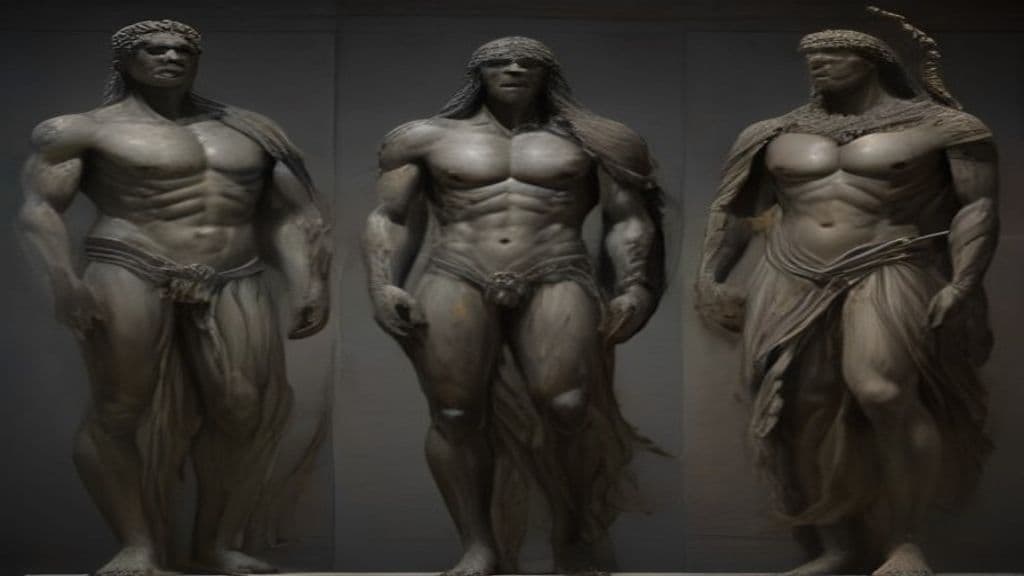
Summaries describe Calliste as arising from a clod of earth which transformed into 'a small woman' or a young woman; emphasis in the accounts is on her youth and small stature at metamorphosis. No detailed iconographic attributes, clothing, or coloration are specified in the available summaries.
The principal miraculous element preserved in the tradition is metamorphosis: a clod of earth given by Triton became a living female figure. In narrative role she functions as a local nymph/sea‑spirit tied to an island and to human voyagers (the Argonauts, especially Euphemos), legitimizing possession or colonization by linking land, sea, and human settlement. The sources do not record hostile, possession, or trickster behaviors.
Argonauts
A band of human heroes in Greek myth who sailed aboard the ship Argo under Jason to Colchis to retrieve the Golden Fleece. Their identity is defined by membership in the celebrated voyage and by shared heroic lineages; membership lists and details vary by source.

Artemis
Artemis is an ancient Greek goddess of hunting, the wilderness and wild animals, transitions (especially childbirth and puberty), vegetation, and chastity. Twin sister of Apollo and daughter of Zeus and Leto, she functions as a protector of young children and maidens while also capable of inflicting disease or punishment for transgressions against her sacred laws.
Acis and Galatea
A pair of lovers from ancient Greek myth: Galatea is a Nereid (sea-nymph) traditionally counted among the daughters of Nereus and Doris; Acis is a mortal youth in classical accounts who, in Ovid's poetic version, is killed by the Cyclops Polyphemus and transformed by Galatea into a river-spirit, explaining a Sicilian stream.
Actaeon
A mortal hunter of Greek myth who, in multiple traditions, is transformed into a stag and torn apart by his own hounds after transgressing the goddess Artemis. He functions as a mythic exemplar about proper deference to divine boundaries and, in some locales, became the focus of cultic rites and memorials.
Aesepus
Aesepus is the personified river-god (potamos) of the Aesepus River in the Troad / northern Mysia of Anatolia. Attested in Hesiod's catalogue of river-children and in Homeric and geographic passages, Aesepus functions primarily as a topographical divine ancestor and eponym for a town and local genealogies.
Aethra
Aethra (Ancient Greek: Αἴθρα, romanized Aithra, lit. 'bright sky') is a name borne by multiple women in Greek myth, most prominently a princess of Troezen who is mother of the hero Theseus. In some traditions an Aethra is also listed among Oceanids, indicating a separate, water‑nymph identity in certain genealogies.
Aganippe (naiad)
Aganippe is the local Naiad of the spring called Aganippe at the base of Mount Helicon in Boeotia. The spring and its nymph are traditionally associated with the Muses and with poetic inspiration; the name Aganippe is also used as an epithet in other, sometimes divergent, local mythic or cultic contexts.
Alegenor
Alegenor (Ancient Greek: Ἀλεγήνωρ) is a minor mortal figure in Greek mythic genealogies, attested as a son of Itonus and the father of Clonius and Promachus. He functions in the sources as a genealogical ancestor situating his more active descendants among the Boeotian leaders of the Trojan War rather than as an independently acting supernatural being.
Alexander (name / epithet)
Alexander is primarily an Ancient Greek personal name (Ἀλέξανδρος, Aléxandros) meaning 'defender/protector of men.' In the assembled sources it functions as an anthroponym and occasional divine epithet (e.g., Hera Alexandros) rather than a single, discrete supernatural entity with a consistent mythic ontology.
Alexida
Alexida (Ancient Greek: Ἀλεξίδη) is an attested mythological figure in Greek literary tradition, presented as a daughter of Amphiaraus and the eponymous ancestress from whom the Elasioi (Elasii), averters of epileptic fits, were believed in Argos to descend. She is preserved in surviving references as a genealogical origin rather than an active cultic agent.
Alpheus
Alpheus (Ancient Greek: Ἀλφειός) is the personified river and river-god of the Alpheios in the Peloponnese. He is classed among the river-deities descended from Oceanus and Tethys and appears in myths linking the Arcadian/Elian river to the Sicilian well Arethusa, to Artemis, and to the labors of Heracles.
Amalthea
Amalthea (Ancient Greek Ἀμάλθεια) is a figure of Greek myth most commonly identified as the nurse of the infant Zeus. Traditions variously portray her as a nymph who tended a goat that fed Zeus or, in later Hellenistic treatments, as the goat itself; she is also associated with the "horn of Amalthea" (cornucopia), a horn reputed to yield inexhaustible food and drink.
Amnisiades
The Amnisiades (Ancient Greek: Αμνισιαδες / Αμνισιδες) are a group of naiads — freshwater nymphs — associated with the Amnisos river in Crete. They are attested in Hellenistic poetry as members of Artemis's retinue and are linked by scholarship to cult activity at a cave of Eileithyia on the Amnisos.
Amphictyon
Amphictyon (Greek: Ἀμφικτύων) is a mytho-historical ancestral king in Greek tradition associated with the generation after the great flood and with the foundation/organization of communities that dwelt around sanctuaries (the Amphictyons). He appears in variant genealogies as son of Deucalion and Pyrrha or as son of Hellen, is called king of Thermopylae and in some accounts king of Athens, and is etiologically linked to the Amphictyonic League and early cultic practice.
Community Record
- [1]Calliste (mythology) — Wikipedia. Wikipedia, 'Calliste (mythology)' (summary of ancient material)wiki
- [2]CALLISTE (Kalliste) - Sea Nymph of Greek Mythology — Theoi. Theoi Project, summary entry for Kalliste (noting Triton, Euphemos, clod-of-earth metamorphosis, island identification)other
- [3]Calliste | Facts, Information, and Mythology — Pantheon. Pantheon.org summary (references Pausanias and other ancient summaries; notes epithet use and clod metamorphosis)other
- [4]Cyrene / Cadmus entries (contextual place and colonization summaries) — MAICar Greek Mythology Link. MAICar Greek Mythology Link (contextual summaries of colonization and island naming traditions cited alongside Calliste material)other