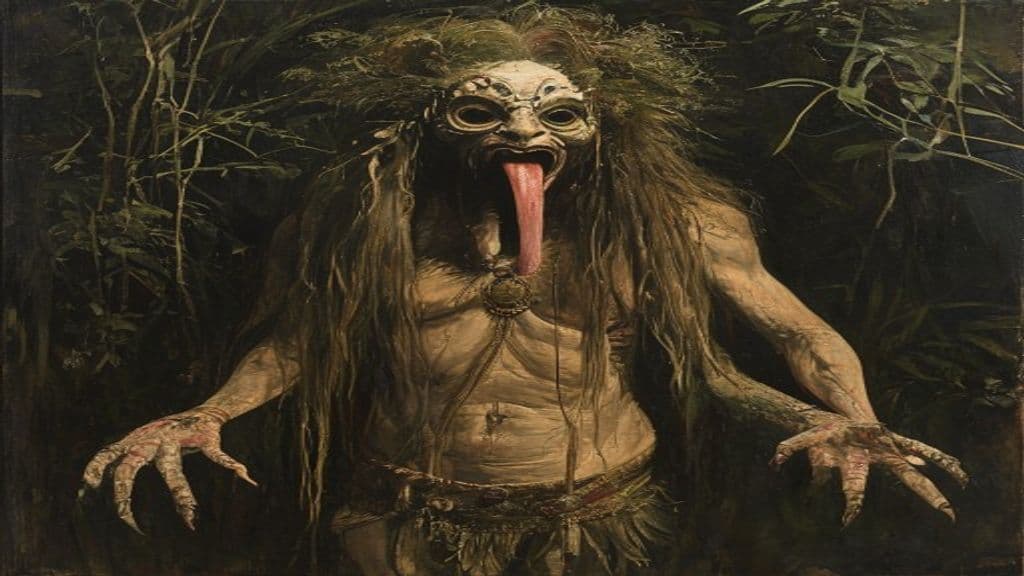
In Balinese narrative and legendarium Rangda is linguistically tied to an Old Javanese term meaning "widow" and is associated in stories with the legendary witch Calon Arang and with accounts of Queen Mahendradatta in Javanese-Balinese histories. In these narratives a grieving or humiliated widow/master of black magic summons Leyaks and evil spirits to wreak disease and crop failure; royal and ritual responses (for example, King Airlangga calling the empu/holy man Empu Bharada and his disciple Empu Bahula) form the story-cycle by which her threat is confronted. Some local traditions and retellings identify or link Rangda with Calon Arang or with Mahendradatta, but sources present these as connected narrative identifications within Balinese myth rather than a single fixed historical fact.
Traditionally represented in Balinese mask-and-costume performance as a frightening, aged female figure: often portrayed as largely nude in theatrical costume, with long unkempt hair, pendulous breasts, clawed hands, and wearing a goggle-eyed fanged mask with a long protruding tongue. This visual type appears consistently in Barong-Rangda dances and related theatrical art forms.
In the Calon Arang legend and related Balinese accounts Rangda is depicted as leading Leyaks (evil witch-spirits) and as responsible for harms such as disease, plague, damage to crops, and attacks on children. She is described as a master of black magic in narrative sources, able to summon or direct malevolent spirits; her menace is principally social and cosmological—providing a personalized supernatural explanation for misfortune that ritual specialists and village protectors must address.
Weaknesses
- ritualIntervention by empu (ritual specialist) and retrieval of the witch's book
- ritualInvocation/assistance of protective deity (Durga) as in the Calon Arang narrative
- ritualConfrontation by Barong (symbolic/performative opposition)
Wards
- ritualBarong cult/ritual presence (village protector)
- ritualEmployment of empu/holy men to counteract witchcraft (narrative remedy)
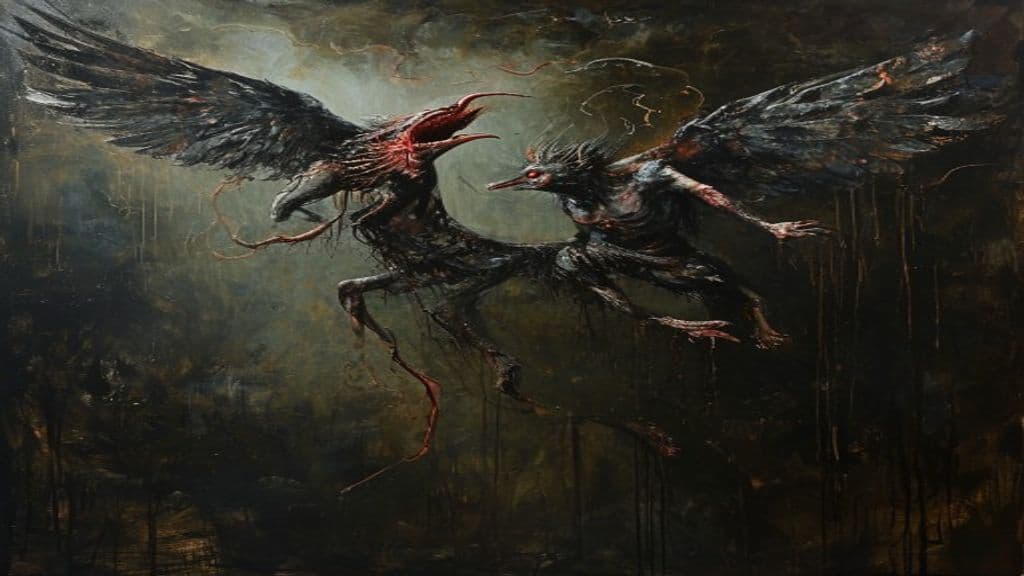
Leyak
A flying head with entrails, targeting pregnant women and newborn children in Balinese folklore. (Note: - Power tier: Primordial (given the cosmic-level abilities of targeting pregnant women and newborn children) - Abilities: The draft only mentions sucking blood, but source material mentions abducting )

Calon Arang
Calon Arang is a witch figure in Javanese and Balinese folklore, traditionally portrayed as a master of black magic whose cemetery ceremony—including the sacrifice of a young girl to the goddess Durga—brings flood and an incurable plague to the village of Girah. In the tale a royal ritual specialist (Mpu Bharadah) and his disciple (Mpu Bahula) neutralize her by recovering her magic scroll and confronting her in ritual contest.
Ramandu's daughter
A fictional immortal female figure in C. S. Lewis's Narnia who is the daughter of Ramandu (the 'star at rest'). She appears in The Voyage of the Dawn Treader as a luminous guide on Ramandu's Island, later becomes Queen of Narnia by marriage to Caspian X, is killed in The Silver Chair, and is listed among the faithful in The Last Battle. The novels never give her a personal name; a 2010 film adaptation names her 'Lilliandil.'
Rambehesht
Rambehesht (Middle Persian: Rām Vahišt; New Persian: رامبهشت), also attested as Denag (Dēnag), is presented in available sources as a 3rd-century noblewoman of the Bazrangi/Badhrangi family, wife of Sasan, mother of Pabag (Papak), and grandmother of Ardashir I. She appears in genealogical and historical accounts that construct Sasanian royal lineage and is described in chronicles (via Tabari) as possessing "beauty and perfection."
Rambha (asura)
Rambha is a Danava (asura) figure in Hindu mythic genealogies presented as a leaderly member of the descendants of Danu and Kashyapa; in several accounts he performs penance to obtain boons and is linked in origin narratives to the birth of the buffalo-bodied asura Mahishasura. Sources vary on details of his death and the precise mechanics of his son's birth.
Ramidreju
The ramidreju is a legendary weasel-like creature from Cantabrian (northern Spain) folklore said to inhabit mountains and forests. It is described as a very long, serpent-bodied animal with slightly green fur whose pelt is traditionally attributed healing properties and which is reputed to seek out gold and treasure.
Ramiel
Ramiel (Raʿamʾēl) is named in the Enochic Book of the Watchers as one of the chiefs among the fallen angels who descended in the antediluvian age, took human wives, and became part of the corrupt company responsible for the Nephilim. The name is a Semitic theophoric compound commonly glossed as “God has thundered.” Later traditions sometimes conflate Ramiel with similarly named holy angels (Remiel/Jeremiel), but in the Book of Enoch Ramiel is listed among the condemned Watchers.
Rana Niejta
Rana Niejta is a Sámi female divine figure associated with springtime greening and the renewal of plant life that provides pasture for reindeer. She is one of several related spring/fertility daughters in Sámi tradition and was propitiated to ensure grass and fodder for Sámi herds.
Rangi and Papa
Rangi (Ranginui) and Papa (Papatūānuku) are the primordial sky father and earth mother of Māori cosmogony whose intimate union encloses their many children in primeval darkness; their forced separation is the central creative act that brings light, space, and the ordering of the world and its domains.
Ranginui
Ranginui (also Rangi, Rakinui in some South Island dialects) is the personified sky and sky-father in Māori cosmology. As one half of the primal parental couple with Papatūānuku, Ranginui's separation from the earth is central to the origin narrative that brings light, the world, and the atua into being; Ranginui is also conceptually associated with the night sky and seasonal/astronomical knowledge such as Matariki and maramataka.
Rangitihi
Rangitihi is a historical ancestral rangatira (chief) in Te Arawa Māori tradition, eponymous ancestor of Ngāti Rangitihi and progenitor of multiple hapū across the Rotorua Lakes District. He is remembered primarily for his role in settlement, lineage formation, and chiefly deeds rather than as a supernatural being.
Rape in Greek Mythology
A common motif in Greek mythology representing sexual assault by supernatural beings against mortals, particularly women. (Note: - Power tier: Change to "Ancient" since the abilities described are more in line with deity-level powers (e.g., transformation through supernatural intervention). - Appearance: Add that the entity its)
Raphael (Archangel)
Raphael is an archangel in Jewish and Christian traditions whose name means "God has healed." He appears in the Book of Tobit as a divine agent who guides Tobias and effects healing, and is commemorated in Christian liturgy as a principal angel invoked for healing, guidance, and protection of travelers.
Rapunzel
Rapunzel is a European folktale heroine of the Aarne–Thompson type 310 'Maiden in the Tower', best known from the Brothers Grimm version. She is a human maiden whose confinement in a tower, extraordinary long hair, and eventual rescue and reunion constitute the central motifs of the tale transmitted in early-modern and 19th-century European literary and oral traditions.
Community Record
- [1]Rangda (Wikipedia). Wikipedia contributors, "Rangda," Wikipedia, The Free Encyclopedia.wiki
- [2]Barong (mythology) (Wikipedia). Wikipedia contributors, "Barong (mythology)," Wikipedia, The Free Encyclopedia.wiki
- [3]Barong, Rangda, and Calonarang – Asian Traditional Theatre & Dance. Asian traditional theatre overview, "Barong, Rangda, and Calonarang."other