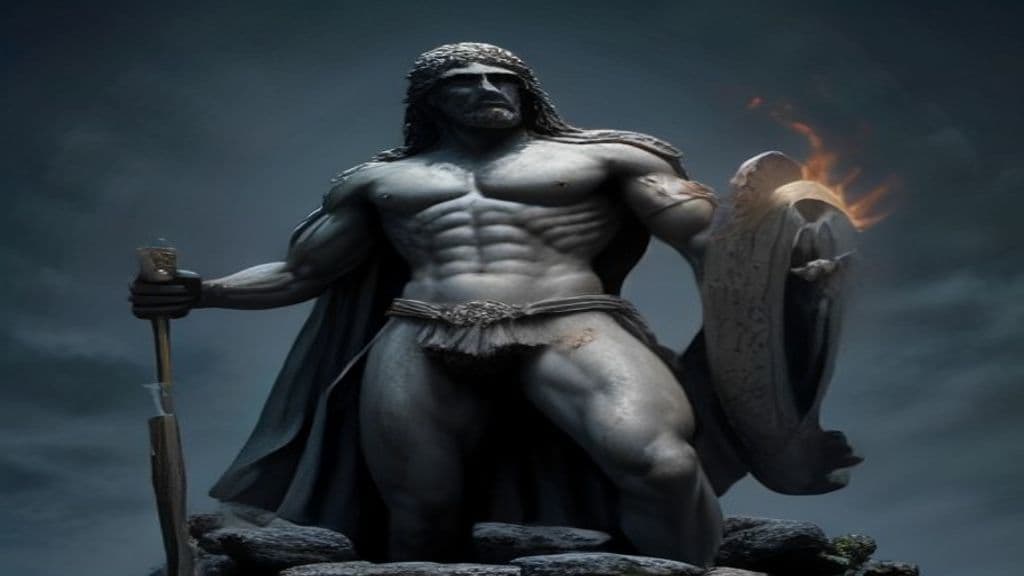
Capaneus is presented in the Greek mythic cycle as a son of Hipponous and a member of the expedition of the Seven against Thebes. He appears in tragic treatments (Aeschylus, Euripides) and in Roman epic (Statius). Genealogically he is tied into heroic lineages (father of Sthenelus in the traditions cited) and married in the narratives to Evadne (traditions vary on some familial details in different sources). His most famous narrative moment is his assault on the walls of Thebes, where his boasting against the gods brings immediate divine retribution.
Sources emphasize Capaneus's exceptional bodily size and great strength. Aeschylus (as reported in the summaries) gives him a shield bearing the image of a man without armour withstanding fire, holding a torch, and inscribed with the threat 'I will burn the city.' Beyond these points, the supplied materials do not give a detailed portrait of face, hair, or armor beyond the noted shield motif.
Capaneus is depicted as an outstanding and formidable mortal warrior and military leader (the narrative tradition credits him with great strength and prowess). A late technical attribution in the sources (Vegetius, as reported) refers to him as the first to use ladders in a siege, a historicizing remark rather than a supernatural power. His defining behaviour is arrogant defiance of the gods, most famously taunting that Zeus could not prevent his assault — a boast that leads to his death by thunderbolt while mounting a ladder.
Weaknesses
- othermortal vulnerability to divine punishment (struck by Zeus's thunderbolt while attacking Thebes)
Wards
None recorded.
Acanthus (son of Autonous)
Acanthus is a mythic human figure in a Greek metamorphosis tale (recorded by Antoninus Liberalis) who, with his family, was transformed by Zeus and Apollo into a bird named after him. The story functions etiologically, explaining the origin and behaviors of certain birds by linking them to formerly human persons and their experiences.
Achaemenides
Achaemenides is a literary mortal figure introduced into Virgil's Aeneid as a marooned member of Odysseus' crew whom Aeneas rescues on Sicily. In Roman epic he functions as a chance survivor and eyewitness who helps link the Homeric tradition to the Trojan refugees and to illustrate Aeneas' magnanimity.
Achates
Achates is the faithful human companion and attendant of Aeneas in Virgil's Aeneid, conventionally known by the epithet 'fidus Achates' and used in Latin literature as the by-word for an intimate, loyal companion.
Admetus
Admetus is a mortal king of Pherae in Thessaly in the Greek tragic tradition (notably Euripides' Alcestis). His life becomes the subject of a divine bargain in which Apollo intervenes to delay his appointed death, a bargain that requires another to die in his stead — most famously his wife Alcestis.
Admetus of Pherae
Admetus of Pherae is a mortal king of Thessaly in Greek myth whose household and fate intersect with Olympian gods (notably Apollo and Artemis), the Fates, the personification of Death (Thanatos), and the hero Heracles. He is celebrated for hospitality and justice and is best known from the tragic cycle surrounding his wife Alcestis, who dies in his stead and is later recovered.
Aegiale
Aegiale is a mortal woman in Greek mythic tradition, best known as the wife of the hero Diomedes. In post‑Trojan War nostos narratives she is depicted in several accounts as unfaithful and as plotting against her husband; some traditions attribute her conduct to the vengeance of the goddess Aphrodite.
Aeopolus
Aeopolus (Ancient Greek: Αἰπόλος, gen.: Αἰοπόλου, romanized Aipolus or Aiopólos, lit. 'goatherd') is a mortal figure in Greek mythic genealogical tradition recorded only in brief scholia and summaries. He is named as the father of Cleobule, who in one variant is cited as a possible mother of Myrtilus by Hermes; some sources note he was also called Aeolus. Attestations are limited and no cult, deeds, or narratives are preserved for him.
Aerope
Aerope (Ancient Greek: Ἀερόπη) is a mythological mortal woman of Greek tradition, a Cretan princess connected to the royal house of Mycenae (the Atreidai). In surviving accounts she functions as a human agent whose sexual relationships and/or the transfer of a symbolic object (the "golden lamb") are narrated as catalysts in the dynastic feuds of Atreus and Thyestes; sources preserve variant and sometimes conflicting traditions about her fate and parentage.
Aesacus
Aesacus (Ancient Greek: Αἴσακος) is a mythic son of King Priam of Troy who, grieving the death of a river-nymph beloved, throws himself from a cliff and is transformed mid-plunge by the sea-goddess Tethys into a diving seabird (mergus). In some traditions (Apollodorus and Tzetzes) he is also described as a seer who learned dream-interpretation from his grandfather Merops and interprets Hecabe’s dream about Paris.
Aeëtes
Aeëtes is a mythic, semi-divine king of Aea (identified with Colchis) in the Greek heroic tradition, son of Helios and the Oceanid Perseis. He is guardian of wondrous objects—most famously the Golden Fleece—and functions as a royal task-master whose demands and possessions test visiting heroes (notably Jason and the Argonauts).
Agrius and Oreius
Agrius (Ἄγριος) and Oreius/Orius (Ὄρειος) are twin sons of Polyphonte and a bear in a Greek mythic tale. Presented as 'twin savage bear-like children,' they committed acts of impiety and violence and were ultimately transformed by the gods into ominous birds (vulture and eagle-owl) as part of divine punishment and resolution.
Alcander (Alcandrus)
Alcander or Alcandrus is a personal name borne by several distinct mythic humans in Greek and Roman epic traditions: a Molossian seer who was transformed by Zeus into a wren, a Lycian warrior slain at Troy, and a companion of Aeneas killed in Italy. The entries are separate narrative figures rather than a single recurrent supernatural species.
Community Record
- [1]Capaneus - Wikipedia. Capaneus, Wikipediawiki
- [2]Thebaid, Book X (translation) — Statius. Statius, Thebaid, Book X (translation), as cited in research notesliterary
- [3]Inferno 14 – Digital Dante. Dante, Inferno Canto XIV (Digital Dante commentary)literary
- [4]Libanius, Sixteen letters to Julian the Apostate (letter reference). Libanius, Letter (reference to Amphiarus and Capaneus as two of the seven chiefs against Thebes)literary
- [5]Capaneus in ancient sources @ attalus.org. Attalus compilation of ancient references to Capaneusother
- [6]The Divine Comedy (version 2 Dramatic Reading) — LibriVox. LibriVox recording of The Divine Comedy (used as record of Dantean reception)literary
- [7]Epic interactions : perspectives on Homer, Virgil, and the epic tradition : presented to Jasper Griffin. Collected essays including reception material on epic figures such as Capaneus (archive listing)academic