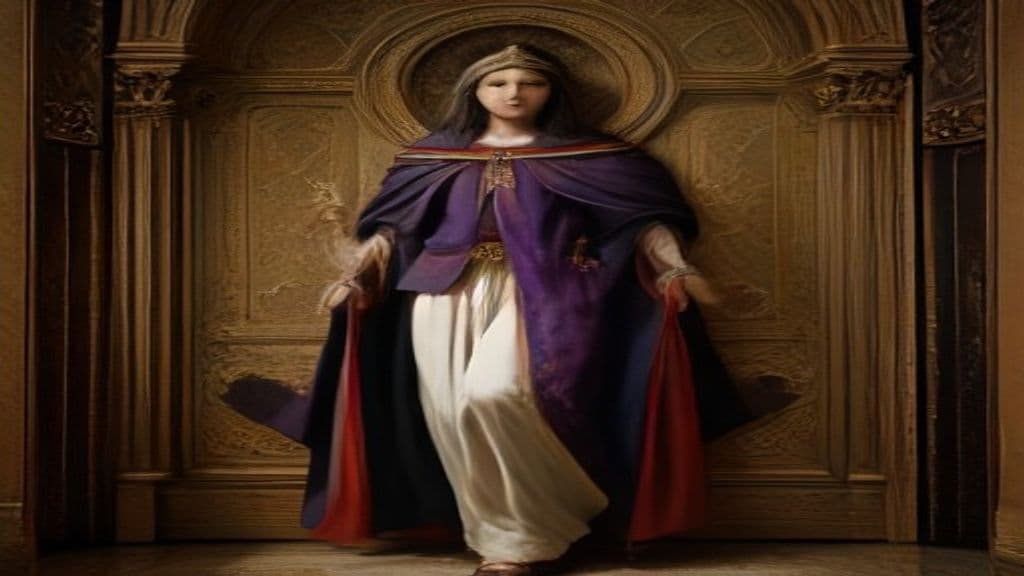
The figure of Caspar as a named individual develops from the unnamed 'Magi' of Matthew 2:1–9. The biblical episode presents non-Jewish wise men who follow a star to pay homage to the newborn Jesus but does not supply personal names. From at least the seventh century in Western Church practice the three visitors were individualized with the names Caspar (and variants), Melchior, and Balthazar; this identification became standard in medieval liturgy, devotional practice, and Christian art. Later medieval and early modern gospel books, mosaics, and paintings continued to represent Caspar as one member of this triad, and the variety of spellings across European languages reflects long-standing vernacular adaptation and diffusion.
Primary textual sources do not provide a consistent physical description of Caspar. In visual and liturgical traditions he is typically portrayed as one of three regal or exotic gift‑bearers—often clad in rich, foreign, or royal attire according to the conventions of Byzantine mosaics and Western medieval and early modern art. Artists sometimes emphasize his foreignness or status as a distinguished sage or king when composing Adoration scenes, but no single canonical or scriptural description of his age, race, or facial features is attested in the supplied sources.
Sources ascribe to Caspar the social and narrative role of a magus/wise man: interpreter of signs, traveler, and gift‑bearer who follows a star to the Nativity. The tradition frames him as a learned non‑Jewish sage (sometimes rendered as a king in later tradition) rather than a supernatural agent; the sources do not attribute independent magical powers, demonic status, or other extraordinary abilities beyond his function in the Epiphany story and his representation as a wise foreign visitor.
Weaknesses
- otherNot applicable / none attested in sources
Wards
- otherNot applicable / none attested in sources
Carol Ferris
Carol Ferris is a fictional human character in the DC Comics universe who serves as an aerospace executive and longtime romantic interest of Hal Jordan. In the comics she has been the primary host for the Star Sapphire gem/persona and is associated with the emotional-entity called the Predator within Lantern Corps cosmology.
Caroline Keene "Carrie" Kelley
Caroline Keene "Carrie" Kelley is a fictional human superheroine created by Frank Miller for his Dark Knight trilogy of Batman graphic novels (1986–2017). In that alternate-continuity narrative she becomes Batman's adolescent sidekick (Robin), later adopting other costumed identities (Catgirl, later presented in a Bat-themed outfit) and serving as a leader of younger operatives within Miller's Gotham.
Carystus
Carystus is an eponymous mythic ancestor and local heroic figure associated with the town of Carystus (modern Karystos) on Euboea. In the surviving modern summaries of classical material he is presented as a son of the centaur Chiron and the nymph Chariclo and as a genealogical/name-giving figure rather than as a narratively active deity.
Casa Romuli
Historical archaeological site associated with the legendary founder and first king of Rome, Romulus. Significant cultural and historical impact. (Note: 1. Power tier: Change to "Greater" since it's associated with a historical archaeological site and not a cosmic or deity-level entity. 2. Add sensory cues, weaknesses, and wards based on source materi)
Casamiquelia
Casamiquelia is not attested as a folklore or supernatural entity in the supplied sources. The available materials are paleontological and taxonomic references; they do not describe Casamiquelia as a spirit, deity, monster, or ritual actor.
Casella (Divine Comedy)
Casella is a historical musician and the friend of Dante who appears as a soul in the early cantos of Purgatorio in Dante Alighieri's Divine Comedy. In the poem he is encountered on the Mount of Purgatory and noted chiefly for singing, which underscores themes of friendship and the moral/aesthetic role of music in the afterlife.
Caspian IX
Caspian IX is a fictional mortal king in C. S. Lewis's Chronicles of Narnia cycle, cited in secondary sources as the murdered father of Prince Caspian whose death enabled his brother Miraz to usurp the throne. He functions as a dynastic predecessor in Narnian narrative history rather than a supernatural figure.
Cassandra
A mortal Trojan princess and priestess of Apollo who utters true prophetic visions but is divinely cursed so that her true predictions are not believed; appears in the corpus of Greek epic and tragedy associated with the Trojan War and its aftermath.
Cassandra Cain
Cassandra Cain is a fictional superheroine appearing in DC Comics, introduced in Batman #567 (1999). A human vigilante within the Batman Family, she has held the mantles Batgirl, Black Bat and Orphan and is portrayed across continuities as an exceptional, non-superpowered martial artist whose childhood conditioning shaped her identity and behavior.
Cassandra Metaphor
A person whose valid warnings or concerns are disbelieved by others, representing a prophetic figure with ignored predictions and warnings. (Note: * The power_tier is not supported by the source material, which only discusses Cassandra as a metaphor, not a Primordial entity with cosmic powers. * There is no information in the sources about appea)
Cassandra Nova
Cassandra Nova is a Marvel Comics antagonist identified as a mummudrai: a bodiless, parasitic astral life-form that manifested in utero alongside Charles Xavier, copied his DNA to create a body, and wields vast psionic powers. She is portrayed as Xavier's ideological/psychic dark twin who has committed mass violence (notably the Genosha massacre) and been opposed by powerful telepaths and containment measures.
Cassie Cage
Cassie Cage is a fictional human character in the Mortal Kombat video‑game franchise, introduced as the daughter of Johnny Cage and Sonya Blade. She debuts as a principal protagonist and next‑generation leader in Mortal Kombat X (2015) and returns with updated designs and moves in Mortal Kombat 11.
Community Record
- [1]Caspar (magus) — Wikipedia. Wikipedia, 'Caspar (magus)'wiki
- [2]Saint Caspar [Relations to actor] :: museum-digital:hessen. museum-digital: Saint Caspar entry and collection metadataother
- [3]Adoration of the Magi (Salomon Koninck) — Wikipedia. Wikipedia, painting 'Adoration of the Magi (Salomon Koninck)'wiki
- [4]From magi to kings – Swiss National Museum blog. Swiss National Museum blog, 'From magi to kings'other
- [5]Stunning Byzantine Mosaic Contains Early, Magnificent Depiction of the Three Magi. Substack article on Byzantine mosaic depiction of the Three Magiother
- [6]Biblical Magi — Alchetron. Alchetron entry on the Biblical Magiother