
In the genealogical tradition preserved for Arcadian royal houses, Cepheus is given as a son of Aleus and succeeds as king of Tegea. He is integrated into wider heroic-age narratives—appearing in lists of the Argonauts and among participants in heroic hunts and wars common to pan-Hellenic myth—and is said to have fathered twenty children. Sources record that Cepheus and most of his sons were killed during Heracles's war against Hippocoon, king of Sparta. A separate mythic figure named Cepheus, king of Aethiopia and father of Andromeda, exists in the same body of tradition; later astronomical and popular summaries sometimes conflate those two figures.
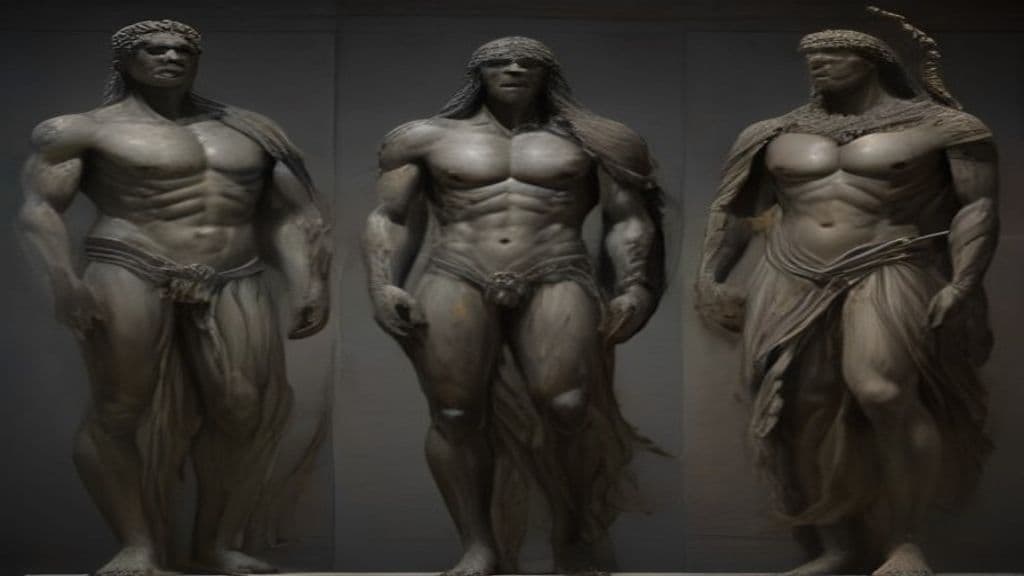
Surviving summaries and genealogical notices do not preserve a physical or pictorial description of Cepheus son of Aleus. Ancient and modern brief accounts identify him by role (king of Tegea), kinship (son of Aleus; father of Sterope and twenty children), and actions (Argonaut; slain in Heracles's campaign) rather than by costume, stature, or iconographic attributes. Thus his depiction in the supplied materials is primarily functional and genealogical rather than visual.
The sources portray Cepheus as a heroic-age mortal: he is named among the Argonauts in several lists and is sometimes included among participants in the Calydonian Boar Hunt in summarized accounts. Beyond his reputation as a warrior-king and his membership in heroic cohorts, no supernatural powers or magical abilities are attributed to Cepheus in the provided materials. He functions as a regional royal figure whose fate is shaped by encounters with greater heroes such as Heracles.
Greek water deities
A class of divine and semi‑divine beings in ancient Greek religion and mythology associated with seas, rivers, springs, and liminal watery places. The category ranges from primordial water powers through an Olympian sea‑god to localized nymphs, heroized mortals, trickster elder sea‑figures, and monstrous progeny, reflecting how the Greeks sacralized maritime and freshwater spaces.
Meliboea
Meliboea (Ancient Greek: Μελίβοια) is a personal name borne by multiple mythic women in classical Greek tradition: chiefly two Oceanid nymphs (an Arcadian/Okeanid of Mount Kyllene and a Syrian Oceanid loved by the river-god Orontes), a Niobid who survives the slaughter and becomes known as Chloris, and several mortal/eponymous heroines associated with places such as Ephesus and the Thessalian town Meliboea. The name functions across local genealogies and foundation stories rather than indicating a single coherent supernatural entity.
Centaur
A mythic hybrid from ancient Greek tradition with the upper body of a human and the lower body and legs of a horse. Centaurs appear as a tribal population associated with mountainous and wooded regions of Greece and embody tensions between human social order and untamed nature.
Centaurides (Centauresses)
Female members of the centaur (Kentauroi) tribe in Greek myth. Attested sparsely in literature (notably Hylonome) but frequently represented in Greek and especially Roman-period and late-antique visual art, often in attendant or decorative roles.
Centaurus
Centaurus (Ancient Greek: Κένταυρος, Kentauros) is the eponymous mythic progenitor of the centaur race in Greek tradition and a figure immortalized as the southern constellation Centaurus. Sources present him as a son of Apollo and Stilbe and as twin brother to Lapithes; traditions vary about which centaur the constellation specifically represents.
Cephalion
Cephalion is attested in classical and late-antique sources as a human name appearing in two distinct registers: (1) an authorial/historian or rhetorician cited by later chroniclers (placed by one source in the time of Hadrian and by another as author of a multi-volume history beginning with Assyria), and (2) a mytho‑genealogical figure named as the son of Amphithemis and the nymph Tritonis. The supplied materials present these as separate, unreconciled references rather than as a single supernatural entity.
Cephalus
Cephalus (Ancient Greek: Κέφαλος) is an ancient Greek masculine personal name borne by several mythological and literary figures. In surviving sources he appears as a hunter, husband of Procris, a beloved of the dawn-goddess Eos in some traditions, a son in varying genealogies, and as a named interlocutor in Plato's Republic rather than as a class of supernatural being.
Cephisso
Cephisso is attested in classical-era lists as one of a triad of Muses described in some local Greek traditions as daughters of Apollo and associated symbolically with lyre-string names. She appears in brief encyclopedic and mythographic notices rather than in extended mythic narratives.
Cephissus
Cephissus (Kephisos) is the personified river-divinity name applied to several distinct rivers in ancient Greece (notably in Attica, Boeotia/Phocis, and Argolis). As one of the Potamoi, Cephissus functions primarily as a local river-god appearing in genealogies (father of naiads and certain mortals), in topographical myths, and in occasional civic or adjudicatory mentions.
Cerberus
The three-headed hound of Hades, guardian of the underworld's gates — welcoming the dead in but allowing no shade to leave and no living mortal to enter uninvited.
Cercaphus
Cercaphus (Ancient Greek Κέρκαφος) is a name borne by several related figures in Greek mythic genealogies and local foundation stories. Most prominently he appears among the Heliadae of Rhodes—portrayed as a son/descendant of Helios whose descendants become eponymous founders of Rhodian cities—but variant traditions attach the name to other ancestral figures in Thessaly and localized etiologies.
Cerceis
Cerceis (Ancient Greek Κερκηίς, Kerkēís) is named in Greek mythological genealogies as one of the Oceanids, the many nymph-daughters of the Titans Oceanus and Tethys. She is attested as a water-associated nymph whose name in the surviving tradition is glossed either as 'of the weaving shuttle' (from kerkis) or as 'gorgeous in form.'
Community Record
- [1]Cepheus (disambiguation) — Wikipedia. Wikipedia, 'Cepheus' (disambiguation)wiki
- [2]Cepheus (son of Aleus) — Wikipedia. Wikipedia, 'Cepheus (son of Aleus)'wiki
- [3]Sterope of Tegea — Wikipedia. Wikipedia, 'Sterope of Tegea' (notes Sterope as daughter of Cepheus and mentions Heracles giving a lock of Medusa's hair to protect Tegea)wiki
- [4]Cepheus — Chandra Photo Album (Harvard/Chandra). Chandra/Harvard, 'Constellation Cepheus' (notes two mythological kings named Cepheus and includes a summary that conflates placement in the heavens)other
- [5]Cepheus — Chandra Photo Album (Smithsonian/Chandra). Chandra/Smithsonian, 'Constellation Cepheus' (constellation summary referencing mythic Cepheus)other
- [6]The Argonaut Cepheus in Greek Mythology - Greek Legends and Myths. GreekLegendsAndMyths, 'The Argonaut Cepheus' (lists Cepheus among Argonauts)folk
- [7]Cepheus constellation notes — dibonsmith. dibonsmith.com, 'Cepheus' (constellation and myth notes)other