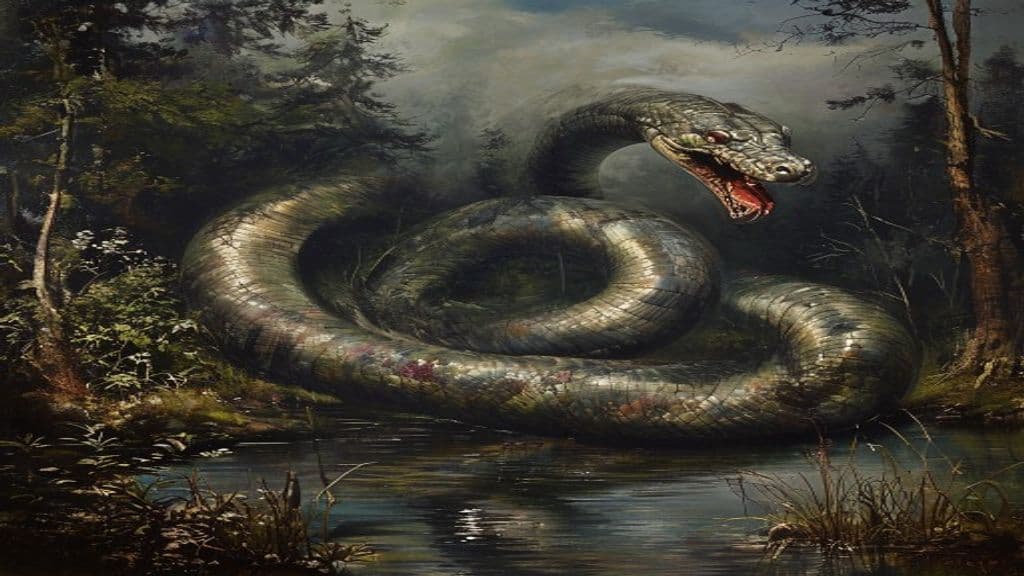
Modern narratives of Champ are grounded in a layered folkloric history rather than a single authoritative origin text. Sources cite Iroquoian (Mohawk) traditions of giant serpents (Onyare'kowa) as antecedent motifs and record European‑era and settler reports from the lake beginning in the 19th century; nineteenth‑ and twentieth‑century newspaper accounts and later popular media linked these strands to produce the named local being 'Champ' used in contemporary storytelling and tourism. The corpus does not provide a documentary lineage equating Onyare'kowa directly with the modern named creature, but treats Indigenous serpent motifs as part of the antecedent cultural material that informs the local legend (see cited reports from 1819, 1883, and later photographic and audio claims).
Descriptions vary across sources and time. Historical newspaper and eyewitness reports describe a large serpentine form: an 1819 Plattsburgh Republican account attributed to 'Capt. Crum' gives an enormously long serpentine figure with colored markings and facial details; an 1883 sheriff's report by Nathan H. Mooney estimated a 25–30 ft (7.6–9.1 m) water serpent and reported seeing round white spots inside its mouth. Modern photographic and video claims (notably Sandra Mansi's 1977 photograph and later video/drone footage) appear to show a long neck and head emerging from the water and have been interpreted by some as 'plesiosaur‑like,' but these images and their provenance are disputed (Mansi's negative was reportedly discarded and location details are uncertain) and alternative explanations such as logs or floating debris are recorded in the sources.
Reported abilities are limited to naturalistic behaviors attributed by eyewitnesses and investigators: swimming within Lake Champlain, surfacing or emerging with a long neck/head, and occasionally being followed by other fish. A 2003 project (Fauna Communications Research Institute) recorded underwater sounds described by the group as similar to beluga or dolphin vocalizations and an article suggested these might be a form of echolocation, noting the lack of known native echolocating species in the lake. The sources do not ascribe supernatural powers, maleficence, or magical agency to Champ; its influence is primarily cultural as a persistent local cryptid attracting public interest and tourism.
Chalchiuhtlatonal
Chalchiuhtlatonal is presented in the cited sources as an Aztec god of water related to the water goddess Chalchiuhtlicue. The sources state that "he looks over the sea, and protects the animals living in it," and that "he granted the gift of water to one human in 10,000 years to help look after the sea."
Chalchiuhtlicue
Chalchiuhtlicue is a principal Nahua/Aztec water deity associated with groundwater, rivers, streams and other waters, and with fertility, childbirth, ritual bathing and purification. She is a calendrical and cultic figure in central Mexican religion who, in mythic tradition, presided over the era of the Fourth Sun and caused a prolonged flood that destroyed that world-age.
Chalciope
Chalciope (Ancient Greek: Χαλκιόπη, Khalkiópē, literally 'bronze-face') is a personal name attested for several distinct mortal women in Greek mythic genealogies. In the sources she functions as a dynastic or marital figure—daughter, wife, or mother—whose significance lies in lineage and offspring rather than any supernatural attributes.
Chalcodon
Chalcodon is a recurring personal name in ancient Greek tradition borne by several distinct mortal figures — kings, princes, and warriors — who appear across local genealogies and heroic narratives (e.g., as a son of Aegyptus, a king of the Abantes, and a king of Kos). The name functions as a legendary human ancestor and narrative foil rather than as a single supernatural being.
Chalcon
Chalcon (Ancient Greek: Χάλκων) is a personal name borne by several distinct figures in Greek myth and epic—ranging from ordinary mortal princes, fathers, and a charioteer/tutor to one attested member of the Telchines. The name does not denote a single species or office but recurs across genealogies and Trojan War–cycle episodes.
Chalkydri
Mythical, angelic creatures associated with the solar cycle and dwelling near the Sun. (Note: - Power tier: Primordial (Chalkydri's abilities are described as bringing heat and dew, which is a cosmic-level phenomenon) - Weaknesses: not mentioned in source material - Wards: not mentioned in sou)
Champion of the Universe (Tryco Slatterus)
A fictional Marvel Comics character, Tryco Slatterus — the Champion of the Universe — is one of the alien Elders of the Universe whose singular vocation is proving himself the greatest warrior in the cosmos. He is portrayed as an ancient, nigh-immortal, physically superlative combatant who travels to challenge powerful fighters and has alternately acted as challenger, ruler, or antagonist within comic-book stories.
Chamrosh
Supernatural bird entity inhabiting the summit of Mount Alborz in Persian mythology. (Note: 1. Remove "Origin story" section since no origin story is provided in the source material. 2. Add a statement about the lack of specific abilities or behaviors under the "Abilities" section to clarify)
Chamunda
Chamunda (also Chamundeshwari, Chamundi) is described in the provided sources as a fearsome form of Chandi, a manifestation of the Hindu mother goddess (Mahadevi), and is counted among the seven Matrikas.
Chanda and Munda
Chanda and Munda are two named asura warriors in the Devi Mahatmya narrative who are sent by the demon-kings Shumbha and Nishumbha to confront the Goddess; their slaying by the goddess's terrifying war-aspect (Kali/Chamunda) gives rise to the epithet Chamunda.
Chandalika
A Dayan witch who has reached approximately 1600 years of age — the final threshold, beyond which she has become more force than person, capable of destroying entire lineages and withstanding divine invocations.
Chandi
Chandi (Caṇḍī / Caṇḍikā) is a fierce aspect of the Hindu Divine Feminine (Devi) prominent in Śākta traditions, celebrated in the Devi Māhātmya (Durga Saptashati) as a warrior‑protector and purifier. She is invoked in homa/chanting rites (Chandipath/Chandi Homam) to remove obstacles, cure evils, and bestow auspiciousness, and appears both in pan‑Indian scripture and varied local village forms especially in eastern India and Gujarat.
Community Record
- [1]Champ (folklore) — Wikipedia. Wikipedia, 'Champ (folklore)'wiki
- [2]Champ | USC Digital Folklore Archives. USC Digital Folklore Archives, 'Champ'folk
- [3]Lake Champlain Monster: Champ | USC Digital Folklore Archives. USC Digital Folklore Archives, 'Lake Champlain Monster: Champ'folk
- [4]Champ (folklore) mirrored entry. Mirrored Wikipedia entry used in corpuswiki
- [5]Lake monster — Wikipedia (comparative motif). Wikipedia, 'Lake monster' (used for comparative category context)wiki
- [6]Bookmice.net — Champ summary. Popular summary and compilation of Champ reportsother