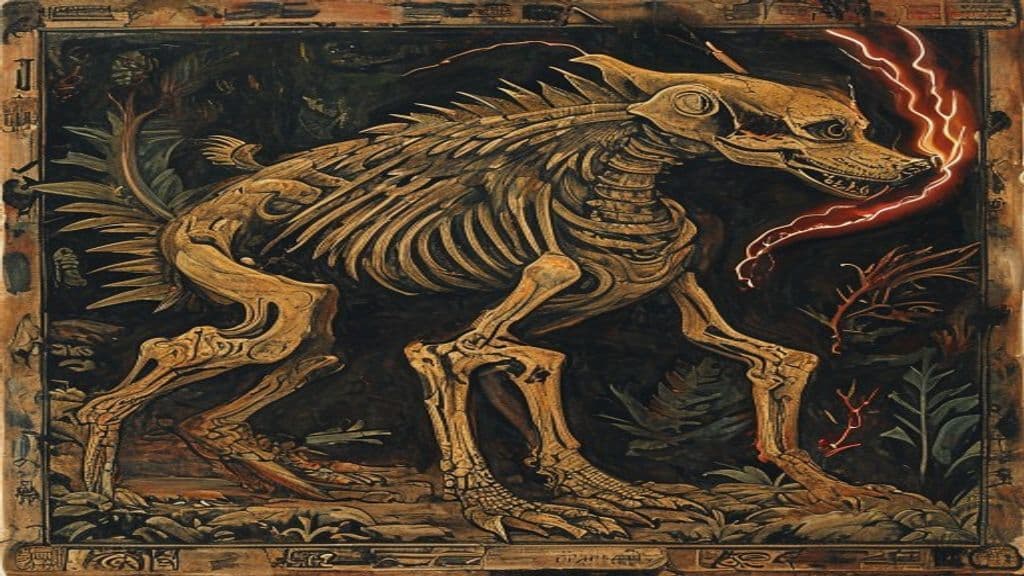
In the narrative recorded in colonial codices (Codex Vaticanus A / Codex Rios) Chantico breaks a ritual fast by eating paprika with roasted fish; as punishment Tonacatecuhtli transforms her into a dog. This story, preserved in the codical and colonial ethnohistoric record, is presented as a moral and ritual lesson about observance of fasts and correct festival behavior and is tied in source commentary to Chantico's calendrical rulership of the ninth day (Nine Dog).
Codical and Sahagún-era descriptions present Chantico with a yellow face marked by two red lines (a fire designation), a yellow body, and specific regalia: a nose ornament (yacapapalotl), small disks around the head, and in Sahagún's description items such as gold ear ornaments, a bouquet of dried herbs, a white kilt, bells, and white sandals. Other iconographic markers across codices include a crown of cactus spikes, a warrior-feather crest (aztaxelli), the atl-tlachinolli motif at the nape (water-fire symbol linked to war and pestilence), obsidian sandals (itzcactli), occasional solar pendants, and at least one depiction in Codex Borgia placing an eagle-foot/eagle-jaguar sacrificial motif in association with her seat or shrine. Colonial descriptions refer to her frequently as the "yellow woman." Sources note ambiguity in gendering in some codical passages.
Sources ascribe to Chantico the role of guardian or sacred power tied to household hearth fires and domestic ritual (Sahagún and codices). She is calendrically associated with the ninth day (Chiconaui itzcuintli / Nine Dog), a day that colonial calendars and codices link with sorcery and misfortune for those born then. Iconography and colonial commentary also connect Chantico to martial symbolism and pestilential/agonistic aspects of fire (atl-tlachinolli, warrior dress, and sacrificial imagery). An origin myth records her being punished by transformation (into a dog) for breaking a fast, linking ritual propriety to mythic consequence. Occupationally, she is associated with stonecutters (tlatecque) and had formal cultic observance in temples (tetlanman) and precincts of the Templo Mayor.
Weaknesses
- conditionritual fasting observance (mythic transgression)
Wards
- ritualtemple cult offerings and priestly care
Acolnahuacatl
Acolnahuacatl is a name attested in central Mexican sources both as a historical Tepanec ruler of Azcapotzalco and, in several modern compilations and trivia lists, as a minor chthonic or underworld-associated figure (often given the variant Acolmiztli). The evidence in the provided material is divided: the historical/genealogical reading is supported by standard reference entries, while the deity reading appears mainly in secondary online god-lists and quizzes and is not substantiated by detailed primary ritual or mythic texts in the supplied set.
Ahuiateteo
Ahuiateteo (Āhuiatēteoh; also rendered Mācuīltōnalequeh) are a quintet of Aztec deities associated with excess, pleasure, and the dangers that accompany over‑indulgence. They appear in calendrical and codical contexts, are invoked in divinatory practice, and are thematically linked to pleasures (feasting, drinking, gambling, sex, music) and the misfortunes that follow excess.
Ahuitzotl
Ahuitzotl is both the personal name of the eighth tlatoani (ruler) of Tenochtitlan (reigned ca. 1486–1502) known for military expansion and monumental rebuilding, and an onomastic term in Nahuatl for an aquatic animal/legendary creature (commonly glossed 'water thorny' and often associated with an otter or water opossum). The sources treat these registers—historical ruler and animal-name—as related but distinct uses of the same Nahuatl lexeme.
Ahuizotl
Ahuizotl is identified in the provided sources as an Aztec mythological creature; the same lexical form also names an historical Aztec emperor (Ahuitzotl). The available materials for this entry are limited to modern reference pages and a small set of artistic and popular-culture uses of the name, and do not contain primary indigenous mythic accounts or detailed ethnographic descriptions.
Akateko
Akateko (赤手児, lit. 'red child's hand') is a yōkai from Japanese folklore commonly told as a small, red, disembodied child's hand that appears from trees—especially the Japanese honey locust—and startles travelers; in some regional variants it is accompanied by a specter of a young woman or manifests as paired foot- or leg-like apparitions. Accounts vary between mostly harmless trickster apparition and a violent variant that attacks humans.
Alicante
Alicante is attested in available reference sources as the proper name of a mythological snake identified with Mexico. The surviving entries provide only the name and a categorical label (mythological snake) without accompanying narrative, attributes, or ritual context.
Amimitl (Opochtli)
A Mexica/Aztec deity associated with fishing, hunting, and water-related technologies; identified in sources with the better-documented figure Opochtli, "The Left," who functions as a specialized patron of implements and as a representative or attendant of the rain god Tlaloc. A temple in the Tira de la Peregrinación has been interpreted by a scholar as possibly belonging to a figure labeled Amimitl, but that identification is uncertain.
Atabey
Atabey is a principal Taíno ancestral mother-spirit (a zemi) associated with fresh water, fertility, and prime matter; she appears in early ethnohistorical transmissions with multiple names and manifestations ranging from nurturing mother to violent storm-mother.
Atlacoya
Atlacoya is named in modern compilations as a figure from Aztec tradition associated with drought; some modern databases alternately classify the name under water-deity categories. The supplied sources do not provide primary-codex citations, iconography, etymology, or detailed ritual texts.
Atlahua
Atlahua is an Aztec water-associated deity attested in colonial and modern summaries as a water god described as a fisherman and archer, identified in sources as a blue/aspectual form of Tlaloc and invoked in contexts of deaths in water.
Atlaua
Atlaua (also recorded as Atlahua, Ahtlahua, Atlahoa, Atlavâ) is an Aztec water deity described in the provided sources as a water god, fisherman and archer who was worshiped at multiple temples and was prayed to by the Aztecs when there were deaths in water.
Aztec Creator-Brothers
A quaternity of primordial divine offspring in Aztec (Mexica) myth who dwell in the highest heaven Ilhuicatl-Omeyocan as children of Omecihuatl and Ometecuhtli. Identified in sources with fourfold aspects (conventionally four Tezcatlipocas / colored aspects such as Black, Red, White, Blue) they act as cosmological agents who create living beings, take turns ruling as the Sun in successive world-ages, and participate in sacrificial acts that sustain cosmic cycles.
Community Record
- [1]Chantico — Wikipedia. Wikipedia entry 'Chantico' summarizing Sahagún, Codex Borgia, Codex Vaticanus A / Codex Rios, and related scholarship.wiki
- [2]Chantico — Wikidata. Wikidata entry for Chantico (concise classification noting association with fire and volcanoes).wiki
- [3]Archive references cited in research notes (contextual). Archive URL listed among source material in research notes (contains compiled references; not a primary codex).other
- [4]Hooting Yard On The Air: On Gods (contextual). Archived page listed in research notes referencing gods (contextual only).other