
Chiwen appears in two intertwined registers in Chinese sources: as one of the Nine Sons of the Dragon (a named dragon‑child figure) and as a long‑attested roof ornament. The motif is archaeologically and visually attested from Han dynasty tomb models and murals through Tang glazed examples; Song‑era building treatises (Yingzao Fashi) formalize construction terminology; later Ming and Qing examples show stylistic elaboration. Sources treat the creature‑name and the ridge‑end ornament together, with older birdlike antecedents (chiwei) evolving into the fish‑dragon forms recorded in later periods.
Iconography commonly shows a dragon head combined with a fishlike body, often with an enlarged wide mouth as if swallowing roof beams; earlier antecedents retain birdlike features (wings or bird heads). Chiwen ornaments are placed at both ends of roof ridges and are commonly made in glazed ceramics (green/blue glazes from the Tang onward), pottery, or colored glass. Song dynasty forms trend more dragonlike, while Ming and Qing examples become more ornate with inward‑turning bodies/tails and regional stylistic variation.
In folklore and architectural symbolism Chiwen 'likes to swallow things' and is placed at ridge ends to 'swallow all evil influences'—a protective attribution quoted in Ming sources. As an architectural element it serves symbolic protective roles against fire, floods and typhoons and may perform practical functions analogous to a waterspout or finial (some sources note the motif 'can spray waves and rain' and compare it functionally to Western gargoyles). Sources do not describe independent supernatural agency beyond these symbolic and practical functions.
Weaknesses
- othernone recorded in provided sources
Wards
- otherinstallation of chiwen on roof ridge ends (architectural placement as preventive measure)

Shachihoko
A Japanese mythic sea-creature and roof-ornament (shibi) combining a predator head (dragon or tiger) with a carp body. In Japanese architectural and folkloric contexts it functions as an apotropaic roof guardian believed to store water and control rain, used primarily to protect wooden buildings from fire and as a status emblem.
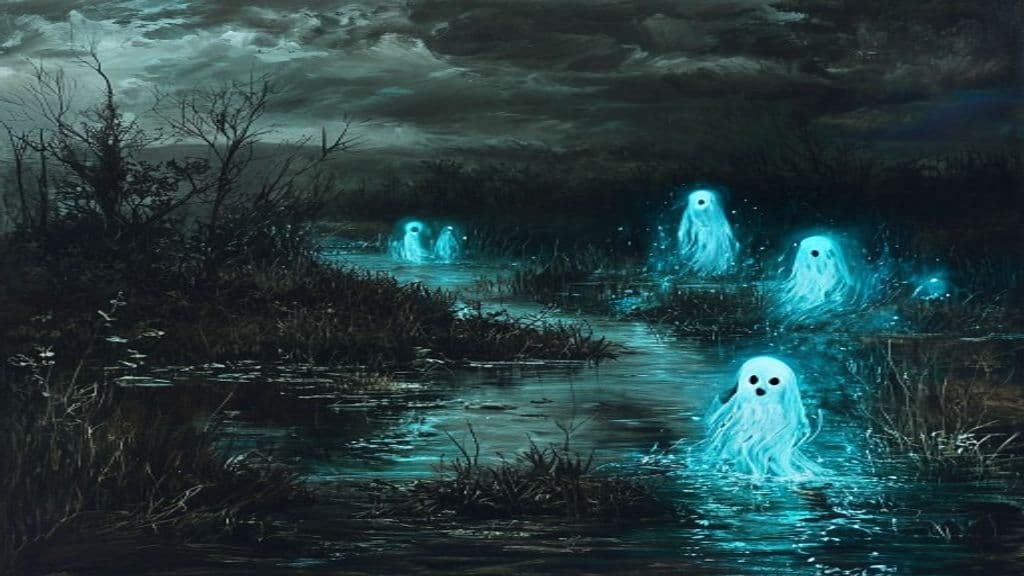
Will-o'-the-Wisp
A wandering light seen over marshy ground at night, leading travellers astray into bogs and fens. Possibly a spirit, possibly the soul of the unbaptised dead, possibly the devil himself.
Asian dragon (long / loong)
The Chinese or Asian dragon (Chinese: long or loong) is a legendary creature in Chinese mythology, folklore, and culture, widely represented as an auspicious, potent being most commonly associated with control over water and weather. It appears across myth, art, and modern public performance rather than as a single folkloric apparition with standardized ritual responses.
Bixi
Bixi (Bi Xi) is a named figure in Chinese mythological lists—traditionally counted among the nine sons of the dragon—and is the canonical form for tortoise-bodied, dragon-crowned stone mounts that bear commemorative stelae. The form functions primarily as an architectural and commemorative sculptural motif used in funerary complexes, imperial mausoleums, and public commemorations from at least the late Han dynasty through the Ming and Qing.
Chang'e
Chang'e (嫦娥), originally attested as Heng'e and linked to the older name Chang Xi, is the female lunar immortal of Chinese myth who resides in the Moon Palace (廣寒宮). Best known from the elixir-of-immortality tale in which she ascends to the Moon and is accompanied there by the Jade Rabbit, she functions across religious and literary contexts as a lunar goddess/immortal and a poetic symbol of solitude and longing.
Dilong (地龍)
Dilong (地龍; dìlóng, "earth dragon") is a category-name in Chinese dragon taxonomy denoting dragons associated with the earth/ground. The term is polyvalent in sources: it designates an earth-associated dragon-type in cosmological and omen literature, and by analogy names earthly animals (notably the earthworm) used in materia medica.
Fox spirit
A widespread class of mythical beings associated with foxes (often represented by red-fox imagery in many traditions) characterized by cunning, shapeshifting, trickery, and ambiguous moral roles; prominently attested in East Asian folklore and present in modern literature and media as romantic, vengeful, or matchmaking figures.
Huli jing (Fox spirit)
Huli jing (狐狸精), commonly rendered in English as "fox spirit," are shapeshifting supernatural beings from Chinese folklore and mythology. Classified among the broader class of yāoguài, they are morally ambivalent figures that may be benevolent, malevolent, or trickster-like depending on the tale and context.
Hungry ghost (E gui)
Listed in a compiled catalogue of supernatural beings from Chinese folk culture and contemporary literature, 'hungry ghost (E gui)' appears as an itemized class of supernatural being in the provided sources. The supplied materials contain the name but do not give further descriptive or ritual detail.
Lady Meng Jiang
Lady Meng Jiang (孟姜女; Mèng Jiāng Nǚ) is a legendary Chinese heroine whose sincere mourning for a husband conscripted to build a wall is said in tradition to have caused a portion of the wall to collapse and reveal his remains. Originating in early anecdote and moral-biographical literature, the tale evolved across centuries into popular balladry, temple cult, and local commemorative practices tied to sections of the Great Wall.
Suiko (水虎)
Suiko (水虎, literally "water tiger") is a Chinese legendary river creature described in the cited sources as inhabiting river systems in areas such as Hubei Province. The available descriptions are minimal and chiefly record its riverine habitat and a single physical detail: it is said to be the size of a three- or four-year-old child.
Swan maiden
A widespread folktale and mythic figure: a female being who changes between human form and a bird via a feathered garment (feather cloak, swan‑shirt, hagoromo). The motif appears across many cultures and is classed in folktale catalogues under ATU 400 and related 'magic wife' narratives.
Tiger spirit (Hu jing)
A provisional, research-note reconstruction: no direct primary or secondary sources in the supplied corpus document a discrete Taoist entity named "Hu jing" (虎精). The entry frames how a hypothetical "tiger spirit" might be situated within Chinese yaoguai and Taoist cosmological templates based only on general sources about animal-spirits and Taoist practice.
Vengeful ghost
A cross-cultural category for spirits of deceased persons who return to the living world to seek redress for a wrong suffered in life. Commonly tied to violent, unjust, or improperly handled deaths and addressed by culturally specific rites of appeasement, exorcism, or corrective funerary treatment.
Community Record
- [1]Chiwen - Wikipedia. Wikipedia: Chiwen (entry summarizing Chiwen as roof ornament and dragon‑son; quotes Ming Wuzazu; discusses iconography and protective function)wiki
- [2]Wikidata: Chiwen (Q758019). Wikidata summary noting sculptural form: 'dragon heads and fish bodies' at roof endsother
- [3]ninesons.txt — Nine Sons of the Dragon catalogue. Catalogue and discussion of the Nine Sons of the Dragon listing Chiwen among the set and noting architectural rolesother
- [4]Samim — Chiwen description (architectural component at ridge ends). Online compilation describing chiwen as animal‑shaped ridge components at both ends of roofsother
- [5]Rhabdophis chiwen (species note). Notes modern taxonomic use of the name 'chiwen' for a snake species; distinct from the mythic/architectural creaturewiki
- [6]Zoomorphic Ornaments / architectural literature. Discussion of zoomorphic roof ornaments and comparisons (notes waterspout/finial functions and cross‑cultural parallels)other