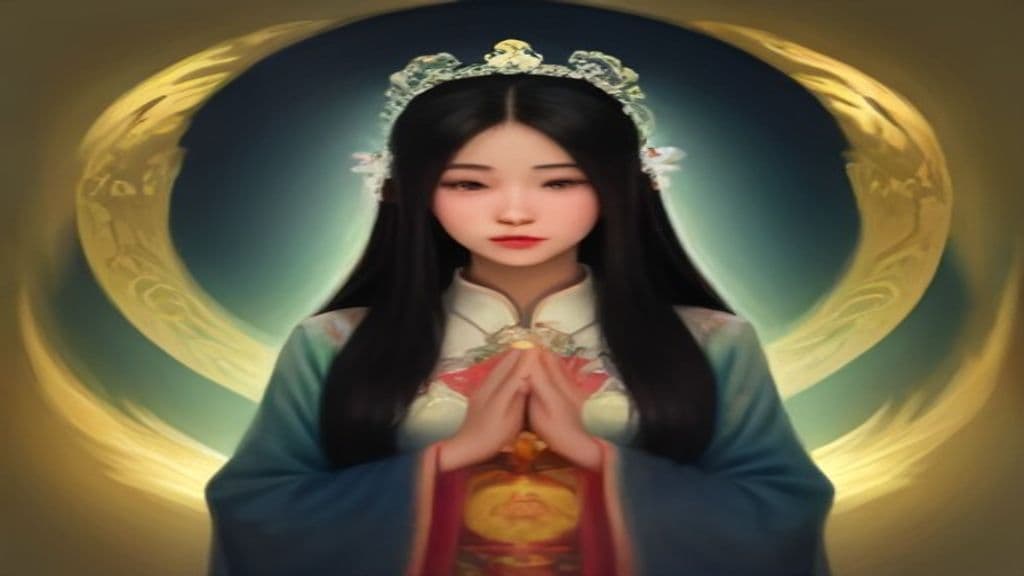
In the classical account preserved in later compilations of earlier material, Chang'e was a woman in the mythic age whose husband or consort, the archer Hou Yi, received two portions of an elixir of immortality. Variants in the tradition describe Chang'e taking the elixir (in some versions to prevent its being seized by the apprentice Fengmeng; in older versions presented as theft) and then ascending into the heavens to make the Moon her immortal residence. The tale is recorded in early Zhou-period divinatory fragments (Guicang) and later reworked across literary histories and popular retellings; her ascension is the central origin motif connecting her to the Moon Palace (廣寒宮).
Sources emphasize Chang'e's renowned beauty and portray her as a graceful celestial maiden or lunar attendant; detailed physical attributes beyond her beauty are not specified in the surveyed materials. She is commonly depicted in literature and popular imagery as a young female immortal associated with the Moon and accompanied by the Jade Rabbit (玉兔).
Primary mythic ability recorded in the sources is transformation/immortalization via the elixir of immortality: consuming the elixir enabled her ascent and permanent residence on the Moon. She is represented as a lunar immortal who inhabits the Moon Palace (廣寒宮) and forms part of a cosmology of immortals, celestial palaces, and attendant functionaries. In literary sources she also functions as a symbolic figure—embodying nostalgia and solitude in poetry (for example, work by Li Shangyin). Narrative episodes place her among Moon Palace maidens and link her to interactions with other mythic figures (Hou Yi, Fengmeng, the Jade Rabbit, and lunar officials mentioned in Journey to the West), but the provided texts do not attribute destructive powers, magic rituals, or defined combat abilities to her.
Ao Kuang
Ao Kuang (also attested as Ao Guang) is the Dragon King of the East Sea in Chinese mythology and folk religion, one of a quartet of sea-dragon sovereigns associated in folklore with the cardinal seas. He appears in classical literature and later popular media as a ruler of maritime waters whose favor or displeasure is connected to tides, rain, floods and storms.
Asian dragon (long / loong)
The Chinese or Asian dragon (Chinese: long or loong) is a legendary creature in Chinese mythology, folklore, and culture, widely represented as an auspicious, potent being most commonly associated with control over water and weather. It appears across myth, art, and modern public performance rather than as a single folkloric apparition with standardized ritual responses.
Bai Ze
Bai Ze (白澤, Báizé; Japanese Hakutaku) is a legendary sacred creature in Chinese tradition famed as an authoritative recorder of ghosts and gods whose illustrated compendium (Bái Zé Tú) was employed as a household prophylactic against spirit-world harm. The creature’s image and diagrams were used in China and later Japan to identify, ward off, and prescribe avoidance of spectral calamities.
Bi'an
Bi'an is attested in the provided sources primarily as a named member of the traditional roster called the Nine Sons of the Dragon, appearing in catalogues of mythic names. The figure is also present as a name-form within the broader lexical field of Chinese folk religious beings (for example, appearing alongside death-escort deities in separate sources), but the supplied materials do not furnish an independent, detailed myth or cultic biography for Bi'an.
Bixi
Bixi (Bi Xi) is a named figure in Chinese mythological lists—traditionally counted among the nine sons of the dragon—and is the canonical form for tortoise-bodied, dragon-crowned stone mounts that bear commemorative stelae. The form functions primarily as an architectural and commemorative sculptural motif used in funerary complexes, imperial mausoleums, and public commemorations from at least the late Han dynasty through the Ming and Qing.
Chenghuangshen (City God)
Chenghuangshen (城隍神), commonly called the City God, is a tutelary deity in Chinese folk religion tied to a specific settlement. Historically associated with a city's walls and moat, the deity functions as protector of local affairs and as a local official in the postmortem ordering of souls for that place.
Chinese dragon (long / loong)
A central legendary zoomorphic being in Chinese myth and culture (Chinese: long / loong), the dragon embodies auspicious cosmic and ancestral power, especially mastery over water and weather, and functions as an imperial and communal emblem across material culture, ritual performance, and state iconography.
Chinese ghosts
Spirits of deceased persons in Chinese folk belief, integrated with ancestor-worship and syncretic Buddhist ideas; often conceived as potentially malevolent if neglected or provoked, while some deceased become honored ancestral spirits through proper ritual care.
Chinese gods and immortals (shenxian)
A heterogeneous corpus of deities (shen) and immortals (xian) in Chinese religious and mythic thought, understood as manifestations or localizations of the cosmic principle (Tian/Tao/qì). They include celestial gods, local tutelaries, deified culture-heroes, and Taoist immortals formed and sustained by temples, ancestral ritual, and popular cult.
Chinese guardian lions (shī, 石獅)
Stone or metal sculptural guardian lions (Chinese: shī, often 石獅 shíshī "stone lion") placed in male–female pairs at thresholds to protect buildings and occupants. Originating in Chinese Buddhist and imperial symbolism, they function as apotropaic architectural emblems believed to ward off harmful spiritual influences and hostile humans when correctly placed.
Chiwen
Chiwen (蚩吻 / 鴟吻 / 鴟尾 / 螭首) is a Chinese mythic dragon‑child figure and an associated class of roof ornament placed at the ends of roof ridges. As one of the traditional Nine Sons of the Dragon, Chiwen is represented in architecture as a dragon‑head/fish‑body finial that symbolically 'swallows' ill influences and functions as a protective architectural device (waterspout, finial) to guard buildings against fire, floods and other hazards.
Daji
Daji (妲己, Dájǐ) is a figure in Chinese narrative and popular religious-cultural materials who blurs human and spirit categories: historically remembered as the favorite consort of King Di Xin of Shang but in later legend and fiction identified as a fox‑spirit (often a nine‑tailed or thousand‑year fox) that possessed or impersonated the woman and precipitated moral and political decline.
Community Record
- [1]Chang'e — Wikipedia. Wikipedia contributors, 'Chang'e,' Wikipedia, The Free Encyclopediawiki
- [2]Wikidata entry: Chang'e. Wikidata, entry Q466462other
- [3]Archive references and modern cultural deployment (selection). Archive.org aggregated materials referencing modern uses of the name Chang'e (e.g., lunar probe names)other
- [4]Notes compiled from provided research brief. Compiled research notes supplied with the prompt (summarizing classical attestations in Guicang, Classic of Mountains and Seas, Tang poetry, Ming/Qing novels, Journey to the West, and modern cultural usage)literary