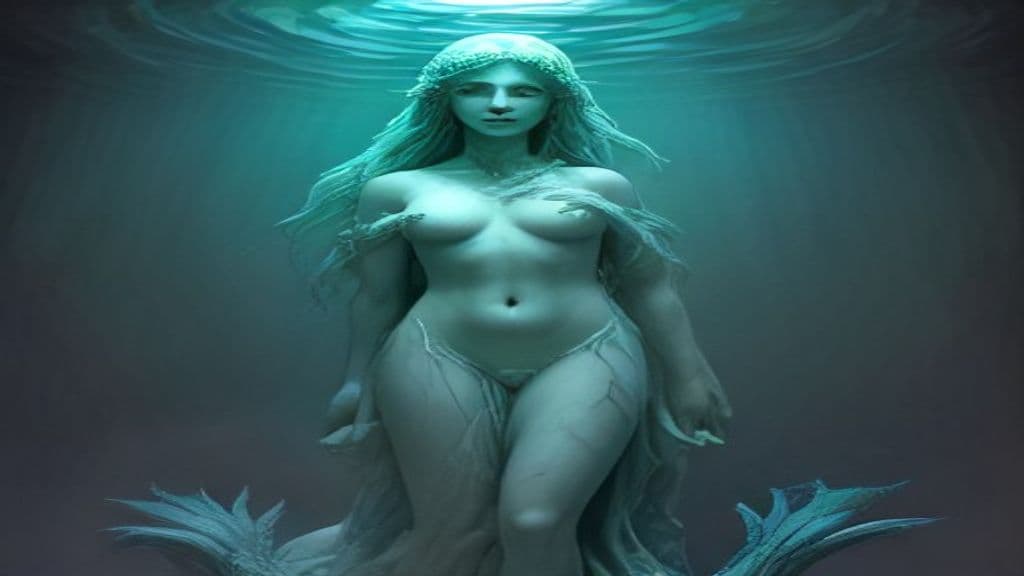
Creneis is presented genealogically as a daughter of Nereus, the so-called 'Old Man of the Sea,' and Doris, an Oceanid. In the classical cataloguing tradition that survives in sources such as Hyginus' lists and later encyclopaedic summaries, she is one member of the fixed cohort of fifty Nereids. This places her within the wider mythic genealogy that traces sea-related personifications and minor divinities back through primordial and oceanic ancestors (Pontus, Ocean, Oceanids). The surviving attestations do not relate an independent origin myth for Creneis beyond this parentage and her inclusion in the Nereid roster.
No specific physical description of Creneis is preserved in the supplied sources; she is known only as a named Nereid. By virtue of that classification, classical tradition generally conceives Nereids as female sea-nymphs attendant on the sea and its deities, but the sources provided do not ascribe particular features, attire, or iconography to Creneis herself. Any detailed image of her appearance would be speculative and is not supported by the cited material.
The available texts do not attribute distinct powers, deeds, or behaviors to Creneis individually. Her role in the literary record is as a member of the Nereid collective; while certain Nereids in wider classical literature sometimes act as helpers of sailors or attendants to greater sea-gods, no such functions or specific abilities are recorded for Creneis in the supplied genealogical lists. Thus she should be understood, on present evidence, as an unindividuated named sea-nymph within the broader category of Nereids.
Weaknesses
- othernone attested in sources
Wards
- othernone attested in sources
Creator God (creator deity)
A functional category of divine agents held responsible for the origin of the world, Earth, and universe within a given religious or mythological system. Depending on tradition the creator is identified with the single supreme God (especially in monotheisms), is one among multiple creator-deities (ancient/polytheistic contexts), or is distinguished from a more transcendent ultimate being.
Creator being
A creator being (creator deity) is the divine agent ascribed responsibility for the origin of the Earth, world, or universe within a religious or mythological system. In some traditions the creator is identical with the single God; in others a secondary creative agent is distinguished from a more transcendent ultimate being.
Creator deity
A category of divine being held responsible in a religion or myth for bringing the earth, world, or universe into being; functions as the explanatory center of cosmologies and as the ultimate source of existence in many traditions.
Creiddylad
Creiddylad is a named figure from early medieval Welsh narrative tradition, presented in Culhwch ac Olwen as a noblewoman of Arthur's court and daughter of King Lludd (Lludd Llaw Ereint). In the surviving tale she is the object of rivalry between two warriors whose annual May Day combat for her possession has been interpreted by later writers as a seasonal or 'May Queen' motif.
Creidhne
Creidhne (Old Irish Credne) is the goldsmith and artisan of the Tuatha Dé Danann in Irish mythology, a member of the Trí Dée Dána who forged weapons and metal-works for the supernatural people and is credited with helping to fashion King Nuada's silver hand.
Crenaeus
Crenaeus is a minor named figure in Roman-era treatments of Greek myth, attested as a son of the rustic god Pan and recorded as a combatant killed during the Theban wars in Statius' Thebaid (Book IX). He is presented as a local, place-linked offspring figure that connects Pan to Theban riverine tradition rather than as an independently worshipped deity.
Creon of Corinth
Creon of Corinth is a mortal dynastic king in Greek heroic tradition, portrayed in later Argonautic and Medea narratives as the ruler of Corinth who offers his daughter in marriage to Jason. His role is political and narrative—a royal father whose betrothal decision precipitates Medea's retaliatory magic—rather than supernatural.
Creon of Thebes
Creon (Kreon) is a mortal royal figure in Greek myth and tragedy, known as prince and later king of Thebes whose edicts—most famously forbidding the burial of Polynices—bring him into conflict with religious custom, prophetic authority, and family. He functions as a secular ruler whose insistence on civic order and law drives tragic consequences in the Oedipus cycle and related tales.
Cres
The provided sources treat Cres as an Adriatic island (toponym) in the Kvarner Gulf of Croatia with deep historical layering; no supplied material describes a supernatural being named 'Cres' or provides folkloric accounts, rituals, or powers attached to such an entity.
Cressida
Cressida is a literary character from medieval and Renaissance retellings of the Trojan War, appearing in works from the Roman de Troie tradition through Boccaccio, Chaucer, and Shakespeare. She is portrayed as Troilus's lover who is exchanged to the Greeks and later becomes associated with an affair with Diomedes; later authors vary in their moral judgments of her.
Cretan Bull
A singular extraordinary bull from Greek myth tied to King Minos of Crete; sent by Poseidon as a divine sign and later implicated in the birth of the Minotaur and in destructive rampages that heroes such as Heracles and Theseus are said to have ended by capture and/or sacrifice. Narrative details vary between traditions about its movements and the exact sequence of events.
Cretan Lie
A literary device used by Homer in the Odyssey, where Odysseus tells a false story to test Eumaeus' loyalty. (Note: - Power tier should be set to Ancient (deity-level), as it's a literary device used by a hero, not a cosmic entity. - Appearance: Include that it is a verbal construct, not physical. - Abilities: Clar)
Community Record
- [1]Creneis (mythology) — Wikipedia. Wikipedia, entry 'Creneis (mythology)'wiki
- [2]Fabulae (selected genealogical lists) — Hyginus (compilation/archive item). Hyginus, Fabulae (genealogical lists as preserved in compilations/transmissions); name-lists of Nereidsliterary