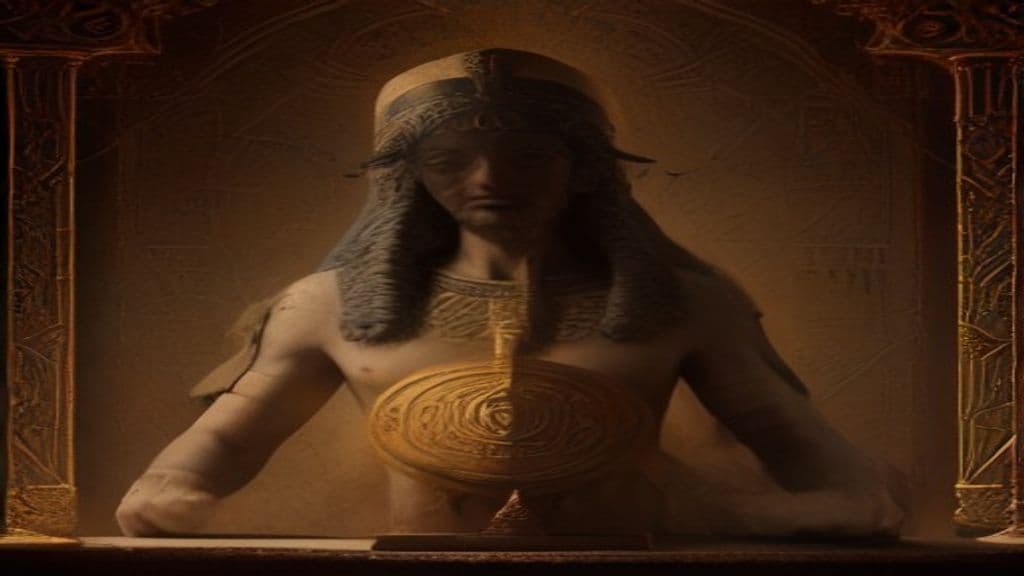
This entry describes a category rather than a single mythic person: across traditions a creator-deity is the being or office credited with bringing the cosmos and life into being. In Hebrew scripture the genus is illustrated by Genesis, where a cosmic account (Genesis 1) represents the creator (Elohim) ordering the heavens and earth by divine speech over six days, while a second account (Genesis 2) shows a personal, formative deity (referred to as Yahweh) shaping the first human from dust and placing them in Eden. In other cases the creator-function may be ascribed to a solar disk (Aten in Akhenaten’s 14th-century BCE reform) or be reinterpreted in philosophical language as the First Cause or Unmoved Mover (as in Philo and later medieval thinkers).
There is no single consistent physical description for creator-deities across cultures. The sources emphasize modes of action or symbolic representation rather than stable corporeal portraits: Genesis 1 foregrounds authoritative speech ('fiat') as the vehicle of creation; Genesis 2 foregrounds formative, hands-on shaping of humans. In Atenism the creator aspect is associated with the solar disk (Aten) and corresponding cultic iconography. Scholarly sources treat many creator-concepts as transcendent and not necessarily depicted anthropomorphically.
Primary abilities attributed to creator-deities in the sources are the origination of the heavens, earth, animals, and humans and the establishment of cosmic order. Modes described include creation by divine command or speech (Genesis 1), formative crafting of humans (Genesis 2), and instituting moral or social orders (Sabbath, dominion). Later philosophical interpreters ascribe metaphysical attributes to the creator concept—omnipotence, omniscience, First Cause or Unmoved Mover—but the sources mark these as interpretive overlays (e.g., Philo, Aquinas) rather than uniform mythic claims. Ritually and liturgically the creator is the object of prayer, sacrifice, and creedal affirmation (e.g., Apostles' Creed, Nicene Creed; 2 Maccabees records communal prayer and sacrifices invoking God as 'Creator of all things').
Abel
Abel is the second son of Adam and Eve in the Genesis narrative, a shepherd whose accepted offering and subsequent murder by his brother Cain form the biblical account of the first death. Later interpretive traditions expand his role, treating him as an archetypal righteous victim, a postmortem avenging or adjudicating figure, and in some systems (notably Mandaean) identifying him with an angelic lightbeing.
Abraham
Abraham (originally Abram) is the foundational patriarchal ancestor in the Hebrew Bible whose life establishes a covenantal relationship between his family/people and God. He functions as an exemplar of faith, the progenitor of promised descendants, and a narrative anchor for claims of land, blessing, and communal identity in later religious traditions.
Adam and Eve
Adam and Eve are the primordial human pair in the Abrahamic creation narratives who function as the first man and woman, placed in the Garden of Eden to steward creation. Their eating of the forbidden fruit produces a changed human condition—knowledge of good and evil, shame, pain, labor, mortality—and their story underpins later doctrines such as the Christian doctrine of original sin while being read differently across Jewish and Islamic traditions.
Adonai
Adonai (אֲדֹנָי) is one of the sacred Hebrew names used in Judaism to refer reverently to the singular God. It functions as a liturgical and devotional substitute or form for the divine Name and is treated with linguistic and ritual care in Jewish practice; it also appears in Christian liturgy (e.g., the Advent antiphon “O Adonai”).
Adonay
Adonay (אֲדֹנָי, often transcribed Adonai or Adonay) is a sacred Hebrew appellation meaning roughly "Lord" or "Master," used in Jewish liturgical and scriptural language as a reverent name for the divine. In the provided sources it functions as a theological title within Judaism rather than a personified folkloric being; discussions around it center on reverent usage and the communal care taken with divine names.
Alpha and Omega
A titulary formula and visual symbol formed from the first and last letters of the Greek alphabet (Α/α and Ω/ω), used in Christian scripture and art to denote God's or Christ's totality — 'the beginning and the end.' It functions as a theological appellation rather than an independent supernatural being.
Al‑Yasa (Elisha)
Al‑Yasa (Elisha) is a prophetic figure attested in Abrahamic scriptural traditions. In the Hebrew Bible he is described as an Israelite prophet and 'wonder‑worker'; later traditions in Christianity and Islam also recognize him among the line of prophets.
Angel
A spiritual or heavenly being functioning primarily as a messenger and intermediary between a transcendent deity and humanity; angels also act as protectors, guides, and executors of divine will across several Abrahamic and adjacent traditions.
Angel of the Lord
A recurring divine messenger in the Hebrew Bible and New Testament who appears on behalf of the God of Israel, acting as God's representative in speech and deed. The figure—Hebrew מַלְאַךְ יְהוָה (mal’ākh YHWH)—functions as intermediary, guide, protector, judge, and announcer at decisive narrative moments.
Aram (Nahapet)
Legendary leader and patriarch in Armenian tradition who united Armenians into one state. (Note: - Power tier: Primordial (given cosmic/unifying abilities) - Summary: Expand to include "unification of Armenians" as a key aspect of his leadership - Abilities: More specific and detailed description)
Arariel
Arariel is an angel attested in rabbinic tradition as having charge over the waters of the Earth. Later popular and New Age sources expand this terse attribution into devotional uses (invocation for fishing, mental calm), but primary sources recorded here offer only the brief custodial office.
Archangel
An archangel is a ranked heavenly messenger in Abrahamic and related religious literatures, understood in many traditions as a high‑level angelic agent charged with carrying out divine missions. The term and ranked office are framed by Greek etymology (archángelos, 'chief messenger') and by medieval Christian angelology (notably Pseudo‑Dionysius), while named figures such as Michael, Gabriel, and Raphael appear across Jewish, Christian, and Islamic texts and liturgies.
Community Record
- [1]Creator deity — Wikipedia. Wikipedia contributors, 'Creator deity', Wikipedia, The Free Encyclopediawiki
- [2]Wikidata item: deity responsible for the creation of the universe (Q635155). Wikidata Q635155other
- [3]2 Maccabees (summary cited in Wikipedia). Summary of 2 Maccabees passage as cited in Wikipedia article on 'Creator deity'literary
- [4]Genesis creation narratives (summary cited in Wikipedia). Summary of Genesis 1–2 accounts as cited in Wikipedia article on 'Creator deity'literary
- [5]Atenism and Akhenaten (summary cited in Wikipedia). Summary of Atenism and Akhenaten's reform as cited in Wikipedia article on 'Creator deity'wiki
- [6]Alchetron: Creator deity. Alchetron entry 'Creator deity' (compilation derived from Wikipedia and related sources)other
- [7]Bagrawat Katha at Nimbaheda Village (Archive metadata). Archive catalog metadata for Bagrawat Katha recordings (listed among consulted sources)folk
- [8]Ethnographic Exploration – India in Paris, Ganesh Procession (Archive metadata). Archive documentary metadata (cited among sources for living worship context)folk
- [9]Studies Of Christianity, James Martineau (Project Gutenberg). Martineau, Studies Of Christianity (cited among sources for theological context)other