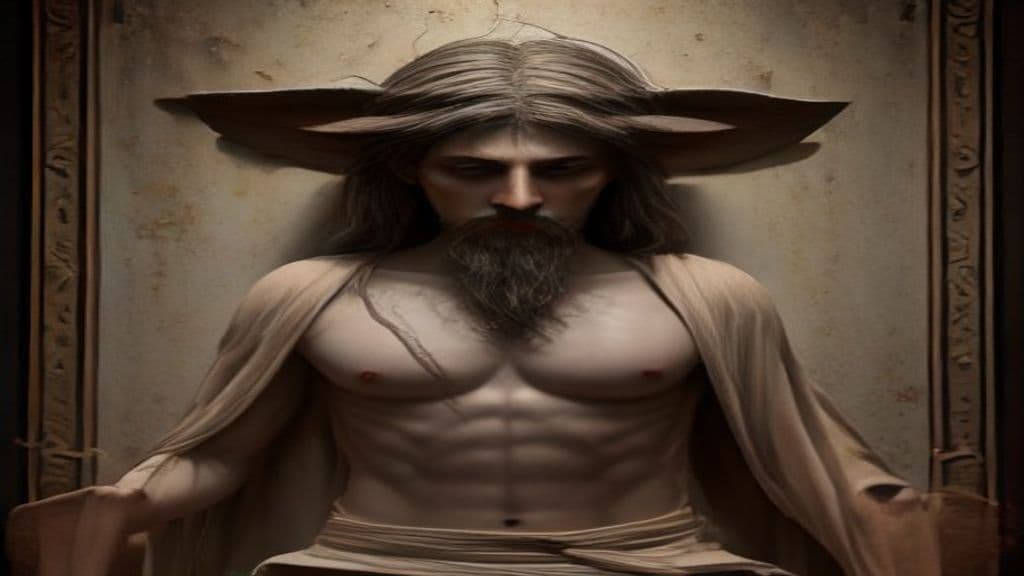
In classical sources Daedalus appears as a mythic-age Athenian craftsman who, after attempting to murder his gifted nephew out of envy and being tried and exiled, fled to Crete where he entered the service of King Minos. He is situated in the heroic/mythic period alongside figures such as Minos, Pasiphaë, the Minotaur, Theseus, and Icarus. The name Δαίδαλος later became eponymous for intricate crafted objects and a Boeotian festival (Daedala); some ancient sources debate whether the personal name derived from the festival objects or vice versa.
Classical narratives emphasize Daedalus's works rather than his personal bodily description. No consistent physical portrait is recorded in the supplied sources. Tangible markers associated with his presence in stories are his crafted artifacts: a hollow wooden cow covered in real hide, the Labyrinth (an elaborate architectural maze), carved wooden cult images (xoana) described as seeming to move, and feather-and-wax wings used in his flight with his son Icarus.
Daedalus is credited with exceptional technical, artistic, and mechanical skill: invention and refinement of carpentry and ship fittings, highly spirited carved statues, architectural design (the Labyrinth), construction of contrivances (the wooden cow enabling Pasiphaë's union with a bull), and the making of wings for human flight. Behaviorally he aids rulers and lovers by providing crafted solutions, but classical accounts also portray him as prideful and dangerously competitive (the attempted murder of his nephew), producing ambiguous moral outcomes: his creations solve problems yet can cause harm or social rupture.
Weaknesses
- conditionhuman moral failings (pride, envy)
- otherlegal and civic sanction (trial and exile)
- othervulnerabilities of his inventions when misused (e.g., wax-and-feather wings failing through improper use)
Wards
None recorded.
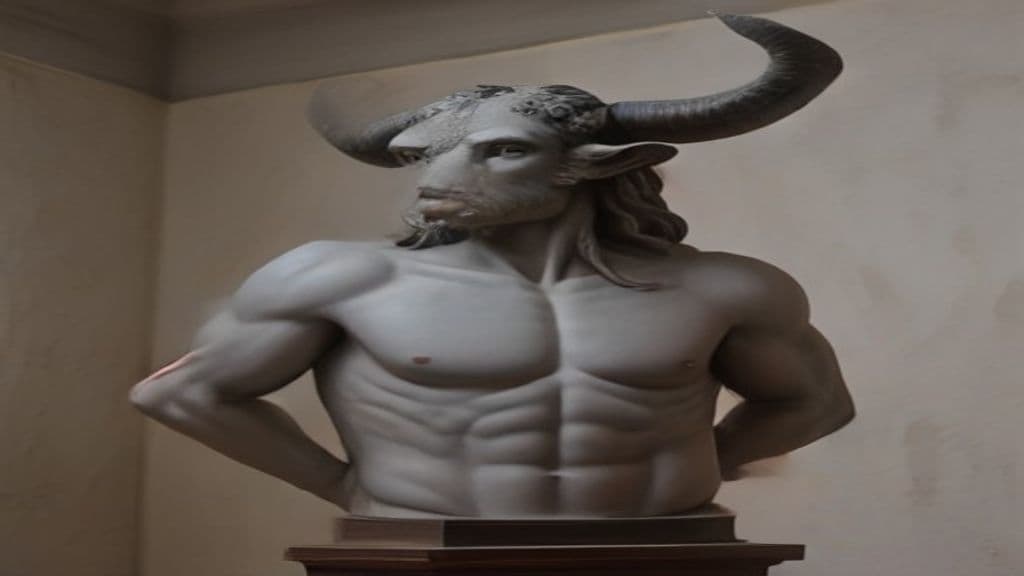
Minotaur
A singular monstrous offspring in classical Greek myth, born of a union between a human woman and a bull, confined at the center of Daedalus's Labyrinth at Knossos and fed on human tribute until slain by the hero Theseus with Ariadne's aid.

Ariadne
Ariadne is a figure from Greek myth—described as a Cretan princess, helper of the hero Theseus, and in many accounts the consort of Dionysus—whose narratives range from abandoned mortal lover to deified cult figure associated with the labyrinth, weaving, and a wedding diadem set among the stars (Corona Borealis).
Amphitryon
Amphitryon is a mortal nobleman of Greek mythic-historical tradition: son of Alcaeus of Tiryns, husband of Alcmene, and the acknowledged stepfather of Heracles. He appears in heroic-age narratives as a warrior, dynastic actor, and the human whose identity is impersonated by Zeus in literary treatments that explore paternity and identity.
Arethusa
Arethusa is a freshwater nymph of Greek myth who, pursued by the river-god Alpheus while serving as a chaste attendant of Artemis/Diana, transforms into a spring and emerges on the island of Ortygia (Syracuse). Her myth explains a subterranean link between distant waters and serves as a civic emblem of Syracuse.
Catreus
Catreus is a mortal figure in Greek myth, presented in mythographic sources as the eldest son of King Minos and Pasiphaë and a king of Crete whose life is shaped by an oracle predicting that one of his children would kill him; efforts to avoid that fate, and variants of the tale, link him etiologically to later heroic genealogies.
Chalbes
Chalbes is a named mortal attendant or herald in Greek mythic accounts of the Busiris episode; he is listed among those slain by Heracles when the hero resists an attempted human sacrifice at the Egyptian king's court.
Cretheus
Cretheus (Ancient Greek: Κρηθεύς) is a mortal king and eponymous founder in Greek mythic genealogical tradition, recorded as the founder-king of Iolcus and an ancestor in the Aeolid family whose descendants include Aeson and Jason. He functions primarily as a dynastic and narrative node rather than as a supernatural figure.
Cycnus of Aetolia
Cycnus (Kyknos) of Aetolia is a mythic Aetolian prince, traditionally described as a son of Apollo by Hyrie/Thyrie and situated in Calydonian/ Aetolian narrative cycles. He appears in sources as a semi-divine youth, variously cast as a princely figure involved in erotic episodes (traditionally the beloved of Phylius in some retellings) and as a combatant referenced in heroic/martial catalogues and poetic metamorphosis traditions.
Epochus
Epochus (Greek: Ἔποχος) is an Arcadian prince of the heroic age, son of King Lycurgus, attested in genealogies and in Pausanias's report of a temple painting at Tegea that depicts him supporting his wounded brother Ancaeus during the Calydonian boar hunt. He is recorded to have fallen ill and died young; no supernatural attributes are ascribed to him in the cited sources.
Gorgythion
Gorgythion is a minor Trojan prince in Homer’s Iliad, a son of King Priam by Castianeira of Aisyme, remembered chiefly for a poetically rendered death-simile (the poppy image) in Book VIII. The personal name was later reused in modern biological taxonomy for a genus of Pyrginae skippers.
Harpalion
Harpalion is a personal name borne by several mortal men in Greek mythic tradition. Attestations identify individuals called Harpalion as ordinary human actors — a Lemnian wine-grower and two warriors who fought and died in the Trojan War — without any supernatural attributes in the cited sources.
Hesione
Hesione is a mortal Trojan princess in Greek myth who was exposed to a sea‑monster as an oracularly required sacrifice for her father Laomedon’s offense against the gods; rescued by Heracles, she is given in marriage to Telamon, ransoms her brother with her veil (after which he is called Priam), and in later tradition becomes a diplomatic pawn whose non‑return is cited among factors leading to Paris's taking of Helen.
Hippalcimus
Hippalcimus (Ancient Greek: Ἱππάλκιμον) is a mythological human figure from Greek tradition, attested in genealogical notices and in catalogues of the Argonauts. Sources record variant filiations and name-forms but do not attribute individual exploits or supernatural traits to him.
Mares of Diomedes
A herd of man-eating horses belonging to the Thracian chieftain Diomedes, famed as the eighth labour of Heracles. They are monstrous animals whose carnivorous habit and violence against guests make them a canonical threat in Greek heroic narrative.
Community Record
- [1]Daedalus - Wikipedia. Wikipedia article 'Daedalus' (summary and excerpts provided in research notes).wiki
- [2]Pausanias (summary on Daedala festival). Summary referencing Pausanias's discussion of the Daedala festival and the question of name origin (as reported in the supplied notes).literary
- [3]Linear B attestation note (Knossian tablets). Summary statement in supplied notes that a form (da-da-re-jo-de) appears on Knossian Linear B tablets, indicating early attestation.academic
- [4]On Verticality: 'Daedalus and Icarus : A Parable of Human Flight'. Discussion of the flight episode and cultural readings (referenced in supplied notes).other