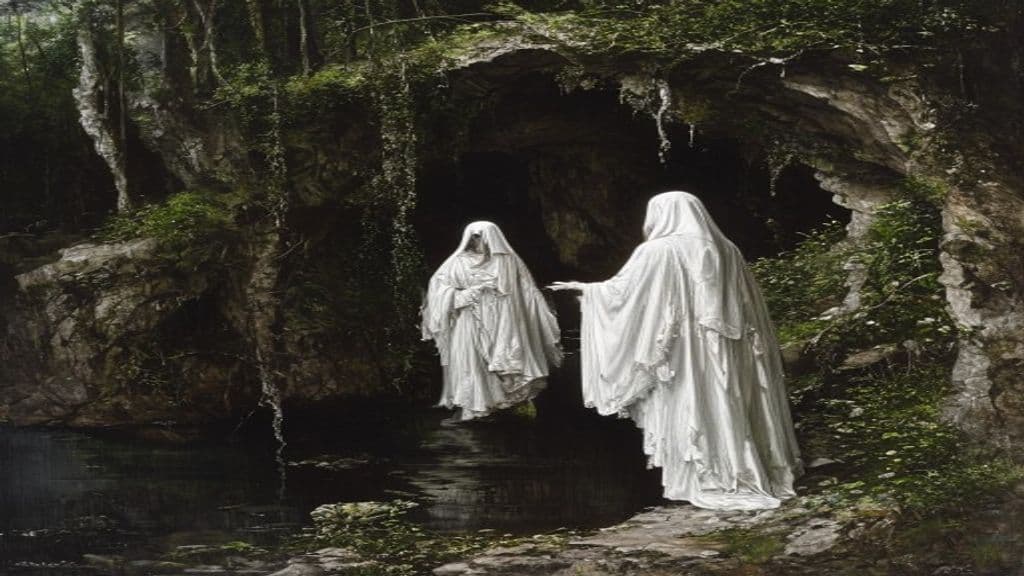
There is no single origin myth in the supplied sources; scholarly commentary and folkloristic comparison locate the Dames blanches within a long interpretive frame. J. A. MacCulloch (reported in secondary summaries) suggests they may be recharacterizations of pre-Christian household/guardian female figures (Matres/Dominæ) based on epigraphic survivals, while Thomas Keightley classifies them as a type of fée in Normandy. Archive program summaries trace the motif's evolution through localized fairy and washer-at-night traditions and link it by function and appearance to sibling 'white lady' figures across Europe; these proposals are presented as scholarly and folkloric interpretations rather than a single traditional origin story.
Across the cited sources the Dames blanches are consistently described as female figures visually associated with whiteness—typically dressed in white robes or garments—and appearing at liminal landscape features such as bridges, ravines, caves and forest paths. Specific local accounts name figures like La Dame d'Apringy (Bayeux ravine) and the Dame of Pont d'Angot (Falaise bridge) but provide no extensive physiognomic detail beyond femininity and white dress. Related Lavandières de Nuit accounts contribute occasional additional traits (for example, a cited archival summary reports one account describing 'yeux brillants et des cheveux sombres'), but those details are from night-washerwomen traditions and are not presented as universal characteristics of all Dames blanches in the sources.
The sources separate two related but distinct behavioral clusters. In Keightley's Normandy accounts, Dames blanches lurk in narrow places (ravines, forests, bridges) and attempt to attract the attention of passersby; they may require the traveler to join in a dance or to perform an act of deference (e.g., going on their knees) to be allowed passage, after which the spirit courteously vanishes. Refusal to comply is reported to bring harm: the recalcitrant are said to be thrown into thistles and briars or to be tormented by attendant creatures (lutins, cats, owls) who assist the Dame. Separately, the Lavandières de Nuit (night washerwomen) motif, which the archival program links to the dame blanche family, describes nocturnal women who wash or beat linen—sometimes described as corpses of infants—and who function as messengers or announcers of death; those washerwomen can seize or beat observers who watch or disturb them. The supplied sources treat the Dames blanches and Lavandières as related motifs with overlapping functions (liminal female presences and death-omens) but attribute specific behaviors to each set of accounts.
Weaknesses
- conditioncompliance with request (dance or deference)
- conditionnon-observation / non-disturbance (avoid watching or interrupting)
Wards
- ritualdancing or kneeling to the Dame (local behavioral ward)
- conditionavoidance of observing or disturbing night washerwomen (Lavandières)
Dalaketnon
A Visayan Philippine engkanto lineage associated with Dalakit/Balete trees; portrayed as an elitist, tree‑dwelling supernatural people who host feasts, abduct humans, and bind victims by compelling them to eat enchanted black rice. Contemporary media elaborates additional powers and aristocratic styling.
Dali (Goddess)
Patron deity of hoofed wild mountain animals in Georgian mythology, associated with hunting and the natural world. (Note: 1. Power tier should be Greater, not Ancient, given that Dali's abilities are deity-level but not cosmic. 2. Origin story could benefit from a more direct quote or clearer summary of how she is introd)
Damarwulan
Damarwulan is a Javanese legendary human hero central to a cycle of courtly-epic narratives and stage traditions (wayang klitik, Langendriyan, ketoprak). The figure—whose name is glossed as "radiance of the moon"—is portrayed as a princely warrior who defeats the Blambangan king Menak Jingga, suffers apparent death and is restored by a hermit, and is ultimately crowned in the Majapahit court. The story is especially associated with East Java and the Serat Damar Wulan manuscript tradition.
Damasiclus
Damasiclus (Ancient Greek: Δαμάσικλος / Δαμασίκλου), also called Amasiclus or Amasichus, is a mortal figure in Greek myth genealogies presented as a Spartan son of Icarius. He functions as a kinship node in variant traditions and is chiefly notable for his place in lineages that connect to the eponym Taenarus.
Damastor
Damastor (Greek: Δαμάστωρ, Damástōr/Damastôr, lit. 'tamer' or 'subduer') is a personal name attested in ancient Greek mythic and epic sources for multiple distinct figures: a Giant who fights in the Gigantomachy and several mortal personages or patronymics (Damastorides) appearing in the Homeric cycle, notably among suitors of Penelope and in Trojan-war genealogies.
Damballa (Damballah)
Damballa is one of the most important loa (spirits) in West African Vodun and its New World continuations such as Haitian Vodou and related African-diasporic practices. Traditionally associated with serpentine imagery and sometimes depicted as a rainbow, Damballa represents a central, revered presence transmitted from the Whydah/Ouidah region of modern Benin into Caribbean Vodou practice.
Damgalnuna (Damkina)
Damgalnuna, commonly called Damkina, is a Mesopotamian goddess attested as the consort of the god Enki/Ea. She is associated in surviving summaries with ritual purification and with interceding on behalf of human supplicants; she appears in multiple myths and had cult centers such as Eridu and Malgium.
Damian Wayne
Damian Wayne is a modern fictional character from American comic books (DC Comics), introduced as the biological son of Bruce Wayne and Talia al Ghul and established as the fifth character to assume the Robin identity. He functions as a legacy figure who embodies tension between the Wayne/Bat tradition and the al Ghul/League of Assassins lineage across main-continuity and Elseworlds stories.
Damno
Damno is a figure in Greek mythographic genealogies identified as an Egyptian princess, daughter of King Belus, who in some accounts marries Agenor and is mother to Isaia (Isaie) and Melia. She functions primarily as a dynastic link in origin myths rather than as an independently active mythic character.
Damu
Damu is a Mesopotamian deity attested from the Ur III period onward whose character shifts over time from an early 'dying/vegetation' figure to a later, better-documented role as a healing god associated with medicine-goddesses and cult centers such as Isin.
Damyanti
A Dayan witch of approximately 800 years — named for Damayanti of the Mahabharata, her power has grown to command weather, disease, and the spirits of the dead across an entire district.
Damysus (Damysos)
Damysus (also spelled Damysos) is named in the supplied sources as one of the Giants (Gigantes) of Greek mythology and is specifically described as "the fastest of all the Giants." No further narrative, genealogical, or iconographic details are provided in the cited material.
Community Record
- [1]Dames blanches. Wikipedia: 'Dames blanches' article (summary and citations including Keightley, MacCulloch and comparative material)wiki
- [2]Dames Blanches (Wikidata). Wikidata entry for Dames Blanches (identifier and linked data)other
- [3]Les Dames Blanches - Histoire de Fantôme (archive video). Archive video summary: Les Dames Blanches — programmatic discussion linking dame blanche motif to European 'white lady' figures and to death-omen traditionsfolk
- [4]Les Lavandières de Nuit - Histoire de Fantôme (archive video). Archive video: Lavandières de Nuit — accounts of night washerwomen, quoted George Sand passage, and discussion of their role as messengers of death; linked in the supplied research notes to the dame blanche motiffolk
- [5]Blood & Honey (archive bibliographic entry). Bibliographic/archive entry cited in the supplied notes (listed among sources consulted in the research notes)other
- [6]Thomas Keightley (1870) (as cited in summaries). Keightley, cited in the Wikipedia article: Normandy accounts describing Dames blanches as a type of fée 'of a less benevolent character' and providing examples (La Dame d'Apringy, Pont d'Angot)folk