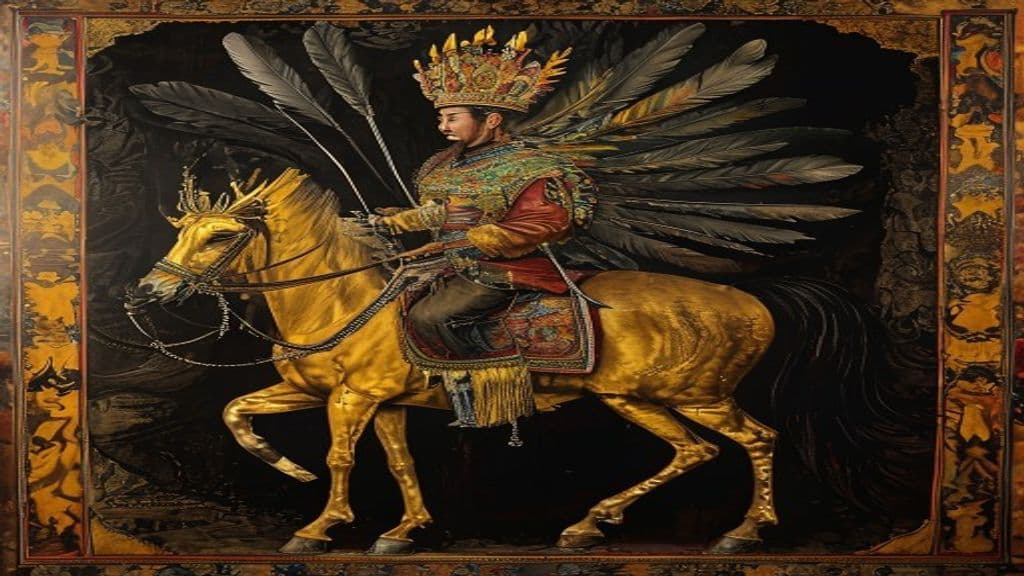
In local sacral texts and shamanic accounts collected from Khövsgöl (as recorded by Ágnes Birtalan), Dayan Deerh is portrayed in narratives that link him to the founding or protection of political power: one tradition describes him as a shaman who eloped with Genghis Khan's wife or daughter (sources give both variants) and then entered into a pact with the Khan that made him protector of the Khan and his people. Another element reported in sacral materials is that Dayan Deerh once 'turned himself into a stone statue' venerated at Tsagaannuur. These origin motifs come from Birtalan's collected sacral texts and shamanic invocations rather than a single unified mythic corpus.
Iconography and cult material depict Dayan Deerh most commonly as equestrian, mounted on a horse and wearing typically Mongolian accoutrements such as boots; in some statues he is shown with a warrior helmet. He is typically shown with a triple shamanic feather crown that includes three mirrors; in at least one scroll image he carries a mirror around his neck and wears a beaded necklace, an element interpreted as indicating coexistence of Buddhist and shamanic symbolism. Material forms in cult space have included a stone statue venerated at Tsagaannuur and a Buddhist warrior-god statue in a cave shrine covered by khatas.
Tradition attributes fertility-bestowing functions to Dayan Deerh—he 'granted cattle and children to people'—and a role as shamanic patron, invoked in initiation and protective rites. He is described as a protector of communities and practitioners (including having become protector of Genghis Khan and his people after a pact). Mythic accounts assert a special invulnerability: he can only be killed by suffocation; 'fire and metal cannot hurt him,' a claim framed in sources as part of the tradition's narrative motifs. His cult functions both within yellow shamanism and among some black shamans, though his Buddhist associations make him contested by other practitioners.
Weaknesses
- conditionsuffocation (tradition holds he can only be killed by suffocation; fire and metal cannot hurt him)
Wards
- symbolmirror (mirror imagery and actual mirrors are used in iconography and shamanic practice; mirrors are described as 'intended to ward off evil spirits')
- ritualveneration with khatas and offerings (the cave shrine's warrior statue is almost completely covered by khatas; maintenance of shrine and offerings functions as preventive veneration)
Daunus
Daunus is attested in the provided sources as a named, eponymous regional ruler invoked in Latin poetic geography (not as a developed supernatural being). Most directly cited in Horace's Odes (III.30), the name marks the Daunians and parts of Apulia — especially the Aufidus/Ofanto river region — as a literary-place reference and emblem of local identity.
David
David is presented in the supplied sources primarily as a personal name whose principal referent is the biblical King David (Biblical Hebrew: דָּוִד, Dāwīḏ, 'beloved one'), a historical‑literary human leader of ancient Israel famed as a shepherd, harpist, warrior, and the second king of a united Israel. Other occurrences of the name in the materials are secular biographical usages for various modern individuals; no source treats David as a supernatural or folkloric being.
Davāzdah Rokh
Davāzdah Rokh (Persian: دوازده رخ, 'Twelve Combats') is a narrative episode in Ferdowsi's Shahnameh describing a sequence of single combats between Iranian and Turanian champions during Kay Khosrow's campaign; it is also locally anchored to the Zibad / Kuh-Zibad region in Greater Khorasan.
Dawn deities
A cross-cultural category of divine figures associated with dawn, morning, or the morning star; these figures personify the transition from night to day and may be integrated into local pantheons or syncretized with solar deities in some traditions.
Dayak Bahau
Dayak Bahau (Bahau, Kayan Mekam) is an ethnic / sub-ethnic group of the Apo Kayan (Apokayan) family in Borneo, documented in sources as inhabitants of parts of East Kalimantan (notably West Kutai Regency) with living ritual traditions such as Hudoq and locally specific practices like Apang Aruq. The supplied materials do not describe a supernatural being named 'Dayak Bahau.'
Dayan (Daayan, Ḍāin, Ḍāini)
A North and East Indian folkloric figure: a malevolent female revenant or vengeful spirit commonly associated with women who died in traumatic or unresolved circumstances. Dayans are described in popular sources as powerful life-draining entities with distinctive physical markers and as a label that also functions in social witch‑hunt practices.
Dayang Bandir and Sandean Raja
Siblings in Simalungun folklore from Sumatera Utara, involved in family dynamics, ambition, power struggles, and loyalty within a kingdom. (Note: 1. Power tier: Based on the source material, Dayang Bandir and Sandean Raja's abilities are more deity-level (Ancient) as they exhibit human-like abilities but have significant influence over kingdoms)
Dazhbog
Dazhbog is a major figure in reconstructed pre-Christian Slavic religion most commonly identified in medieval East Slavic texts as a solar deity, described in one passage as "the Sun" and named as a son of the smith/sky god Svarog. Linguistic evidence of his name also supports a role as a dispenser of wealth or good fortune.
Daʻat
Daʻat (Hebrew: דַּעַת, "knowledge") is a Kabbalistic locus or mystical state on the Tree of Life in which the sefirot are united; it functions as a mediating point between the transcendent Keter and the manifest sefirotic structure and as a correlate of certain human cognitive-emotional capacities.
De Divinatione
An abstract concept in Roman tradition related to prophecy and divination, described in De Divinatione by Cicero. (Note: * Power tier: The text does not support Primordial power, which typically refers to entities that are cosmic or universal in scope. A more accurate classification would be Ancient (deity-level), as it)
DeSaad
DeSaad is a fictional New God from DC Comics' Fourth World mythos, serving as Darkseid's master torturer, inventor of torture devices, and a manipulative agent of Apokolips. Presented across multiple comic continuities and media adaptations, he functions as a technological and psychological practitioner of cruelty rather than a mystical folkloric entity.
Dea Dia
Dea Dia is an ancient Roman agricultural goddess associated with fertility, growth, and daylight; her cult was maintained by the priestly college the Fratres Arvales, who performed a three-day festival in May in a sacred grove (lucus) and chanted the archaic Carmen Arvale to secure crop success. Her name is interpreted as 'Goddess of Daylight' or 'Bright Goddess' and she is sometimes identified with Ceres/Demeter.
Community Record
- [1]Dayan Deerh (Wikipedia summary used in research notes). Wikipedia contributors. 'Dayan Deerh.' Wikipedia, The Free Encyclopedia. https://en.wikipedia.org/wiki/Dayan_Deerh (summary consulted).wiki
- [2]Ágnes Birtalan — collected sacral texts and invocations (as cited in the Wikipedia summary). Ágnes Birtalan, sacral texts and field-recorded invocations of Dayan Deerh (as cited in the Wikipedia article on Dayan Deerh).academic