
In the medieval East Slavic textual frame preserved in compilations such as the Hypatian Codex and quoted in later summaries, Dazhbog appears in a genealogical/interpretive passage that presents him as the son who succeeded Svarog: "his name was the Sun, and they called him Dazhbog ... Sun tsar, son of Svarog." This passage is part of a Slavic retelling that parallels a Greek text (mapping Svarog to Hephaestus and Dazhbog to Helios), so scholars caution that the medieval wording may reflect translator substitution or literary framing in addition to indigenous mythic memory. Linguistic reconstruction (Proto-Slavic *dadjьbogъ) gives the name a morphological meaning of "giving god" or "god-giver," which has led scholars to read Dazhbog's origin as a solar/divine benefactor figure in Slavic cosmology; however, direct narrative origin myths in native vernacular sources are not preserved in the supplied materials.
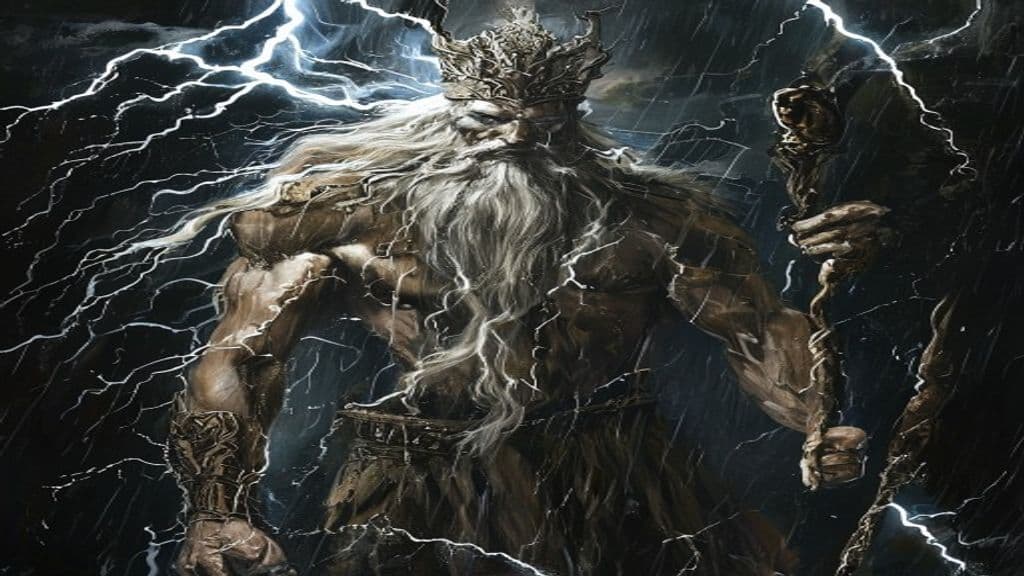
Primary medieval sources do not supply a consistent corporeal iconography for Dazhbog; the key attestation describes him functionally as "the Sun" or "Sun tsar, son of Svarog," which is a theological identification rather than a detailed visual description. Slavic linguistic practice generally treats the Sun (suntse) as grammatically neuter or feminine across many dialects, making a clearly male solar portrait in the textual passages notable but without accompanying standardized iconography. Modern artworks and popular-media depictions exist but are contemporary imaginings and not primary evidence of traditional appearance.
Attested functions in the surviving materials are limited to a solar or solar-related role (the Hypatian Codex passage identifies him as the Sun) and a semantic/etymological association as a "giving" deity (from *dadjь- + *bogъ), read as a dispenser of wealth, fortune, or blessing. Scholarly reconstructions situate Dazhbog within a family of sky/forge/fire divinities (as son of Svarog) and sometimes link or contrast him with Svarozhits or Khors; beyond these functional identifications the supplied sources do not record specific magical powers, spells, or operant feats attributed to him.
Davāzdah Rokh
Davāzdah Rokh (Persian: دوازده رخ, 'Twelve Combats') is a narrative episode in Ferdowsi's Shahnameh describing a sequence of single combats between Iranian and Turanian champions during Kay Khosrow's campaign; it is also locally anchored to the Zibad / Kuh-Zibad region in Greater Khorasan.
Dawn deities
A cross-cultural category of divine figures associated with dawn, morning, or the morning star; these figures personify the transition from night to day and may be integrated into local pantheons or syncretized with solar deities in some traditions.
Dayak Bahau
Dayak Bahau (Bahau, Kayan Mekam) is an ethnic / sub-ethnic group of the Apo Kayan (Apokayan) family in Borneo, documented in sources as inhabitants of parts of East Kalimantan (notably West Kutai Regency) with living ritual traditions such as Hudoq and locally specific practices like Apang Aruq. The supplied materials do not describe a supernatural being named 'Dayak Bahau.'
Dayan (Daayan, Ḍāin, Ḍāini)
A North and East Indian folkloric figure: a malevolent female revenant or vengeful spirit commonly associated with women who died in traumatic or unresolved circumstances. Dayans are described in popular sources as powerful life-draining entities with distinctive physical markers and as a label that also functions in social witch‑hunt practices.
Dayan Deerh
Dayan Deerh (also Dayan Degereki) is a locally venerated shamanic and protective divinity of Khövsgöl Province, Mongolia, associated with fertility (granting cattle and children), shamanic patronage, and communal protection. His cult occupies a syncretic position between indigenous shamanism and Tibetan Buddhist (Yellow) practice and is centered around sites such as Tsagaannuur, a cave shrine near the Russia–Mongolia border, and communities around Lake Khövsgöl.
Dayang Bandir and Sandean Raja
Siblings in Simalungun folklore from Sumatera Utara, involved in family dynamics, ambition, power struggles, and loyalty within a kingdom. (Note: 1. Power tier: Based on the source material, Dayang Bandir and Sandean Raja's abilities are more deity-level (Ancient) as they exhibit human-like abilities but have significant influence over kingdoms)
Daʻat
Daʻat (Hebrew: דַּעַת, "knowledge") is a Kabbalistic locus or mystical state on the Tree of Life in which the sefirot are united; it functions as a mediating point between the transcendent Keter and the manifest sefirotic structure and as a correlate of certain human cognitive-emotional capacities.
De Divinatione
An abstract concept in Roman tradition related to prophecy and divination, described in De Divinatione by Cicero. (Note: * Power tier: The text does not support Primordial power, which typically refers to entities that are cosmic or universal in scope. A more accurate classification would be Ancient (deity-level), as it)
DeSaad
DeSaad is a fictional New God from DC Comics' Fourth World mythos, serving as Darkseid's master torturer, inventor of torture devices, and a manipulative agent of Apokolips. Presented across multiple comic continuities and media adaptations, he functions as a technological and psychological practitioner of cruelty rather than a mystical folkloric entity.
Dea Dia
Dea Dia is an ancient Roman agricultural goddess associated with fertility, growth, and daylight; her cult was maintained by the priestly college the Fratres Arvales, who performed a three-day festival in May in a sacred grove (lucus) and chanted the archaic Carmen Arvale to secure crop success. Her name is interpreted as 'Goddess of Daylight' or 'Bright Goddess' and she is sometimes identified with Ceres/Demeter.
Dea Matrona
A Gaulish river-associated mother goddess whose name (Mātr-on-ā / Matrŏna) identifies the river now called the Marne; attested as part of the wider Matres/Matronae mother-figure tradition in northern Europe and interpreted as a localized tutelary maternal presence.
Deacon Frost
Deacon Frost is a fictional vampiric antagonist originating in Marvel Comics (first appearance: The Tomb of Dracula #13, 1973) and adapted across film and anime media. Portrayed variably as an older, 19th-century–styled vampire in the comics and as a youthful revolutionary vampire leader in the 1998 Blade film and later adaptations, he is notable for scientific knowledge and (in comics) the unique ability to create mind-controlled vampiric duplicates.
Community Record
- [1]Dazhbog - Wikipedia. Wikipedia: Dazhbog (article summarizing attestations in the Primary Chronicle and Hypatian Codex; etymology and scholarly discussion)wiki
- [2]Dažbog - Wikidata. Wikidata entry for Dažbog (linked identifiers and name forms)other
- [3]Slavic Mythology (A quick introduction) - Archive.org (YouTube mirror). Archive.org mirror of an introductory video referencing Slavic deities including Dazhbog (modern explanatory media)other
- [4]Slavsia, Rus! - Arkona - translation - Archive.org. Archive.org mirror of a song translation that references the Svarog/Dazhbog motif in modern cultural receptionother
- [5]Dazhbog Runestone Gwent Card Art - Archive.org. Contemporary artwork invoking Dazhbog (modern reception; not primary medieval evidence)other