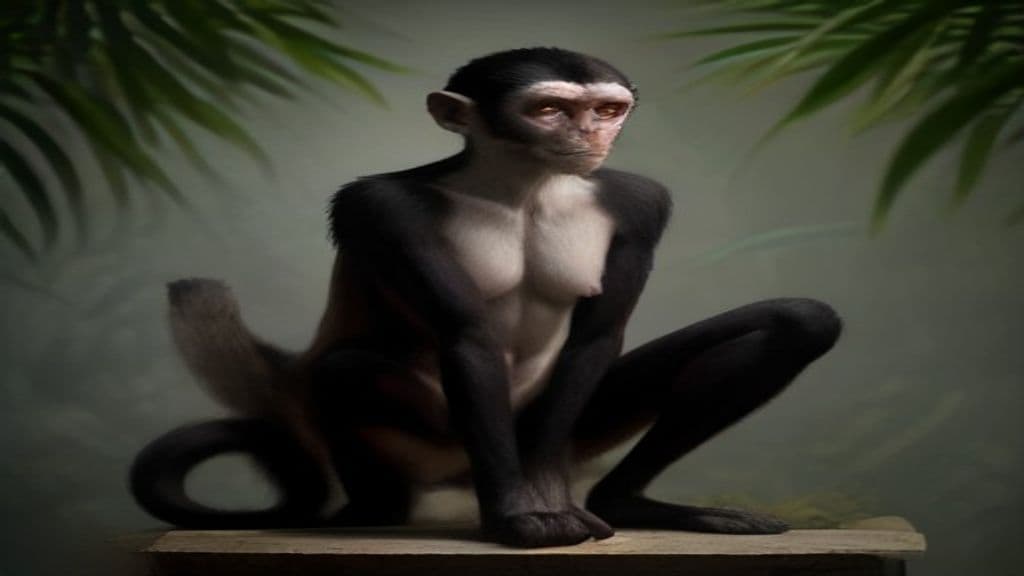
There is no mythological or supernatural origin for the Diana monkey in the supplied material. The English common name originates in a European naturalist analogy: the species' distinctive white, crescent-shaped browband was said to resemble the crescent associated with the Roman goddess Diana, and this visual resemblance led to the English name. The provided sources do not supply indigenous West African names or cosmogonic narratives for the animal.
Adults measure roughly 40–55 cm in body length (excluding the tail), with tails around 50–75 cm, and weigh approximately 4–7 kg; healthy individuals may live up to about 20 years. The pelage is generally dark (black or dark grey) with striking white facial and throat markings: a crescent-shaped white browband, white throat, ruff and beard, white underarms, and a white stripe down the thighs; the backs of the thighs and lower back are chestnut-coloured and some fringes on the limbs are present. The fur has been described in sources as "rough and tough." The crescent browband is the species' most distinctive feature and is explicitly cited as the trait that inspired the common English name.
The Diana monkey is a diurnal, arboreal primate that forages at all canopy levels and rarely descends to the ground, sleeping on upper branches without building nests. Its diet is primarily frugivorous and folivorous (fruit, blossoms, leaves), supplemented occasionally by insects and other invertebrates. Socially, groups typically consist of a single adult male, multiple reproducing females and their infants; daughters commonly remain in natal groups while males disperse before sexual maturity. Reproduction involves a gestation of roughly five months, nursing for about six months, and sexual maturity around three years. The species is vocally active: females produce distinct alarm calls, alert calls, and contact/greeting calls, and their alarm calls can be predator-specific and are used by other forest species (for example, yellow-casqued hornbills and other birds) as referential signals. Predators recorded in the sources include the crowned hawk-eagle, African leopard, common chimpanzee, and humans. The species has been the subject of primatological research into referential labelling and attention in conspecifics.
Weaknesses
- conditionhabitat dependence (primary forest)
- conditionvulnerability to hunting/poaching
Wards
None recorded.
Allochrocebus
Allochrocebus is a zoological genus of Old World monkeys known as the terrestrial guenons, containing species such as L'Hoest's monkey, Preuss's monkey, and the sun-tailed monkey. The genus was split from Cercopithecus in recent taxonomic treatments and comprises ground-oriented guenon species native to Central and West African forests.
Grass snake (Natrix natrix)
A Eurasian semi‑aquatic, non‑venomous colubrid snake (primarily Natrix natrix and closely related taxa) commonly found near water, compost heaps and field edges. Treated in the provided sources as a biological species with well‑documented natural history rather than a mythic or supernatural being.
Pallas's cat (manul)
Pallas's cat (Otocolobus manul), commonly called manul in Mongolian, is a small wild felid of Central Asian montane and steppe ecosystems. Sources treat it as a biological species with distinctive long dense fur, a stocky build and specialized ecological adaptations to cold, rocky habitats; it is not presented in the provided materials as a supernatural being.
Polyura dolon
Polyura dolon is a species of large butterfly (rajahs and nawabs group) in the subfamily Charaxinae (Nymphalidae) found across parts of the Indomalayan realm. Sources treat it as a biological species documented in faunal lists, field records, photographic catalogs, and commercial specimen listings rather than a supernatural being.
Wainuia clarki
Wainuia clarki is a species of air‑breathing predatory land snail in the family Rhytididae, endemic to New Zealand. Sources describe it in biological and conservation terms; it is carnivorous and feeds mainly on earthworms.
Di sma undar jordi
Di sma undar jordi are a Gotlandic class of small, subterranean 'hidden people' (Gutnish: Di sma undar jordi; Swedish: de små under jorden) who act as caretakers of farms, people, and animals so long as they are not angered. They belong to the regional underjordiska/vættir-like tradition and are normally invisible except under a peculiar viewing condition recorded in local tales.
Dia (wife of Ixion)
Dia is a mortal woman in Greek mythic genealogies, chiefly attested as the wife of Ixion and in some traditions the mother of Pirithous. Her figure functions relationally in narratives about divine–human interaction, contested paternity, and the consequences of transgressive kinship and desire.
Diamond (dog)
Diamond is a named dog appearing in anecdotal accounts associated with Sir Isaac Newton; in popular and literary retellings the animal is said to have overturned a candle and so caused the destruction of Newton's experimental manuscripts. The story is widely reproduced in 19th‑century biographies and literature but is described in some sources as largely apocryphal.
Diana
Diana is a Roman goddess of the countryside, wild animals and hunting, childbirth, crossroads, the night, and the Moon. In Roman religion she was equated with the Greek Artemis and absorbed much of Artemis' mythic profile; later receptions reinterpreted aspects of her in folklore and neo-pagan writing.
Diao Si
Insufficient source evidence to document a distinct Taoist spirit or demon called 'Diao Si.' The supplied material is a general overview of Taoism and does not contain attested information about an entity by this name; contextual notes indicate where such a concept might fit within Taoist cosmology, but no specific claims about origins, appearance, powers, rituals, or wards can be supported by the provided source.
Diarmuid Ua Duibhne
Diarmuid Ua Duibhne, often called Diarmuid of the Love Spot, is a heroic figure of the Irish Fenian Cycle described as a warrior and demigod-like hero fostered by the Tuatha Dé Danann. He is best known for the magical 'ball seirce' (love-spot), his role as Gráinne's lover in the Pursuit of Diarmuid and Gráinne, and for otherworldly adventures including a voyage to the Land-under-Waves.
Dictys
Dictys is a personal name applied to multiple distinct figures in Greek myth and pseudo‑historical tradition: a fisherman of Seriphos who rescues Danaë and Perseus, a sailor transformed into a dolphin by Dionysus, a centaur at Pirithous's wedding who dies in the Lapiths' battle, and the literary persona Dictys Cretensis who purports to be an eyewitness of the Trojan War.
Community Record
- [1]Diana monkey - Wikipedia. Wikipedia contributors, 'Diana monkey,' Wikipedia, The Free Encyclopediawiki
- [2]Diana monkey - Wikidata. Wikidata entry Q724362wiki
- [3]What do Diana monkeys know about the focus of attention of a conspecific?. Research Repository, University of St Andrews — study of attention in Diana monkeysacademic
- [4]Diana Monkey Characteristics | Cercopithecus diana Diet & Facts. BioExplorer species profile: Diana Monkeyother
- [5]Referential labelling in Diana Monkeys – Replicated Typo. Replicated Typo blog post on referential labelling in Diana monkeysother
- [6]Diana Monkey Facts - SoftSchools. SoftSchools: Diana Monkey Factsother
- [7]Hunting discussion - Man with gun carries dead Diana Monkey. Discussion board documenting hunting/poaching observationsother
- [8]Diana monkey picture postcard - National Crafts Museum (collection). Museum collection entry featuring Diana monkey imageryother