
The name Δίκτυς (literally 'netman') recurs across Greek narrative as several distinct personages rather than a single origin. In one tradition a mortal fisherman of Seriphos finds Danaë and the infant Perseus—either washed ashore in a chest or caught in his fishing-net—and raises Perseus; later accounts report Perseus making him king. Elsewhere Dictys is named among sailors who attempt to abduct Dionysus and are transformed by the god into dolphins. A separate Dictys appears as a centaur at Pirithous's wedding who dies fleeing the Lapith attack. Finally, Dictys Cretensis is a literary persona, a Cretan companion of Idomeneus presented as the putative author of a first‑person diary of the Trojan War.
Descriptions vary by tradition rather than yielding a single physical type. The Seriphos Dictys is portrayed as an ordinary mortal fisherman (no detailed physical description provided in the sources). The sailor Dictys, after the Dionysus episode, is transformed into a dolphin. The centaur Dictys is a half‑human, half‑horse centaur who, according to the account, slips from a cliff and becomes impaled on an ash tree. The Cretan Dictys is a narrative persona with no physical description in the attested texts.
Accounts attribute no supernatural powers to the fisherman or the literary Dictys beyond mortal actions (rescue, hospitality, and the role of eyewitness narrator). The sailor Dictys's notable change—becoming a dolphin—is the result of divine metamorphosis inflicted by Dionysus rather than an ability of Dictys. The centaur Dictys participates in the martial behaviors typical of centaurs in the Lapiths' wedding episode but suffers mortal death; the Cretan Dictys's 'ability' is literary: purported eyewitness narration of the Trojan War.
Weaknesses
- conditionmortality (fisherman and centaur)
- conditionsubject to divine retribution (sailor transformed by Dionysus)
Wards
None recorded.

Dionysus
Dionysus (Ancient Greek: Διόνυσος) is a major ancient Greek deity associated with wine and winemaking, vegetation and fertility, festivity and theatre, ritual ecstasy and possession, and liminal links with death and the underworld. He is an epiphany-god who travels between worlds, whose cult includes ecstatic rites and mystery initiation.
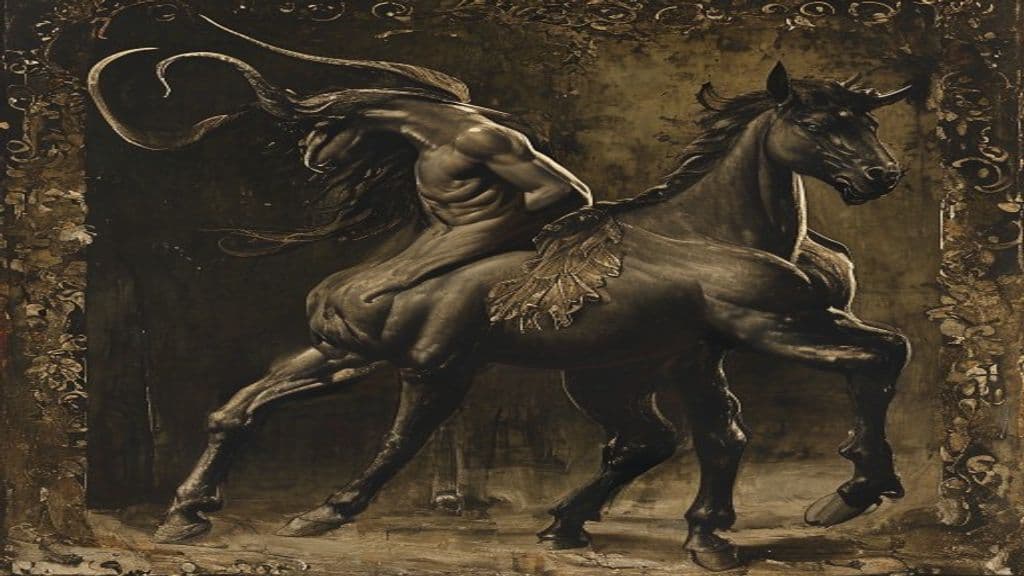
Centaur
A mythic hybrid from ancient Greek tradition with the upper body of a human and the lower body and legs of a horse. Centaurs appear as a tribal population associated with mountainous and wooded regions of Greece and embody tensions between human social order and untamed nature.

Rakshasa (Himalayan variants)
A Himalayan reception of the pan-Indian rakshasa motif: hostile or disruptive non‑human beings known from Sanskrit epic and Puranic literature, here noted where Himalayan sources and discussions intersect with the broader epic tradition. The supplied sources do not document distinct, well‑attested Himalayan folklore variants; the entry therefore presents primarily the epic/legendary profile as transmitted into Himalayan contexts in general references.
Community Record
- [1]Dictys. Wikipedia: Dictys (entry summarizing multiple traditions)wiki
- [2]Dictys Cretensis. Wikipedia: Dictys Cretensis (literary persona of a Cretan eyewitness)wiki
- [3]Dictys Cretensis, Ephemeridos belli Troiani libri sex (archive edition). Archive: edition of Dictys Cretensis (ephemeris tradition)literary
- [4]Delphin Classics volumes (archival references). Archive: Delphin classics volumes referenced in notesother
- [5]Troy and Iphigenia at Aulis (Dictys version). Online text presenting Dictys material relevant to Trojan War narrativesliterary
- [6]Multi-spectral Imaging of P.Tebt. 268 (Dictys material). Project page on papyrological evidence for Dictys Cretensis traditionacademic